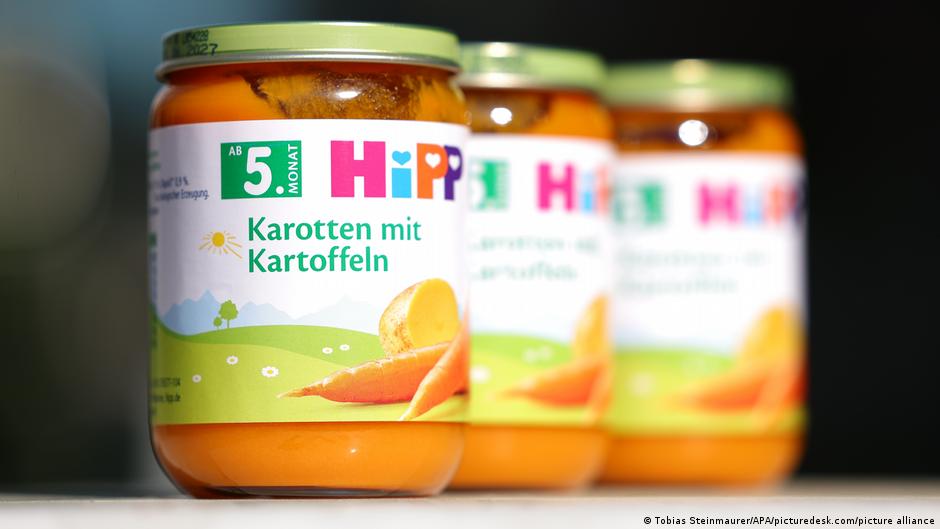
“HiPP is a victim of blackmail” – this is what the press release from the leading German baby food manufacturer says. Over the weekend, jars of baby food contaminated with rat poison were found in Austria and two neighboring countries. Austria’s food safety agency AGES issued a warning, and at least one supermarket chain initiated a recall. Now the focus is on finding out who did this.
What is known about the current case?
Police in the German city of Ingolstadt told DW on Monday that prosecutors are investigating an attempted blackmail. The Ingolstadt unit is responsible because HiPP is located in the nearby town of Pfaffenhofen an der Ilm. Police said five jars were found in three countries.
The first jar was discovered near Eisenstadt in Burgenland, Austria’s easternmost province. Initial tests showed that a 190-gram jar of carrots with potatoes was contaminated with rat poison. Police are still searching for a second contaminated jar they suspect is in the same area.
Two more jars containing poison were found in a shop in the Czech city of Brno. Prosecutors said both jars were marked with a white sticker and a red circle, as described by the suspected blackmailer in an email, local media reported. This marking is also mentioned in the AGES warning. Contaminated jars were also found in the town of Dunajská Strada in southern Slovakia.
How can you tell if your HiPP jars may be affected?
The lids of all affected jars were damaged and did not make the normal “pop” sound when opened. Like many foods, baby food is hot-filled into jars and sealed with a screw lid; As it cools, a vacuum is formed. The popping sound when opening confirms that the jar has not been opened since it was filled. According to HiPP, the contaminations were “criminal external” manipulations that must have occurred outside the factory premises.
Ingolstadt police advised consumers to pay attention to the familiar popping sound, smell the ingredients and, if anything seems unusual, not to give the food to their children and to contact local police immediately. The manufacturer issued similar advice.
Have such cases come to light before?
In a previous infamous case, the blackmailer was actually a police officer from the UK’s Scotland Yard. In 1988/89, Rodney Whitcheloe tampered with baby food using chemicals or razor blades and then put the jars back on store shelves. He demanded £4 million ($7 million at the time) in ransom but was caught and sentenced to 17 years in prison. This and other cases in the 1980s eventually led to the introduction of “pop” lids that would help consumers check if someone had tampered with the jar.
In 2017, several jars of baby food contaminated with antifreeze – each containing a potentially fatal dose – were discovered in Friedrichshafen, southwestern Germany. At that time the criminal attempted to extort approximately €12 million (approximately $14 million at the time) from a supermarket chain. He is currently serving a 10-year prison sentence.
Then, in the United Kingdom, in 2018 a blackmailer tried to extort £1.4 million in Bitcoin. He had put metal pieces into several jars and threatened to cause further contamination, including salmonella. Supermarket surveillance footage led to his arrest and he was sentenced to 14 years in prison.
In 2025, Polish police arrested a man accused of attempting to extort money by threatening to poison children’s food. However no verdict has yet been reached, and no contaminated product was actually found.
Why is baby food targeted?
Targeting infants and using them for extortion and blackmailing demands is widely considered particularly reprehensible – and therefore warrants maximum attention and pressure to be paid to companies. Furthermore, baby food is available in countless stores, giving criminals many potential points of access.
Generally, baby food is subject to particularly strict controls to minimize any risks. Manufacturers restrict access to their factories and rely on tamper-evident packaging and batch numbers, allowing individual products to be more easily recalled. In recent years some retailers have also increased security by installing surveillance cameras – to prevent people from placing contaminated jars on shelves without paying attention.
This article was originally published in German.