
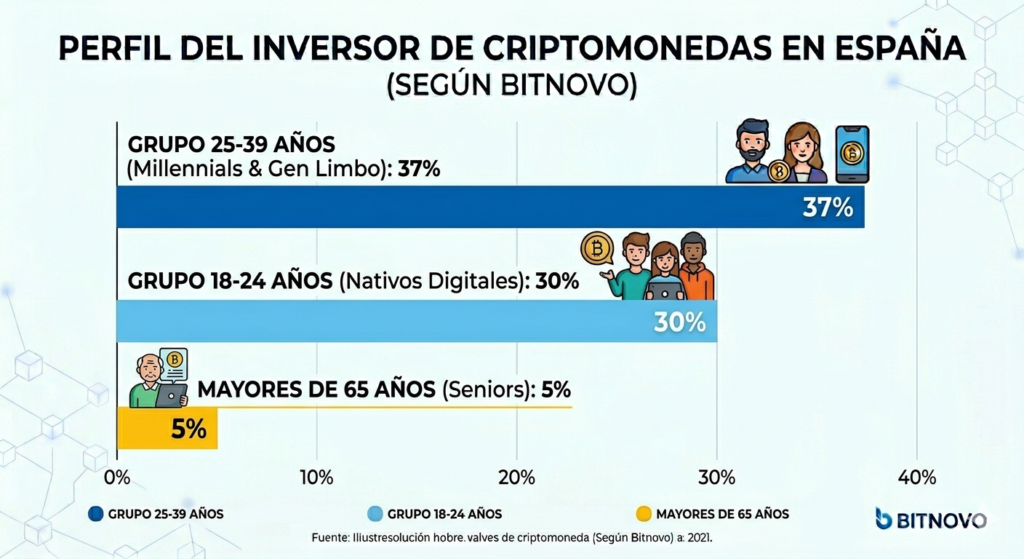
Investors between 25 and 39 years old represent 37% of the total and constitute the dominant profile.
Those over 65 have gone from less than 1% five years ago to 5% today.
Investment in cryptocurrencies in Spain presents an increasingly defined profile, according to a recent analysis by Bitnovo, a Valencian provider of non-custodial cryptoasset services.
Although the typical investor is still a man between 25 and 39 years old with a university education and a high tolerance for risk, the market shows clear expansion in different demographic segmentsboth towards the youngest and towards the seniors.
The 25 to 39 year old group continues to be the main driver of the sector and concentrates 37% of users. This section, made up of millennials and the so-called “limbo generation”, is characterized by their familiarity with the digital environment and their predisposition to take risks.
The study, which incorporates data from the Bank of Spain, also reveals a marked gender gap: 73.2% of investors are men compared to 26.8% women.
In the educational field, holders of university degrees exceed the national average by ten percentage points, and 17% declare themselves to have advanced financial knowledge.
This combination of training and digital profile translates into more sophisticated investment strategies. 72% of those surveyed claim to be willing to take risks and usually combines cryptocurrencies with traditional assets such as stocks or investment funds, reflecting a diversified and non-speculative approach.
Beyond the central core, the report highlights a notable age expansion. The 18 to 24 year old group has registered the largest increase in recent years, going from 9% in 2019 to 30% currently.
This early incorporation of digital natives reinforces the idea that technological familiarity accelerates the adoption of cryptoassets. At the same time, those over 65 years of age, who five years ago barely exceeded 1%, now represent 5% of the total.
This evolution indicates that interest in cryptocurrencies is extends transversally between different demographic segments. Javier Castro-Acuña, director of Digital Assets at Bitnovo, interprets this data as a consolidation of use.
These data not only confirm that digital natives are the most interested in cryptoassets, but that use is consolidated and maintained over time, demonstrating that those who know this technology do not stop using it.
Javier Castro-Acuña, Director of Digital Assets at Bitnovo.
The rise among the youngest responds, in part, to the context of economic uncertainty experienced by these generations. Accustomed to crises and inflation, they perceive the traditional financial system as slow and restrictive, and find in cryptocurrencies an alternative with greater autonomy.
“Economic instability during crises and inflation has led this generation to distrust the financial system. Although they do not show a complete rejection of the traditional system, they do perceive it as slow, so they look for other options,” says Castro-Acuña in an email sent to the CriptoNoticias editorial team.
The research determines that the Spanish investor in cryptocurrencies is concentrated in well-defined demographic segments: predominantly young, educated, digital and with a greater tolerance for risk.
It is important to comment that already in 2025 this medium reported that Spaniards invested more money in bitcoin and cryptocurrencies than the average for all of Europe, which speaks of the reach that digital assets have had in that country.
However, the market is expanding towards previously marginal profiles, such as seniorswhich confirms that cryptoassets are no longer a minority phenomenon but have become a structural element of the national financial ecosystem. This generational and educational evolution points to greater maturity and permanence of the sector in the coming years.