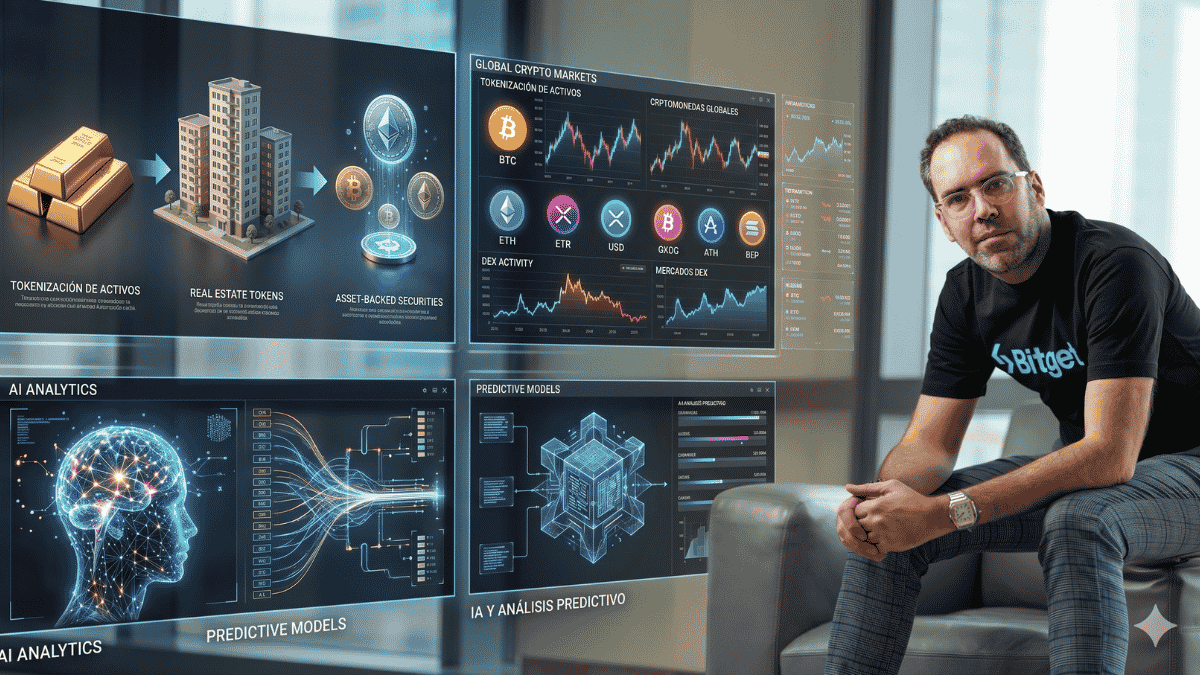
The narrative of tokenization has matured, explains the interviewee.
For Aguirre Franco, artificial intelligence will help traders, but will not replace them.
«Please stop talking to me about cryptocurrencies. I can’t take it anymore. Why don’t you get a job somewhere where you can talk to them about this? And when you return home, you talk to me about normal things. That phrase, blunt and honest, did not come from a Bitcoin detractor, but from the wife of Ignacio Aguirre Franco. In 2015, Ignacio, a systems engineer passionate about new technologies, saturated family dinners with discussions about decentralization and cryptocurrencies.
What began as a suggestion to recover peace at home ended up catapulting Aguirre Franco to an almost seven-year full-time career in the industry. After passing through companies of complianceholding management positions at Xapo Bank and navigating decentralized finance (DeFi) protocols, today he serves as Chief Marketing Officer (CMO) of the Bitget exchange.
In an extensive and relaxed talk with CriptoNoticias, the manager breaks down why The industry has left behind the era of hype to focus on tangible solutions. For Aguirre Franco, the future is not a distant promise; is being built on the foundation of real-world asset (RWA) tokenization and the integration of artificial intelligence.
Riding the wave of technology
Born in Mexico and today resident in Luxembourg, Ignacio’s path to bitcoin (BTC) and cryptocurrencies was a mix of engineering curiosity and Latin American pragmatism.
“Blockchain as a protocol has spectacular potential,” he says. Remembering its beginnings in 2015, it highlights that value transfer and speed They were the initial hooks.
“In Mexico, we have a normal financial system, but I feel that many in Latin America are used to not having top-level things,” he reflects on the frictions and costs of traditional money transfers that pushed him to investigate Satoshi Nakamoto’s protocol.
His background technician, added to a career in giants such as Universal Pictures, Lenovo and Adobe, has allowed him to see the evolution of technology as a constant wave. “It was natural, I was riding the wave of technology,” he says about his definitive transition to the cryptocurrency ecosystem.
Tokenization: the solution to decades-old financial problems
Tokenization is the topic of the momentbut Aguirre Franco is quick to differentiate noise from signal. He recognizes that at the beginning it was simply a «buzzword» that people used to sell anything—even “tokenized fruit”—with no clear meaning. Today, however, the narrative has matured.
“What tokenization does is that it opens borders,” he explains with conviction.. For the Bitget manager, this technology solves structural problems that the traditional system has not been able (or wanted) to correct.
The first is the liquidity of traditionally static assets. The second is operational availability.
“If you want to trade shares on the New York Stock Exchange, you can do so from Monday to Friday from 9:30 a.m. to 4 p.m., but if you want to sell your shares on the weekend, the market is not open.” Tokenization, on the other hand, allows that market to be 24/7, eliminating the downtime of analog finance.
A crucial point that Ignacio highlights is transparency and immediate validation of origin. To illustrate, he mentions the famous debate between gold advocate Peter Schiff and Binance founder CZ. The founder of Binance said: ‘Here is a gold bar, check it, is it real?’, and Schiff replied: ‘I don’t know.’
In the tokenized world, that doubt disappears: “If something is tokenized, you can validate the origin by seeing the smart contract and verify that it is true,” explains Ignacio.
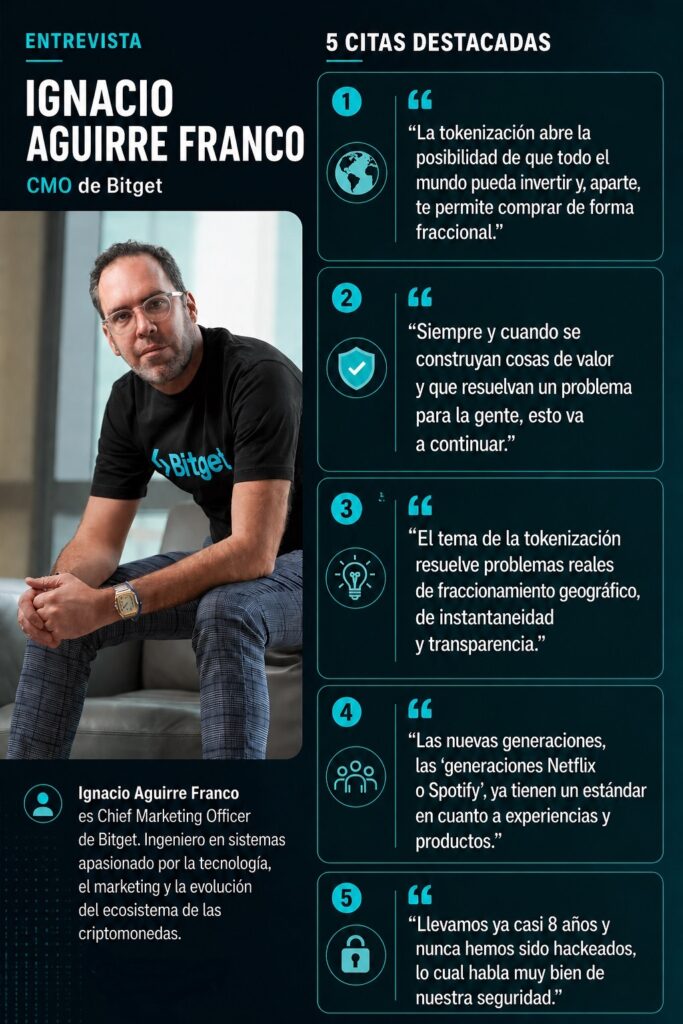
Furthermore, tokenization democratizes access through fractionalization. Aguirre Franco remembers that before, to invest in Tesla, for example, you needed to have the $1,000 that a whole share cost. «This opens up the opportunity to balance a portfolio without having to own an entire stock; “You can see what you believe in and start building a portfolio fractionally.”
The “Universal Exchange” and the music analogy
To explain where Bitget is going, Aguirre Franco uses an analogy about the evolution of how we consume music. According to him, the exchanges have gone through several stages:
- The cassette era: rudimentary exchanges with few tokens and manual processes.
- The Napster/LimeWire era: the predecessor of DeFi; peer-to-peer, but difficult to use and limited.
- The iPod era: the state of many current exchanges; “1,000 songs in your pocket”, but still closed in “crypto-for-crypto” silos.
- The era of streaming (Spotify/Netflix): the concept of Universal Exchange.
“What we did with Universal Exchange “It was to mix CeFi, DeFi and TradFi in the same place, tear down the walls and give people a financial ecosystem where they can make all their investments without having to open another application,” he says. The goal is to eliminate the technical friction that scares away the average user.
AI, a co-pilot for traders and investors
Continuing with the talk, we come to another point that has become relevant in the cryptocurrency sector: artificial intelligence (AI). Bitget CMO explains that There are already useful tools for investors and traders that incorporate AI.
«It is not just consulting like in ChatGPT; Here you already have the execution layer,” he explains, making references to tools available on the exchange where he works.
The user can ask the AI to analyze their portfolio, identify risks and then execute the rebalancing. According to the Bitget manager, it will be the standard for new generations.
However, Ignacio does not believe in the total replacement of the trader. “It gives traders an extra set of eyes to validate their trades. “It helps a lot for beginners, but the human element is still there.” AI serves to mitigate the emotional factor that does so much damage in the markets: “Having decisions based on data will help people be better traders.”
Latin America is an adoption laboratory
Speaking of his region of origin, Bitget’s CMO sees Latin America as a real adoption laboratory out of necessity. “We have financial systems that may not be as inclusive for the entire population,” he comments.
Countries with remote regions without quality banking access, They find in cryptocurrencies a solution for financial sovereignty.
Real utility is the current focus. «Today cryptocurrencies solve real problems of remittances and payments. “We just launched the Bitget card in Asia,” he says, suggesting that the direction is to give the digital asset everyday use.
About the future
Despite the optimism, Aguirre Franco does not ignore the risks. In an industry marked by hacks and collapses, he emphasizes that safety must be the priority when choosing a platform.
“We’ve been hacking for almost 8 years now and we’ve never been hacked,” he boasts, mentioning a protection fund that averages $700 million and the implementation of AI to detect “red flags” in market behavior.
For the remainder of 2026, the news is ambitious. In addition to expanding Copy Trading into the world of traditional finance (TradFi), Bitget is venturing into exclusive markets. «We have a pre-IPO of SpaceX, Elon Musk’s company. “We are tokenizing to be able to participate and buy,” he reveals as a scoop of the assets they seek to democratize.
By way of closing, Ignacio puts aside his managerial suit and returns to being the technology enthusiast who started a decade ago. He surprises by confessing that, despite his position in one of the largest exchanges in the world, he recently decided to “get his hands dirty” with the hardware. «I love that in CriptoNoticias they talk so much about mining; “I recently started mining because I realized that I didn’t have much of an idea and I bought a miner.”
His advice to users, in general, is to lose fear but remain curious. “I think people only use 10% of what exchanges offer,” he says.. He encourages those who listen (or read) not to remain alone in the trading in cash (spot), but to explore other functionalities present in the cryptocurrency ecosystem.
In summary, the dialogue with Ignacio Aguirre Franco left us with a contagious enthusiasm for what is to come, life lessons and the desire to continue learning about Bitcoin technology.
Furthermore, it reminds us that Latin America is an important region for the growth and adoption of cryptocurrencies and that we are privileged to live in a time where Much has already been done, but much more is in the process of being built and we can be protagonists and pioneers in adoption and development.