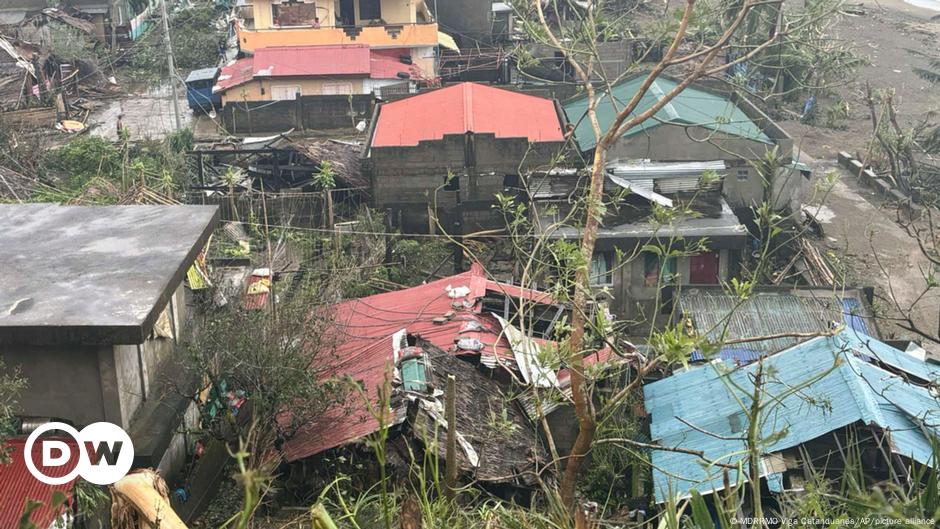
As the impacts of climate change intensify, vulnerable countries like the Philippines face increasing devastation. The archipelago has become one of the most vulnerable to extreme weather changes caused by climate change.
Lorena Ivy Bello Oganya lives in Samar, a province in the Central Visayas region of the Philippines, which faces the Pacific Ocean.
In 2013, Typhoon Haiyan, one of the most powerful tropical cyclones on record, killed or missing more than 7,300 people, devastated villages and devastated Samar.
be in the front row
“As a child, I loved playing in the rain. Now, it scares me,” Oganiya told DW.
She recalls how at that time she was pregnant with her third child and how she gave birth in a tent.
Recovery from the storm was very slow, with the province remaining without electricity for several months.
Tony Ablets lived in the Philippine capital Manila during Haiyan and still remembers fearing for his family in Samar.
“I was on the phone with my mother when the line went down,” he recalled. “For five days, I didn’t know if she was alive or not.”
Both Oganya and Abletes live on the front lines of the climate crisis, and are grappling with the trauma of surviving extreme weather.
In late 2024, the Philippines was hit by six major typhoons in less than a month.
In November, Typhoon Usagi flooded rural villages, knocking out power and displacing thousands of people. Just days earlier, Typhoon Toraji caused flooding and forced more than 82,000 people to flee their homes in northern provinces.
For others living in coastal communities such as Oganya, Ablates and Samar, the climate crisis has become an almost daily battle for survival.
offset climate loss
Countries vulnerable to natural disasters linked to global warming, including the Philippines, have long requested financial assistance to help cope with the loss and damage caused by catastrophic weather events.
COP27, the 2022 UN climate conference in Egypt, had considered a “landmark agreement” to establish a fund for losses and damages. The Loss and Damage (L&D) Fund was officially launched a year later at COP28 in Dubai.
The fund compensates developing countries that contribute little to global warming but suffer its worst impacts, including destroyed livelihoods, infrastructure and loss of biodiversity.
By requiring wealthy, high-polluting countries to contribute, it addresses global warming inequalities. In 2024, the Philippines was selected to host the L&D Fund Board to strategize fund distribution and address urgent climate needs.
John Leo Algo, national coordinator of Accion Clima, a civil society network for climate action, emphasized that the L&D Fund should function as a grant, not a financing agreement.
“Funds distributed from the L&D Fund should not further burden countries that are already vulnerable to the climate crisis,” he told DW. He described such a scenario as “unacceptable and unjust.”
Bridging the funding gap
Algo stressed that the Fund should prioritize climate-affected communities while ensuring access and availability during extreme emergencies.
Although hosting the L&D Fund Board does not give priority to the Philippines, it highlights the country’s frontline experience with the climate crisis.
“Our role is to inform the board about emerging loss and damage trends around the world, as we address some of the highest risks and vulnerabilities in recent years,” Mark Dennis Joven, board member of the Fund Responding to Loss and Damage, told DW. Have experienced.” ,
However, Joven acknowledged the significant funding gap, with only $750 million (€725 million) of pledges secured globally – far short of the billions needed.
“We almost need to act like this to ensure we don’t lose momentum,” he said. “Operating the Fund and quickly deploying funds will encourage stronger commitments from donor countries.”
Joven emphasizes the importance of mainstreaming L&D as the third pillar of climate financing alongside mitigation and adaptation.
“Unlike project-linked finance, L&D allows for rapid deployment and direct budget support, which is critical to achieving climate justice,” he said.
home remedies
As international talks on the L&D fund continue, advocates in the Philippines are pushing for the Climate Accountability (CLIMA) Bill, which aims to hold carbon polluters accountable by creating a fund for climate loss and damage victims and linking compensation with corporate responsibility. To be made accountable.
The CLIMA bill is similar to recent legislative actions in the United States.
Under a bill signed into law last week, the US state of New York would fine fossil fuel companies $75 billion over 25 years to cover the costs of climate damage, including funding to mitigate impacts such as retrofitting infrastructure. Will happen.
New York follows Vermont, which passed a similar law this summer, both based on Superfund laws that require polluters to pay for toxic waste cleanup.
This push for accountability echoes global efforts, with advocates like Virginia Benosa-Lorin emphasizing the need for polluters to face consequences.
“Every nation must ensure that the biggest polluters pay. Without action, life-and-death climate impacts will become the new normal.” Virginia Benosa-Lorin, senior campaigner for Greenpeace Philippines, told DW.
Edited by: Keith Walker