
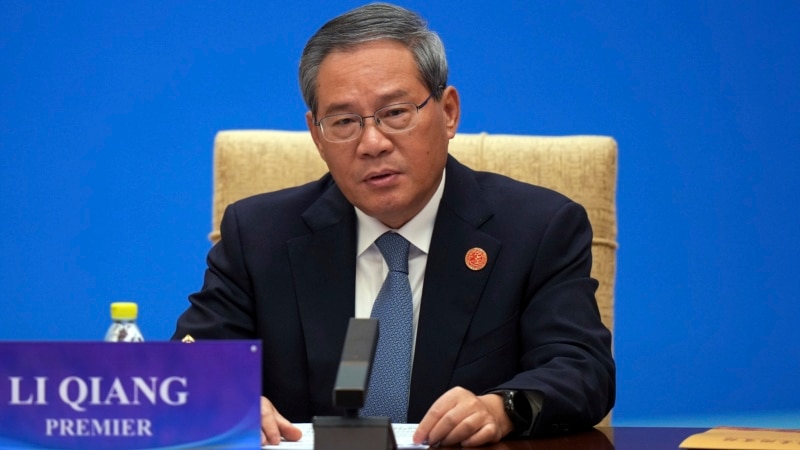
China shuts down its biggest political meetings of this week as the excess tafs from the United States and the leadership in Beijing see the President of Whatness to address the “complex and versatile” economic challenges.
Starting on Tuesday, thousands of Chinese clans and MPs began gathering in the Chinese capital for “two sessions,” or “Lianuhi”, which would establish and discuss a wide range of policy agenda for 2025.
From business and academics to the government and the people of the party, a wide health gathering, Chinese Peoples Political Consultative Conference, is called on Tuesday. After that day, China’s Rubber-Stamp Parliament, National People’s Congress or NPC will start their annual legislative session.
Li Kiang will provide the much awaited government work report in the initial NPC’s initial meeting, underlining the Economic Development Taria of the Chinese government and other major economic policies for the Premier Lee Kiang 2025.
This year’s meetings come amidst a dull economy, weak domestic demand, low investor and consumer confidence, a dull property sector crisis and a spectacular trade war in the United States. The additional 10% tariffs that are threatened with the US government to impose on all Chinese imports are scheduled to be effective on Tuesday.
Facing domestic and external challenges, the analyst says that this year’s NPC will be an important opportunity for the “political unity” project for Chinese leadership and demonstrates that “China is on the right path for greatness under the leadership of Xi Jinping.”
“The strong leadership from the Chinese Communist Party and the Chinese’s economic and technical flexibility against external shocks is more essential than ever and the only way is long -term growth,” said Chinese politics expert Niss Grust in Mercaters. China Studies, or Merrics Institute in Germany.
In an article published in Chinese Communist Party magazine Prudence On Saturday, President Xi Jinping said that the top priorities for economic functions, which they portrayed as “complex and versatile”, include the facility between the market and the government, ensuring a balance supply and demand, adaptation of resources and optimization of resources. Quality and scale in development.
Since the Chinese economy continues to face “difficulties and challenges”, some experts say the 2025 official development target of Beijing wants to be “about 5%” in 2024.
Lizzie Lee, a partner of the Chinese economy at the Asia Society Policy Institute, said, “5% target” reflects a silence of economic headwind, but indicates continuity and stability. ,
Since all the Chinese products exported to the US can face 20% tariffs starting on Tuesday, Lee said that the Chinese government would focus on rolling out policies to promote domestic and consumption.
“We are likely to look at strong policy efforts to revive the expenditure beyond trade-in subsidies for cars, home appliances and digital products,” he explained the VOA in a written response. He said that Chinese policy makers are likely to put resources in live stream commerce and “Silver Economy” -Services and Services for Goods and Services, which will probably put Chinese policy makers.
Additionally, Lee feels that China may increase fiscal deficit, establish state -backed investment funds to support strategic industries, and “roll out policies” to push “to support banks to support local economies.
Technical innovation and private sector
In addition to promoting domestic demand and consumption, the Chinese government is trying to expand high -tech construction and drive innovation by promoting private sector spirit and encouraging leading technical giants for both domestic and international operations.
During a seminar with leaders of several Chinese technical giants on 17 February, Xi urged “efforts to promote the health and high quality development of the country’s private sector.” So they vowed to eliminate the obstacles that prevent private companies from “competing in the market to a large extent”.
The comments were in contrast to a series of cracks, which the Chinese government has started since 2020 against the discovery of technical giants as Alibaba, Tensent and Ant Group.
Some analysts say that Beijing may strengthen the state -led support support for Artificial Intelligence or Companies working on semiconductors, while ensuring that these private companies have been aligned with national priorities to help China to be strong in the ongoing competition with the US.
“Private sector has an important role in a webinar on 27 February,” a senior analyst at Merrics, Antonia Hamady, said during a party guidance, “said during a webinar on 27 February.
He said, “AI is a fundamental priority for the party and the state, a broad law is unlikely to emerge in two sessions as the party state has ensured that it ensures safe use with using AI to use AI to use AI,” he said.
TatiFS Countmerers
On the foreign policy front, the international community must have been closely looking at that China decided to combat taffs that the US government has vowed to impose sugar imports.
In ASPI, Lee said the Chinese government may double the supply chain flexibility, diversify export markets and strengthen its domestic technical ecosystem.
He said, “I hope to expect policies emphasizing domestic demand to overcome trade risks, to increase fiscal support for industrial upgradation and to deepen economic relations with ASEAN, Middle East and Global South,” he told VOA.
On Monday, the Chinese state operated by the state Global period It is reported that the Chinese government is “studying and formation” against the US tafs, including potentially targeting American agriculture and food products, which are accompanied by measures of taff and non-tattles.
In the light of a change in foreign policy, the US has implemented President Donald Trump since returning to the White House in January, the Taipei-based political scientist Wen-T-Song for the Australian University, said that China would try to “project for” continuity and certified image “in the context of foreign. Policy during two sessions.
He said, “It seemed that China had revisionist power in the international system, but as the US has changed the rules of the game, it would try to re-prepare themselves as a pro-status quo power,” he told the VOA by phone.