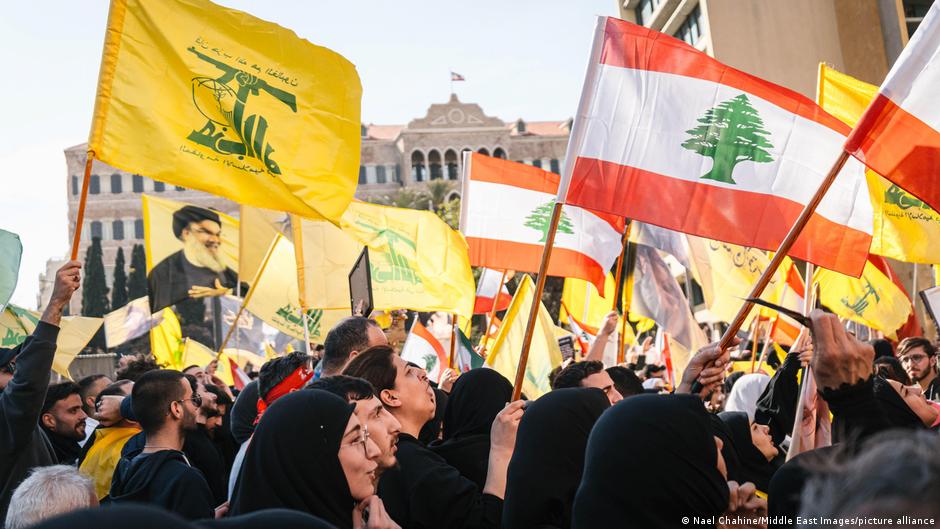
According to some conservative commentators, last week’s Israeli attack on Lebanon, which killed more than 300 people and injured more than 2,000, actually disrupted a potentially troubling political plot.
“It appears that Israel has exposed the plot [Lebanese group] Eric Stekelbeck, a conservative American commentator on a YouTube show on Middle Eastern affairs, said enthusiastically two days after the attack, “Hezbollah will essentially overthrow the Lebanese government.” And Lebanon apparently averted a major disaster here, thanks to the Israeli Air Force.
Steckelbach’s show on youtube Has more than one million followers.
However, the existence of a Hezbollah plan to topple the Lebanese government has not been confirmed by any of the organizations allegedly involved – neither Hezbollah nor the Lebanese or Israeli governments. DW’s inquiries to Israel’s Defense and Military Ministry had not been responded to by the time of publication.
There were rumors that the coup attempt was first reported by the Israeli media. But in fact the first mention DW found online came from a social media user named Sufyan al-Samarai, who is known for his inflammatory anti-Iran, pro-Israel comments and has about 225,000 followers.
Only an hour after last Wednesday’s attacks, which were launched around 2 p.m., in al-Samarai Written in Arabic on X, That “Israel foiled a coup against the Lebanese government.” Al-Samarai’s tweet, in which he did not specify where the information came from, was then amplified by many users with similar opinions.
The story of the coup was further reported by media outlets in the region, including Arabic and French-language outlets in Lebanon.
“According to informed sources, Hezbollah was planning to arrest ministers, members of parliament and political figures and target the Prime Minister by bombing the Grand Seraglio or his residence.” Lebanon’s MTV wrote A day after the Israeli attack. The purpose of the “Beirut coup” was to “terrorize the Lebanese people” [and] …was thwarted by the Israeli attack,” it said.
Why did the coup seem real?
There are several factors that make the coup story credible.
For example, the Lebanese Prime Minister announced on April 12 that he would not travel to the US for talks with Israel “in light of the current internal circumstances”. Some observers took this as a sign that he wanted to deal with the coup.
There were also rumors that Israel was able to target mid-level Hezbollah members in Lebanon last Wednesday because they were all plotting on Zoom calls and had somehow revealed their locations.
“This rumor is false,” a Zoom spokesperson told DW. He explained that the locations known as IP addresses from individual computers during an online Zoom meeting are “only approximate geographic data.” It means a city or area, not sure. Zoom doesn’t have that information, and even if it does, it doesn’t provide enough detail for air strikes.
It is also true that Hezbollah has a combative history with other parts of the Lebanese government, with the Amal Party even having its own ministers sit in the country’s Cabinet. Critics of Hezbollah often argue that the group has taken over the Lebanese state to some extent.
political competition
Hezbollah plays a large role in Lebanon, reportedly representing the country’s Shia Muslims, who make up about 30% of the population. The group has often been described as “a state within a state” due to its social and political reach and military branch considered stronger than Lebanon’s own national army.
Hezbollah presents itself as a defender of Lebanese sovereignty and is currently fighting Israel in southern Lebanon, where Israel has invaded to establish an essential “buffer zone” for security.
But Hezbollah is also closely aligned with Iran and in early March, after Israel assassinated Iran’s supreme leader, Hezbollah fired rockets at Israel. This led to an increase in Israeli attacks on Lebanon. Hezbollah’s critics accuse it of dragging Lebanon into war on behalf of a foreign power, with most locals routinely saying they want no part in it.
Recently, senior Hezbollah members have been critical of the Lebanese government’s willingness to negotiate with Israel.
Talks between Lebanon and Israel began in Washington on Tuesday. After the US and Iran agreed to a ceasefire, and it became clear that Lebanon was not part of it, these new talks with Israel are meant to address Hezbollah’s role in Lebanon.
In an interview on youtube Last month, senior Hezbollah member Mahmoud Komati likened the Lebanese leadership to France’s Vichy government, which collaborated with Germany’s Nazi regime during World War II. But, as he also said, “We are committed to stability in the country. We are capable of turning the country upside down, we are capable of overthrowing the government. …But we are not doing anything.”
Expert: Coup unlikely
Amal Saad, a political scientist at Cardiff University in the UK and an expert on Hezbollah, explains why a coup would make no sense for Hezbollah at this time.
“Hezbollah has always been against civil conflict, but even more so in the context of war due to displacement,” she says. “They number more than a million and if there is civil unrest, they will suffer. That’s why a coup is unlikely now.”
In 2008, after an attempt by the Lebanese government to destroy Hezbollah’s telecommunications network, Hezbollah fighters were able to take control of parts of western Beirut.
But, as a former senior Israeli defense official told DW, things are very different now. “I don’t think there’s any real possibility of a coup,” he said, speaking off the record during an online panel. “I was also told that if Hezbollah staged a coup, the Shia soldiers in the army would fight the Lebanese army. Whereas if the Lebanese army decided to eliminate Hezbollah, they would likely participate or not participate.”
‘An excuse’ for bombing Lebanon?
Whether genuine or not, the alleged Hezbollah coup has become a subject of debate in Lebanon. Whether one believes this story to be true or not depends on political affiliation. The same applies to how the Lebanese view this week’s talks in Washington, which are believed – in part – to be the result of last Wednesday’s attack.
Makram Rabah, a professor at the American University of Beirut, wrote for a local media outlet, “The country woke up to the possibility of peace under the false impression that the Iran-US ceasefire somehow included Lebanon.” now lebanon. “Hezbollah, instead of asking how displaced people can return to their homes, appears to have moved straight to the more urgent national priority of toppling a government that is still engaged in perpetuating the bloodshed.”
“The Israeli account of the Hezbollah coup appears to be an excuse for disproportionate bombing of Lebanon,” said local Francophone outlet Liba News, which describes itself as a citizen media initiative. competition. “What was troubling Israel was not some hypothetical coup. What was troubling Israel was the dynamics of the negotiations.” [between the US and Iran]”
The publication argued that US-Iran talks opened up the possibility of a regional ceasefire, which would have limited Israel’s scope for military maneuver in Lebanon. “Israel did not stop a coup that never happened,” she said. “It used a political pretext to justify an attack of massive violence, at a time when diplomatic dynamics could have avoided it. And it was Lebanon that, once again, paid the heaviest human cost.”
Edited by: Jess Smee