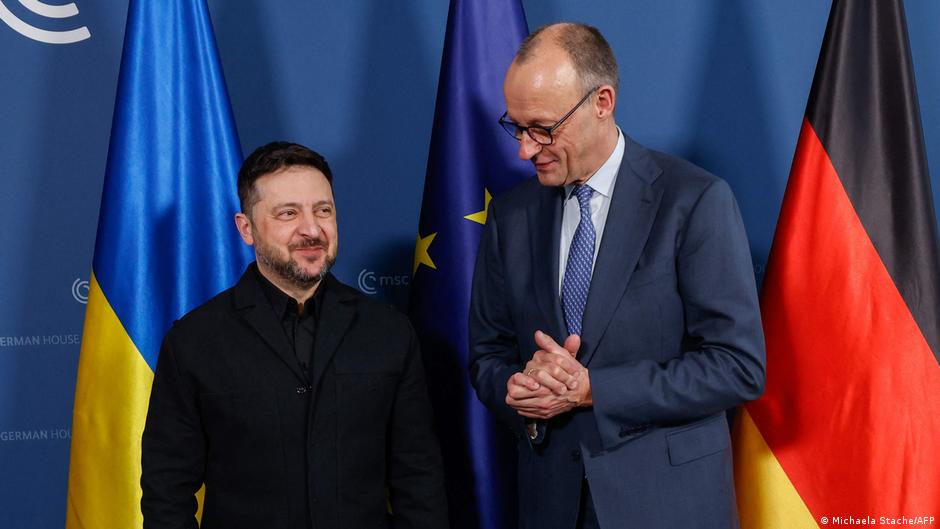
Since the beginning of the war on Iran, fears have grown in Ukraine that the country may be left to fend for itself in a defensive war against Russia. At the same time, US President Donald Trump is insisting on a quick peace agreement between Russia and Ukraine and has drastically cut US aid to Ukraine. As a result, Germany and other European countries are playing a larger role.
However, following Viktor Orban’s election defeat in Hungary on Sunday, there is likely to be little reaction from European leaders on continued support for Ukraine. And at the German-Ukrainian government talks in Berlin this Tuesday, the German government intended to send a reassuring message that they can continue to trust Germany.
Apart from the US, Germany is by far Ukraine’s second largest bilateral donor. The German government has provided approximately €100 billion ($118 billion) in aid to the country since the beginning of the war (until early 2026). Germany has provided military, financial, technical and humanitarian assistance. And that includes taking in more than one million Ukrainian refugees.
logistical support
According to its own data, the total amount of military aid provided by the German government to Ukraine, or scheduled for the coming years (until December 31, 2025), is approximately €55 billion.
This included deliveries of equipment and weapons from Bundeswehr stocks as well as deliveries from state-funded industries. This includes the entire spectrum of military equipment: from air defence, artillery and combat vehicles such as tanks to small arms and medical supplies.
In addition, Germany has trained more than 24,000 Ukrainian soldiers in Germany since the beginning of the war.
However, as the war progressed, the focus of Germany’s aid changed significantly. For example, battle tanks – which Germany had made available only after much hesitation – no longer played a significant role in the conflict. Instead, combat drones now dominate the battlefield. Germany is also supplying combat drones to Ukraine, and some are manufactured by German companies in Ukraine.
Chancellor Friedrich Merz has said that the question of whether Germany should send Taurus cruise missiles to Ukraine – a topic that has been debated for years – is no longer relevant. During a government question-and-answer session in the Bundestag in late March, the Chancellor said Ukraine could now produce its own long-range weapons. Ukraine is “better armed today than ever before.” Merz said the problem is a lack of funding, an issue Germany is willing to help with.
civil and humanitarian assistance
According to government figures, Germany’s bilateral civil aid (in addition to aid provided through the EU) amounts to approximately €39 billion. This includes all non-military assistance that enhances the resilience and operational capacity of the Ukrainian state.
The main focus of aid is on energy supplies, which Russia has increasingly targeted. Since the beginning of the war, the German government has provided over €1.2 billion of support to the energy sector alone, making it the second largest donor to the sector after the US. This includes repairs to destroyed facilities and emergency repairs.
At the same time, German experts are working with Ukrainian partners to rebuild the energy infrastructure, with a focus on energy efficiency and the expansion of renewable energy sources.
Humanitarian assistance efforts are funded in close collaboration with international and non-governmental organizations, ensuring that medical care, food, clean water and other emergency assistance reaches people – especially those on the front lines – as quickly as possible.
aid for refugees
More than one million Ukrainian refugees, mainly women and children, have found refuge in Germany since the beginning of the war. The federal government provides assistance to states and municipalities in housing and caring for these people, for example, through direct financial assistance or by making federally owned buildings available as shelters.
For example, refugees receive German language courses, training and integration programs, as well as assistance in finding employment. According to data from the Institute for Employment Research (IAB), as of February 2026, about half of Ukrainian refugees of working age are employed.
reconstruction and reform
And the German government is already planning to rebuild Ukraine in cooperation with Ukraine and partners in the EU and the G7. The plan aims to modernize the state and economy with a view to integrating Ukraine into the European Union, a process which Germany fundamentally supports.
There have already been several international reconstruction conferences (Ukraine Recovery Conference, URC), including one in Germany in 2024. In 2026, Poland will host the URC, which is scheduled to take place in Gdansk at the end of June.
Resistance from right and left side
Not everyone in Germany agrees with the nature and scope of support for Ukraine. If Germany is asked to do more, resistance is likely to grow even greater as the US increasingly withdraws from aid to Ukraine.
Resentment among the German population towards Ukrainian refugees is relatively low, partly because they are perceived as relatively well integrated. However, there has been criticism of the fact that Ukrainian refugees received more immediate benefits than other asylum seekers. For this reason, the coalition agreement between the conservative Christian Democratic Union (CDU)/Christian Social Union (CSU) and the center-left Social Democratic Party (SPD) specifies that refugees entering Germany after April 1, 2025 will receive fewer benefits in the future.
There is broad consensus among most political parties in Germany on support for Ukraine. However, this is not the case on the far right and far left sides of the political spectrum. Although for different reasons, Germany’s far-right populist Alternative for Germany (AfD) – parts of which have been labeled extremist by the domestic intelligence service – and the socialist Left Party both view the war and Germany’s support for Ukraine critically. The Left Party claims to be the only genuine pacifist party in Germany.
On the other hand, the AfD has long sought to re-establish closer ties with Russia. The party argues that there is not enough money for Ukraine due to Germany’s empty treasury and the heavy debt burden on the German people. He has also said that Germany again needs cheap energy from Russia. It’s an argument that’s gaining momentum right now, especially given the high fuel prices caused by the war against Iran. German officials are worried that the AfD, in particular, could use this to its advantage in state elections in the eastern states of Mecklenburg-Western Pomerania and Saxony-Anhalt this September.
This article has been translated from German