The service operates from Monday to Friday until 2:00 p.m., with settlement in Bolivians.
Bolivia aligns itself with neighboring markets that use cryptoassets in the face of physical illiquidity.
Bolivia’s financial sector continues its transition towards digital assets, a process that takes shape with the launch of the Banco FIE Crypto Account. This service, available since April 9, 2026, allows the purchase and sale of USDT (Tether) from its mobile application, joining a trend that seeks to mitigate the difficulties of accessing the US dollar in the local market.
The FIE Bank Crypto Account allows Bolivian citizens over 18 years of age residing in the country can access the service through the relatocripto.bancofie.com.bo platform. During registration, the bank requests the user’s complete personal dataincluding a current ID card, contact information and identity verification.
The mechanism operates under an institutional custody model in which USDT funds remain in the custody of the bank in an integrated digital wallet, while operations are carried out by debiting directly from the bank account in bolivianos.
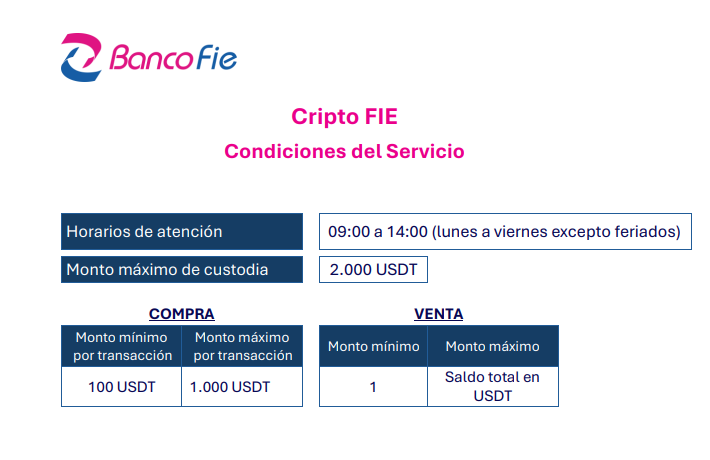
Interestingly, transactions are only available Monday to Friday between 9:00 a.m. and 2:00 p.m. (by design, cryptocurrencies like USDT have no time restrictions), with a maximum custody limit of 2,000 USDT and limits per operation established to comply with money laundering prevention regulations.
This opening occurs in a context of foreign currency illiquidity that has affected the country for the last two years. For a user who needs to make international payments or safeguard the value of their savings, the use of stablecoins (digital currencies linked 1:1 to the dollar) It is presented as an immediate settlement alternative without depending on the availability of US currency.
Bolivian banking is transformed with USDT
Banco FIE, with more than 40 years of operation and around 1.4 million customersis positioned as one of the most relevant financial entities in the microfinance segment in Bolivia.
Although it is not among the five largest by volume of assets, a sector led by Unión, Mercantil Santa Cruz and Nacional de Bolivia, Banco FIE is distinguished by its network of 472 service points nationwide and its orientation towards small producers and rural sectors traditionally excluded from the financial system.
Its move now towards digital assets is supported by the recent policy change of the Central Bank of Bolivia. After almost ten years of strict prohibitions, the monetary authorities enabled the use of electronic channels for transactions with bitcoin (BTC) and cryptocurrencies in mid-2024, as reported by CriptoNoticias.
Subsequently, in December 2025, Bolivia’s Minister of Economy, José Gabriel Espinoza, announced that the country will integrate cryptocurrencies and stablecoins into the formal banking system. According to the official, digital assets will function as a “legal tender payment instrument” within the financial system, allowing banks to offer services such as custody, savings accounts, credit cards and loans denominated in crypto assets.
Banco FIE is not the only entity that offers this type of service. At least two other institutions already operate with digital assets in the country: Banco BISA (through its CriptoBISA platform) and Banco de Crédito de Bolivia (BCP), which allow the custody, purchase and sale of USDT. This trend shows that several Bolivian private banks are incorporating stablecoins as a practical solution to the persistent shortage of dollars and the reduction of international reserves.