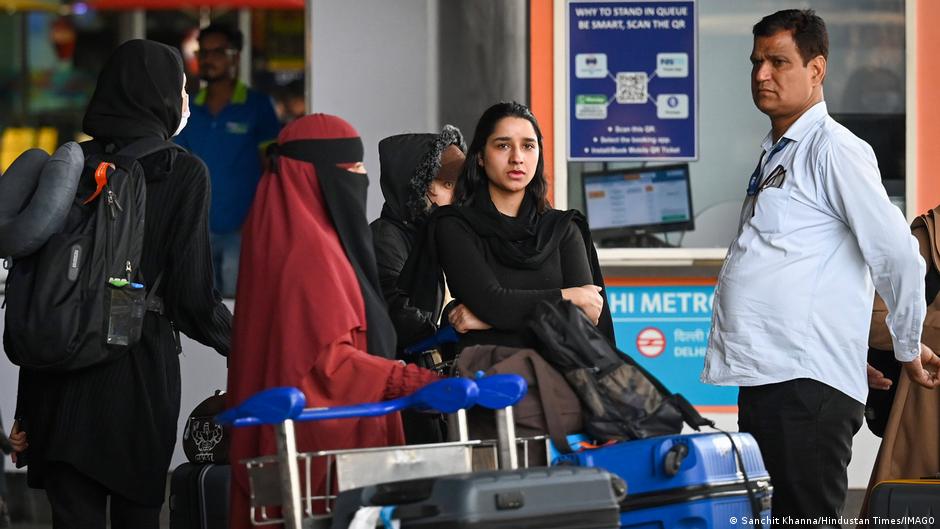
Sandeep Sikdar was to fly from India’s capital, New Delhi, to Munich, Germany with a stopover in Sharjah. They had planned their vacation months in advance. But then, just days before their departure, the US-Israeli conflict with Iran caused their plans to fail.
Sikdar had to rebook both legs of his journey, while some of the prices for one leg had increased almost five times.
“It’s been pretty tough,” he said.
Sikdar is one of millions of travelers in India whose travel plans have been affected by rising prices or cancellations due to airspace closures during the war.
Before the conflict, India’s aviation sector was one of the fastest growing in the world. Now, the ongoing geopolitical crisis is reshaping flight paths and the economics of air travel for Indian carriers.
Airspace disruptions lead to costly detours
At the center of the crisis is the restricted airspace in the Middle East due to the Iran war, which is a vital route for flights connecting India to Europe and North America.
Airlines that once relied on the shortest, most fuel-efficient routes are now forced to take longer detours to avoid flying over Iran.
Indian carriers are under additional pressure to avoid Pakistani airspace, which was closed to their airlines following hostilities following the Pahalgam terror attack in April 2025.
Experts say flight durations on some routes have increased by 15-40%, while small regional areas have seen journey times more than double in extreme cases.
In some cases, flight times have increased dramatically. According to the FlightRadar24 tracking service, the New Delhi-Tashkent route previously took just over two hours, but now it has increased to more than five and a half hours.
Aviation lawyer Nitin Sarin told DW that the hurdles are particularly punitive for Indian carriers.
“because they [Pakistan] are so strategically located geographically that if we can’t fly through them, we’ll have to burn a lot of extra fuel and waste a lot of extra time getting from here to Europe or North America,” he said.
Foreign carriers, unrestricted by Pakistani airspace restrictions, are able to maintain shorter routes and more stable schedules.
Fuel prices raise financial concerns
The diversion comes at a time when Iran has severely disrupted global energy supplies and oil prices have soared, including aviation turbine fuel (ATF) rates, the biggest expense for most airlines.
According to the report, fuel typically accounts for 30-40% of operating expenses and could rise to around 45% in India due to higher taxes.
Earlier this month, jet fuel prices in India rose dramatically and international flight rates more than doubled. Although the government has taken steps to limit price increases for domestic operations, airlines are under immense cost pressure.
For an industry that typically operates on thin margins, the combined impact of longer routes and higher fuel prices is severe, Sarin said.
“Global oil prices are rising, and because India is a high tax jurisdiction, the costs for airlines are tremendous,” he said.
Carriers have already begun passing on some of this cost to passengers through fuel surcharges and higher ticket prices, especially on long-haul routes.
But there are limits to how much can be moved before demand is impacted.
“It will be a very large portion of leisure travel and non-work travel that will be affected,” Sarin said.
Disturbances cause ripple effects
Apart from fuel and fares, the disruptions are putting pressure on airline operations.
“Longer routes increase costs, ranging from higher fuel expenses and aircraft maintenance to additional crew requirements and longer layovers to meet duty time regulations,” a pilot with one of India’s leading airlines said on condition of anonymity.
Longer routes increase crew duty hours, make schedules more complex and lead to stricter compliance with remaining regulations. Aircraft utilization, a key driver of airline profitability, is also being affected, as planes spend more time completing shorter trips.
For example, an aircraft that normally makes two trips per day may only make one and a half trips on some routes. This has a direct impact on the airline’s revenue as the same assets are flying less efficiently.
These changes can spread throughout the network, affecting fleets, employees and crews.
A changing competitive landscape
Indian airlines face a structural disadvantage compared to their global counterparts due to offering shorter routes and more stable pricing.
At the same time, disruption in the Gulf threatens a key revenue stream: traffic between India and the Middle East, which has long been a “cash cow” for many airlines carrying workers and passengers between the regions.
However, there are potential opportunities. Sarin suggested that India could lobby China to open new air routes over the Tibetan region “for a much shorter route, especially from India to North America bypassing Pakistan completely”.
Passengers have to bear the brunt
For travelers like Sikdar, the consequences are already clear: longer journeys, higher fares and increased uncertainty.
As flights become more expensive, airlines can expect to lose the budget-conscious travelers who have helped drive India’s aviation growth.
There are early signs of tension within the industry as well. Budget airline SpiceJet is considering layoffs amid reduced operating capacity, the Economic Times newspaper reported on Thursday.
An industry at a crossroads
Before the war began, India’s aviation sector was preparing for rapid expansion due to the increasing demand for air travel. But the current crisis highlights how vulnerable growth is to external shocks.
However, experts say the industry’s fundamentals are in place.
Journalist Jagriti Chandra said, “While India’s aviation sector is firmly on a growth path, there is a huge, under-penetrated market still to be tapped – currently only 2-3% of the population travels by air.” “As incomes increase and connectivity improves, it leaves a lot of scope for expansion.”
Chandra, who has been covering the aviation industry for more than a decade, says external shocks such as the conflict in the Gulf may disrupt travel in the short term, but they are unlikely to affect long-term demand, which usually grows rapidly once normalcy begins.
He noted that Tata Group-backed Air India can maintain its expansion despite volatility, while IndiGo Airlines’ strong liquidity of ₹36,945 crore ($3.9 billion or €3.39 billion) in cash reserves supports continued growth and market dominance.
“In short, the underlying momentum of the sector remains intact – low penetration, strong balance sheet and structural demand will continue to drive India’s aviation story,” he said.
Edited by: Carl Sexton