
Paraguay leads the region with cheap and stable energy, capturing 4.3% of the global hashrate.
The fall in global profitability forces capital to migrate to markets with surplus energy.
Latin America has one of the largest reserves of surplus energy in the world, although it barely contributes 6% of the computing power (hashrate) that supports the Bitcoin network globally. This gap between natural potential and industrial reality is the focus of a report published on April 15, 2026, signed by analysts Gerson Martínez and El Sultán, manager and business director of Luxor Technology, who warn that the region faces a historic opportunity driven by the need for the sector’s survival.
The industry is going through a critical inflection point due to the drastic drop in hashprice, one of the indicators that measure mining profitability. This metric has collapsed after a “perfect storm”: while the difficulty of mining remains at high levels, the price of Bitcoin fell from USD 124,000 in October 2025 to stabilize near USD 65,000 in February 2026.
With profit margins cut in half, Bitcoin mining operational efficiency is a permanence requirement. In this scenario, global capital began a migration towards refuges of cheap and abundant energy, placing the hydroelectric and gas surpluses of Latin America as the logical destination port to compensate for the fall in income.
Paraguay, the stability model for Bitcoin mining
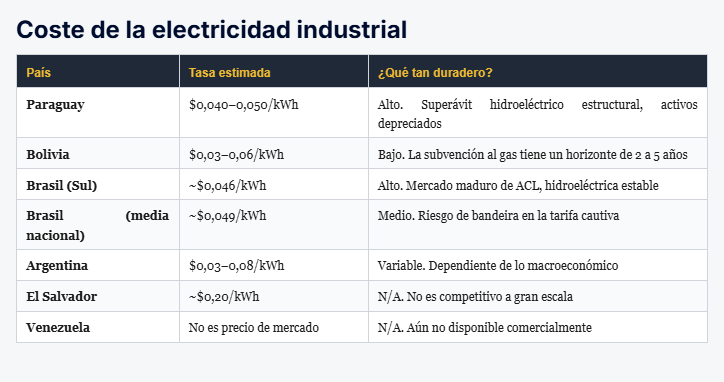
He published report in Hashrate Index, titled “The State of Bitcoin Mining in Latin America (2026)”, identifies Paraguay as the model to follow. By using the surplus from the Itaipu Dam to offer industrial rates of between USD 0.037 and USD 0.050 per kWh, the country has climbed to fourth place in the world in hashrate contribution.
Paraguay is the only world-class Bitcoin mining market in the region. With ~43 EH/s and 4.3% of the global hashrate, it ranks #4 globally in Q2 2026, despite having a population of only 7 million. Itaipu’s structural hydroelectric surplus allows industrial electricity to cost between ~$0.037 and $0.050 per kWh. That’s the whole story. Then there is Paraguay at #4 with 4.3% of the global hashrate (~43 EH/s). A landlocked country with 7 million inhabitants, situated alongside the United States, Russia and China as one of the four dominant Bitcoin mining jurisdictions in the world.
Hashrate Index report on Bitcoin mining.
So, for all this, Luxor analysts point out that “Paraguay is the only world-class Bitcoin mining market in the region.” Their thesis is that digital mining requires capital-intensive investments with payback horizons of up to ten years. And they are convinced that The future of the network will not be decided only in the rivers or gas wells, but in the offices where the regulatory frameworks are defined.
Politics as a definitive variable in Latin America
Brazil is also positioned as a safe harbor for Bitcoin mining. This is based on the fact that the Brazilian model is experiencing expansion through deregulation. With the implementation of direct bilateral contracts through the Free Contracting Market, The country recorded a 133% increase in its hashrate in the last year, consolidating an infrastructure of 3.5 EH/s that positions it as one of the most dynamic markets in the region
On the other hand, Argentina is trying to capitalize on its resources through the use of waste gas in Vaca Muerta, although macroeconomic instability has caused a 42% drop in its installed capacity, showing that energy alone is not enough if there is no financial predictability.
Additionally, Bolivia registered year-on-year growth of 2,400% due to gas subsidies, but part of that activity was reduced in the second quarter. Argentina saw a 42% drop year-on-year, largely due to the closure of a 40 MW Bitfarms site. Venezuela and El Salvador show low or symbolic levels.
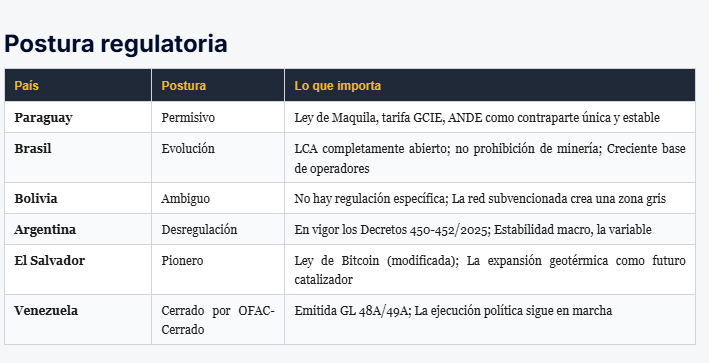
In fact, in Venezuela, the integration of Bitcoin mining offers a mutually beneficial relationship for the region where operators could access cheap energy while the electrical system finds a buyer for its surpluses. This flow of capital would make it possible to make profitable resources that would otherwise be wasted, financing the updating of deteriorated electrical networks, as reported by CriptoNoticias.
Regarding Venezuela, the Hashrate Index report is categorical in pointing out that the country represents “untapped potential.” Martínez warns that, despite having Caroní’s infrastructure and large-scale electrical surpluses, factors such as OFAC licenses and local regulatory uncertainty have reduced its participation to barely symbolic levels compared to its neighbors.
According to analysts, the energy necessary for Latin America to dominate the sector already exists. The determining factor will be the capacity of governments to offer legal stability that allows you to transform these natural resources into digital sovereignty. At the end of the second quarter of 2026, the data confirms that, while the rest of the world faces saturated electrical networks, Latin America has in its hands the key to keep the most important network in the world on.