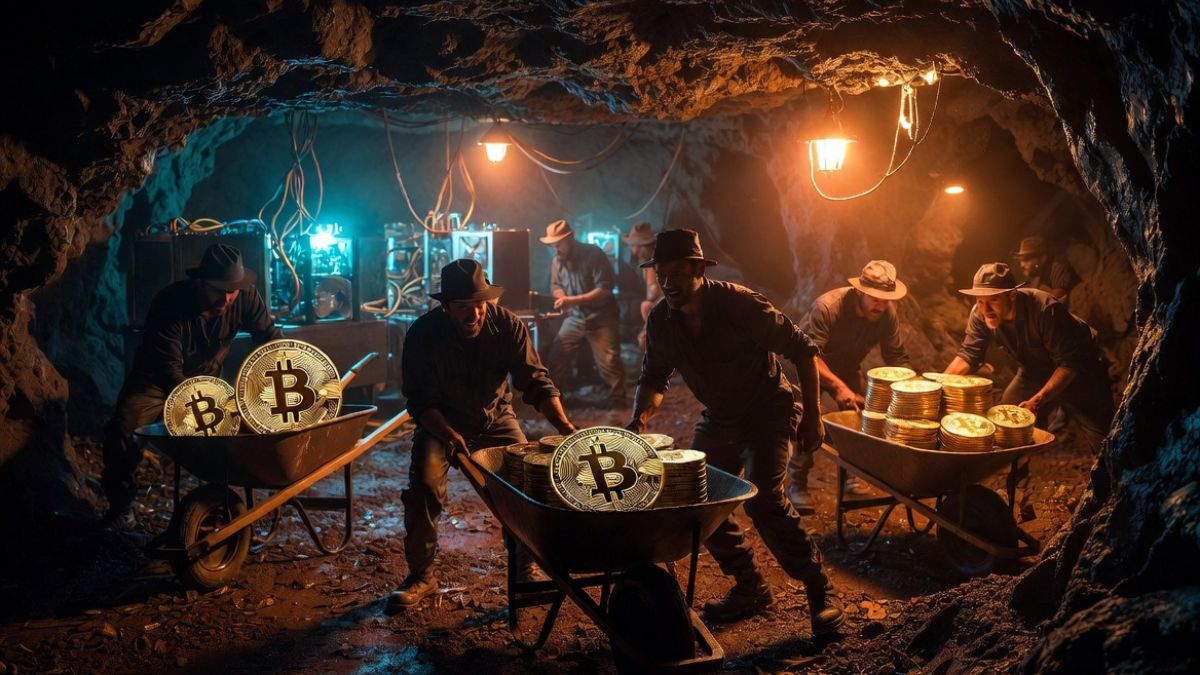
Public mining companies sell their reserves to cover costs and expand into AI.
From the ATH marked in October of USD 126,000, the value of BTC fell by 40%.
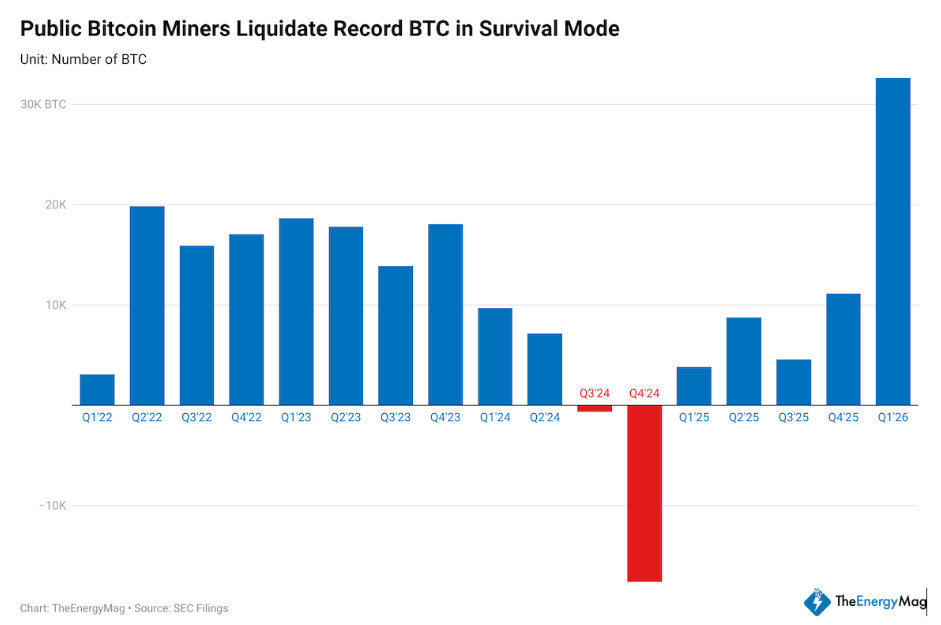
Major public Bitcoin miners, including MARA Holdings (MARA), CleanSpark (CLSK), Riot Platforms (RIOT), Cango (CANG), Core Scientific (CORZ) and Bitdeer (BTDR), sold more than 32,000 bitcoin (BTC) in the first quarter of 2026, surpassing the total net sales of the four quarters of 2025 and setting a new all-time record for quarterly liquidations, according to the specialized site in mining and energy The Energy Mag.
Since some companies’ first quarter reports are still pending, the figure of 32,000 BTC could be even higher.
The previous record was from the second quarter of 2022, when miners liquidated approximately 20,000 BTC during the collapse of the Terra-Luna ecosystem, a period in which the price of BTC fell from $47,000 to approximately $18,000.
The Energy Mag team emphasized in their April 16 report that, at the end of 2024, those same companies were aggressively accumulating and closed the year with a net addition of 17,593 BTC, bringing their combined reserves above 100,000 BTC.
Why do these miners sell their bitcoin reserves?
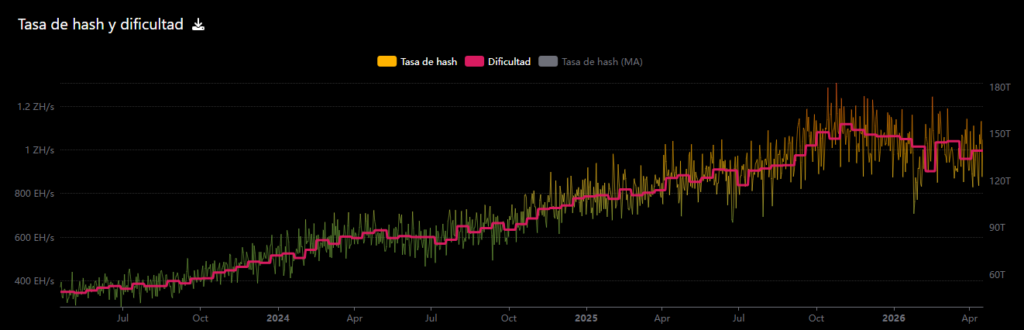
With the price of bitcoin far from its all-time high of $126,000 set in October (a 40% drop), the global hashrate and network difficulty growing or near record highs, mining profitability collapseswhich pushes them to draw on their reserves to cover operating costs and maintain their operations.
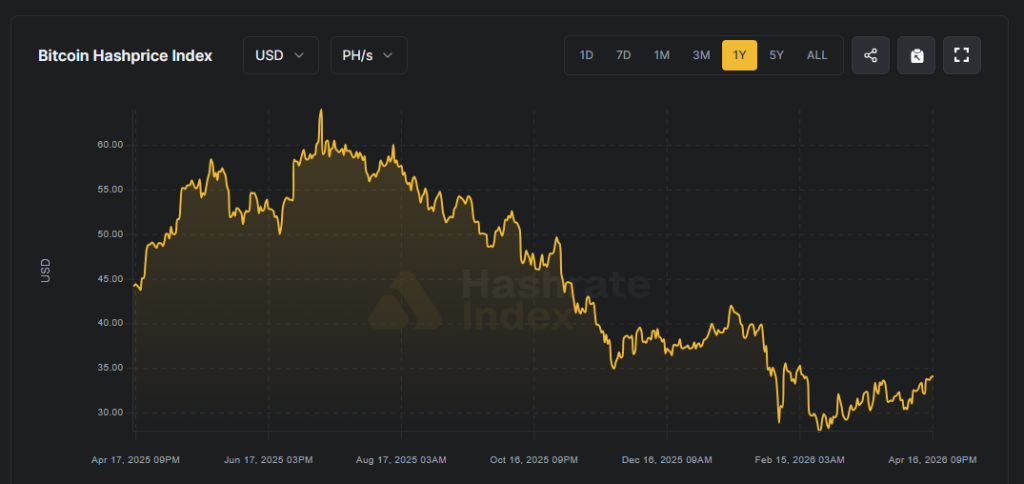
A direct indicator of the current problem for miners is the hashprice, the metric that measures the expected daily income per unit of computing power contributed to the network. Currently, the hashprice is around USD 34 per petahash per day (USD/PH/day), near all-time lowsaccording to Hashrate Index data.
A low level of this measurement leads to ASICs generating less revenue. If in this context, fixed costs, such as energy, maintenance and infrastructure, do not decrease in the same proportion and the conditions of the network remain at a maximum, that ASIC begins to mine at a losswhich implies zero or negative profit margins.
Although the price of BTC has been growing since April 5, going from USD 67,000 to USD 76,000 registered today, April 17 (an increase of 13%), this increase is not enough for miners.
Proof of this is that, according to data of Antpool, of the 10 most profitable Bitcoin ASICs on the market today, the first on that list operates with estimated daily profits of just $0.001 per terahash (TH, a measure below petahash) per day.
Mining companies towards AI: a way out of volatility
Pressure on margins is pushing these mining companies to diversify into artificial intelligence (AI) as a more predictable source of revenue.
As reported by CriptoNoticias, MARA confirmed in March that it sold 15,000 BTC coins and that it will continue to do so opportunistically in 2026 to finance its expansion into high-performance data centerswith the ability to switch between mining and AI processing depending on the profitability of each segment. In February, it formalized an alliance with Starwood Capital to convert facilities with up to 2.5 gigawatts of capacity.
Cango Inc, for its part, sold 4,451 BTC, more than half of its reserves, for approximately USD 305 million, to finance your transition towards leasing graphical processing units and training language models. According to the company’s statement, the new model will allow it to generate more predictable income than Bitcoin mining. Riot Platforms also announced a partnership to expand the AI capacity of its data center in Rockdale, Texas.
The common argument is structural: mining revenue depends on BTC price volatility and network conditions, while AI computing contracts offer more predictable flows. For companies with large-scale energy infrastructure, converting part of that capacity towards AI allows them to diversify without abandoning mining.
The record of liquidations in the first quarter of 2026 thus reflects how survival pressure forces the sale of reserves to sustain operations, and a long-term strategic reconfiguration in which bitcoin continues to be the core of the business but is no longer its only pillar.