The bridge uses burning and minting to move USDC between different networks.
Users question the commissions, despite the transparency promised by Circle.
Circle launched the USDC Bridge on April 17, 2026, an official frontend built on top of its USDC cross-chain transfer protocol, CCTP V2. It uses a burn and mint process to transfer native USDC between 17+ chains.
The company presents as a simpler and more transparent solution than the previous version. The new bridge allows USD Coin (USDC) to be moved between different networks without the need to select routes or interact with multiple protocols.
As Circle explained, the system uses a “burn-and-mint” mechanism: tokens are destroyed on the source network and issued again on the destination network, maintaining equivalence.
The company highlights that the product offers visible commissions before executing the operation, real-time monitoring and automatic gas management in the destination network. The proposal aims to reduce the technical complexity associated with bridges between networks and offer a more direct experience for the user.
Although standard shipping is free (gas only), fast mode charges between 0-14 bps. This generated criticism because community interfaces such as cctp.to allow CCTP to be used without extra Circle fees, although with less automation. Reception in the community was mixed. Part of the criticism focused on the cost of use and the comparison with tools already available.
One of the questions came from Alex, an analyst linked to the data firm Artemis, who through his X account pointed out: “Good product, but I don’t see why I would use this instead of cctp.to, which charges 0 commissions and supports Solana.” Your comment points to the lack of a clear competitive differential compared to alternatives that already allow similar transfers with lower costs.
As CriptoNoticias has explained, Cctp.to is an interface that allows you to use the Cross-Chain Transfer Protocol (CCTP), Circle’s infrastructure to move USDC between different networks through burning and minting, but without charging an additional commission for the service. His comment points to the lack of a clear competitive differential compared to alternatives that already allow similar transfers with lower costs.
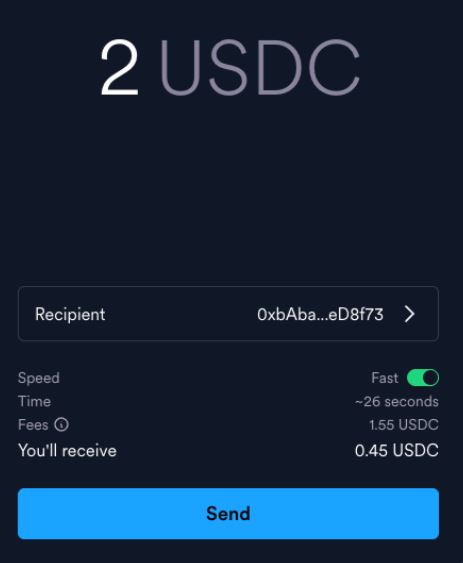
Criticism also focused on the level of commissions. Another user, identified as Max, shared a transaction where, when trying to transfer 2 USDC, a fee of 1.55 USDC was applied, reducing the final amount received to 0.45 USDC. “Man, stablecoins becoming the new SWIFT, hahaha, what is this?” he joked, referring to the costs associated with traditional international transfer systems.
Another area of criticism was related to confidence in the implementation. A user identified as Juergen he questioned system security and company communication, noting that Circle should “review its ethics” and improve transparency in handling errors and updates.
Observations also arose from the technical level. Edison Lim, developer and co-founder of the Based project, express his disappointment in stating that he expected a “1:1” conversion, suggesting that the cost structure or conditions of the bridge introduce friction into the process.
Taken together, the reactions reflect a tension between Circle’s technical simplification proposal and the expectations of users, who prioritize low costs and efficiency over existing solutions.