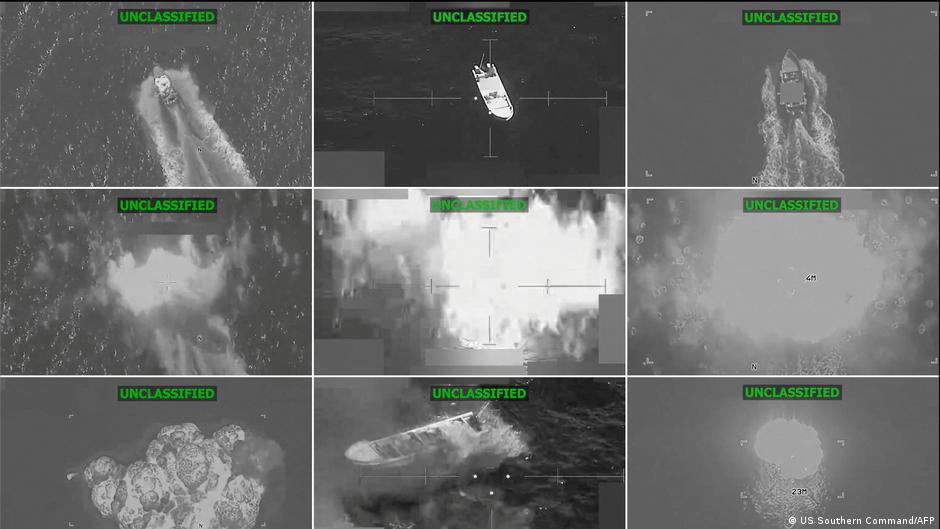
The US Navy’s Southern Command has resumed attacks on what US President Donald Trump’s administration calls “drug boats”. It is believed that these are smuggler ships used by cartels to transport narcotics from South America to the US.
According to various media reports, the total number of ships sunk since September 2025 has exceeded 50. British news outlet The Guardian says at least 177 suspects have been killed so far. However, the US government has not yet provided any evidence that the ships were carrying illegal cargo or revealed the identities of those killed.
Some observers have been highly critical of these attacks. One such critic is Carlos Pérez Ricart of Mexico’s Center for Economic Research and Teaching (CIDE), who told DW, “[these strikes] The US administration rejects such criticism and offers several justifications for why its deadly military strikes comply with international law. It says that in essence, the strikes are an act of self-defense because cartel actions amount to an armed attack on the US.
At the end of his first term in office, Donald Trump wanted to label drug cartels as foreign terrorist organizations, yet refrained from doing so at the request of Mexico’s then-President Andrés Manuel López Obrador. However, Trump pushed the designation forward to February 2025, shortly after beginning his second term in office. His administration initially applied the terrorism label to the Mexican drug cartel, El Salvador’s Mara Salvatrucha street gang, and Venezuela’s Tren de Aragua crime syndicate.
Legal classifications and their implications
In October 2025, several US news outlets, citing unnamed sources, reported that the Trump administration now viewed itself as being in a “non-international armed conflict” with the cartel, and classified those killed in the boat attacks as “unlawful combatants”. Later in December, Trump officially classified fentanyl as a “weapon of mass destruction”. All designations play a role in international law and have different implications, although many legal experts doubt that they apply in this context.
There is no doubt that drug cartels are causing great harm in America. Every year, thousands of people die from drugs smuggled into the country from Latin America. Illegally manufactured fentanyl has been the deadliest drug ever produced. The National Institute on Drug Abuse (NIDA) found that it is responsible for approximately 70% of fatal overdoses in the US. In fact, fentanyl is so poisonous that it can be used as a weapon. This happened in 2002, when Russian authorities used chemicals to defuse the Moscow Dubrovka theater hostage crisis.
Fentanyl, which is sold illegally throughout the United States, is primarily produced in Mexico rather than South America. The same goes for psychostimulants, which are the second-deadliest drug class in the US after synthetic opioids like fentanyl, according to NIDA. South America is largely responsible for cocaine smuggling into the US.
Meanwhile, the deadliest US attacks have occurred in the Caribbean, from where drugs are typically smuggled to Europe by boat, rather than across the Pacific, the route taken by many drug smugglers bound for the US.
What was achieved by the attacks?
“Drug traffickers have certainly become more cautious because they know who they’re up against,” says Manuel Superville, a national security expert and former U.S. military lawyer. He has no doubt that the sunken boats were actually carrying drugs. He said, he knew from his time as a lawyer for the Southern Command in the early 2000s that the fight against drug traffickers should not be lethal. He told DW that in his time, snipers would take out the boat engines from helicopters so they could not be attacked. “That’s when the coast guard would come, arrest the crew and confiscate the drugs,” recalls Superviel.
Alex Papadovasilakis of the investigative news outlet Insight Crime believes that the US attacks have successfully disrupted some drug trafficking routes in the Caribbean. “But that doesn’t mean the cocaine will stop flowing,” Papadovasilakis tells DW. “Drug cartels have many more options, particularly because the United States cannot maintain this level of military pressure for long.”
Economist Pérez Ricard cast further doubt on the effectiveness of the US strategy, telling DW that “the price of a gram of cocaine on the streets of New York and Los Angeles has not changed.”
Victor M. Mijares, a political scientist at the Universidad de los Andes in Bogotá, Colombia, says the removal of Venezuelan President Nicolas Maduro could have a far greater impact on drug trafficking from South America, telling DW that “we know there is a lot of evidence linking the regime to drug trafficking.”
Does Trump Really Care About Fighting Drug Traffickers?
Superville believes that this inability, along with the US’s struggle to justify its attacks, shows that the US was actually trying to create the political conditions for Maduro’s downfall. “He was only the face of the regime, while other people made the real decisions, but now they are cooperating,” Superville told DW.
In fact, the Venezuelan interim government led by Delsey Rodriguez says that it is working professionally with the US government. It is primarily concerned with opening the Venezuelan economy to American investors, especially in the oil sector. The Latin American country has the world’s largest known oil reserves.
Pérez Ricart argues that Trump is primarily concerned about his domestic base. This is what matters most to President Trump right now, says political scientist Mijares. “He needs to unify the MAGA base behind him in the upcoming elections.”
This article was translated from German.