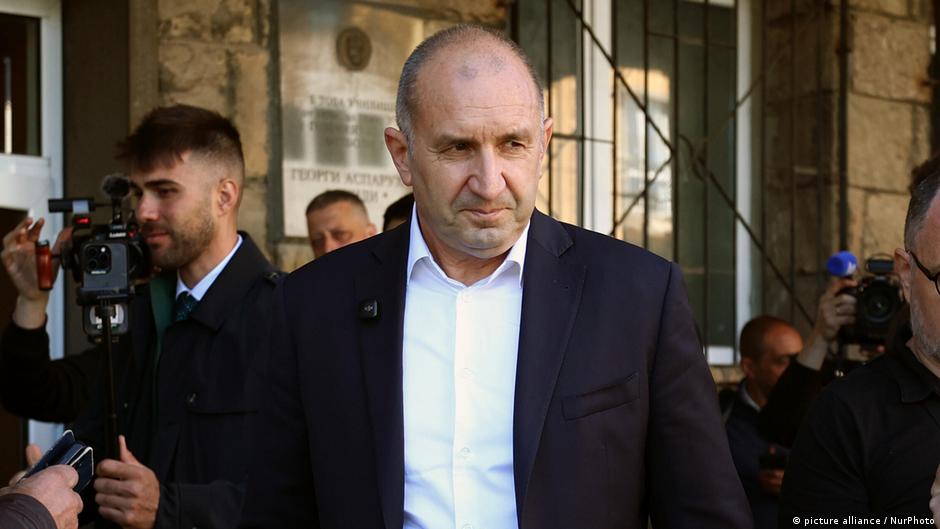
The results of Bulgaria’s eighth parliamentary election in five years are set to reshape the country’s political map, with former President Rumen Radev’s sweeping victory and clear majority and less support for established parties.
Defying pre-election surveys that had predicted another possible coalition government, Rumen Radev’s Progressive Bulgaria received 44.7% of the vote, with 96% of ballots officially counted.
This would give the party an absolute majority in Parliament – the first political force to achieve this on its own since 1997.
The result has raised hopes of an end to the cycle of short-lived coalition governments in the country, as Radev has promised to crack down on corruption, tackle inflation and pursue a more independent foreign policy within the EU – a policy that does not exclude dialogue with Russia.
“Progressive Bulgaria has won decisively. It is a victory of hope over distrust, of freedom over fear,” Radev said after releasing the results of the first parallel count, “The people rejected the complacency and arrogance of the old parties and did not succumb to lies and manipulation.”
established parties were far behind
With 96% of the votes counted, Progressive Bulgaria’s unexpected victory has already made a big difference: only five parties are set to enter parliament, compared to nine after the last election.
The official members of the previous coalition – GERB, the Bulgarian Socialist Party and There Is Some a People Party – were severely punished by voters.
The centre-right GERB party, led by three-time Prime Minister Boyko Borissov, has fallen below 20% for the first time in its history. It currently stands at 13.4%, placing it in second place and just ahead of the opposition liberal PP-DB party, which received 12.8% of the vote.
The major political shift followed mass protests last December against Borissov and DPS party leader Delyan Peevski, who had supported the previous government without formally being part of it and was accused of pulling the strings behind the scenes.
The protesters accused both men of being the main promoters of corruption in the country. The US and Britain have imposed sanctions on Peevski for alleged corruption.
DPS currently stands at 6.6%, down from 11.5% in 2024. Such people have got less than 1%.
massive vote buying
After polling stations closed, the Bulgarian Ministry of the Interior announced that DPS and GERB ranked first and second in official reports of vote-buying, generating 631 and 318 reports respectively.
At the beginning of the elections, there was a massive crackdown on vote buying. The Interior Ministry said it had seized more than €1.2 million ($1.41 million) earmarked for vote buying and detained more than 370 suspected vote buyers.
“I am confident that what has been seized is a very small part of the whole,” Interior Minister Emil Dechev told DW.
socialist not in parliament
For the first time since post-communist Bulgaria’s first democratic elections in 1990, the Bulgarian Socialist Party (BSP), which was part of the previous coalition government, failed to enter parliament, falling below the 4% threshold.
The BSP was the political force behind Radev’s rise to prominence and his first presidential bid.
Its core voters switched camps and supported Radev, who also attracted voters from the far-right pro-Russian Revival party.
Although Revival’s support has fallen sharply, from 13.3% to 4.3% in 2024, according to official calculations, it is still set to enter parliament.
Radev faces big challenges
Radev’s in-tray is very full, and experts say he needs to be grounded.
Two top priorities will be passing the budget for 2026 – the first since Bulgaria joined the eurozone on January 1 – and introducing measures to tackle inflation linked to the war in the Middle East.
“I think there are two big hopes in our society: one is for justice and the other is the question of judicial reform. The other is for stability,” Antony Todorov, a professor of political science at the New Bulgarian University, said on Bulgarian national television.
While Radev is projected to win a clear majority of 130–132 MPs in the 240-seat parliament, he will need the support of other parties to make any major judicial or constitutional changes which would require a two-thirds majority (160 seats).
high expectations
Radev, a former air force general who was Bulgaria’s president for nine years before stepping down in January to run in elections, has pledged to fight the “oligarchic governance model” in the country.
According to surveys, Progressive Bulgaria attracted support from Gen-Z voters, including those who protested in December, middle-aged voters and voters over 60.
He also won the overseas vote, believed to be the highest overseas vote in years. About 67% of those who did not vote in the last parliamentary election also voted for Radev.
This is not the first time that a new party has won a Bulgarian general election. In recent years the two parties have taken advantage of voters’ willingness to support new actors in the hope of change. However, none of them managed to win a majority, weakening their ability to deliver on campaign promises and resulting in a loss of support.
Although Radev himself has never led a political party and their structure remains relatively weak, with the movement behind him largely composed of unrecognized experts, sports figures and economists, the fact that he has a majority puts him in a position to implement his agenda.
A new foreign policy curriculum?
Throughout the campaign, Radev and his party refused to condemn Russian President Vladimir Putin’s aggression in Ukraine, trying to appeal to his pro-Russian leanings and drawing backlash from other voters who feared the country might be diverted from its pro-European course.
Radev clarified that he would not veto or torpedo the bloc’s joint decisions, but would instead walk out of them if he deemed them harmful to Bulgaria’s national interest.
Over the years, he has advocated resuming energy imports from Russia and opposed military aid to Ukraine.
Yet progressive Bulgaria tried to placate voters by playing down allegations that Radev could become Putin’s new Trojan horse within the EU, as Valery Heyer, leader of the Renew Europe group in the European Parliament, pointed out. financial Times.
“A strong Bulgaria in a strong Europe needs critical thinking; it needs pragmatism,” Radev said on election night. He said the bloc needs to focus on energy supply and industrialization. “Europe has become a victim of its ambition to be a moral leader in a world without rules,” he said.
With Bulgaria entering new and uncharted territory under a party that has not yet defined its European political family, the country could be moving toward a stable government for the first time since 2021.
What this will actually mean for both Bulgarian foreign policy and the EU remains to be seen. Much will depend on what direction Radev actually takes after coming to power.
Edited by: Angiel Flanagan