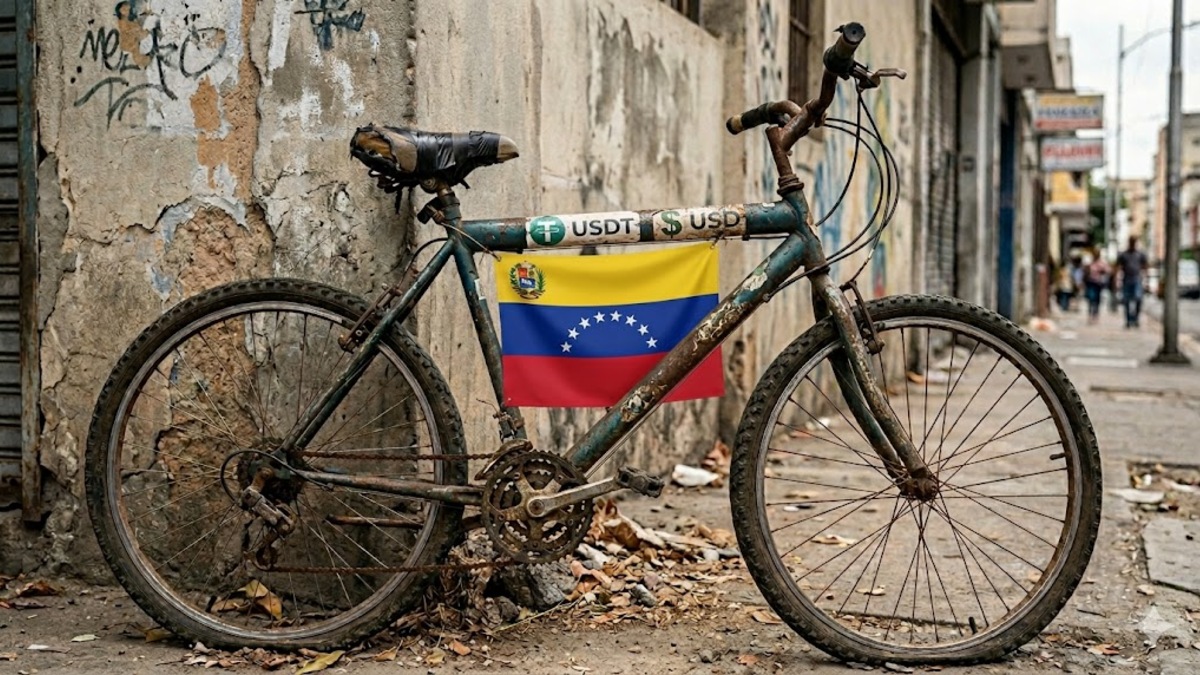
This is a consequence of mechanisms to buy USDT “directly”, such as Binance’s BPay.
The easing of sanctions on Venezuela and favorable economic expectations also play a role.
As predicted, Venezuela’s exchange cycle became unprofitable for the participants in this arbitration scheme. This mechanism, which consists of buying dollars in Venezuelan banks to sell them for bolivars as a digital asset (specifically the USDT stablecoin) at a higher price, has seen a significant decline in its profitswhich reached just 2%, on average.
That minimum margin, reported until this Monday, April 20, 2026, marks the end of an era in which local operators They managed to obtain profits that previously ranged between 20% and 40%.
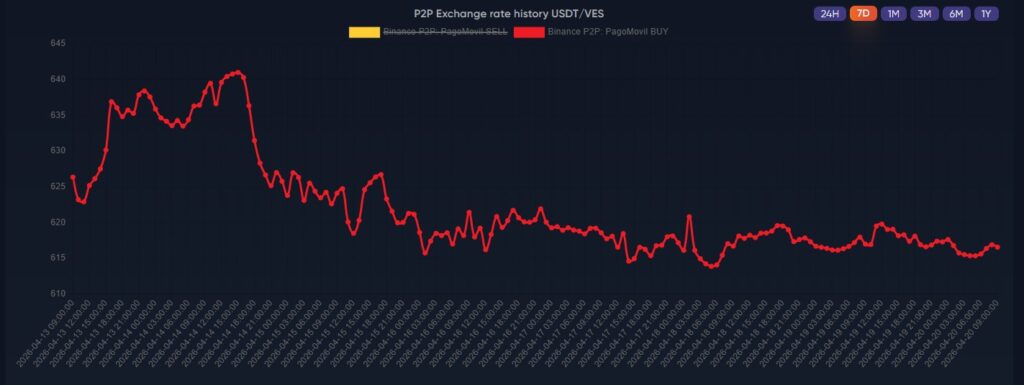
According to market data, the stability of the price of USDT below 620 bolivars in the peer-to-peer (P2P) markets in the last week – reflected in the following graph -, together with the progressive advance of the official rate of the US dollar in Venezuela, has almost completely neutralized the benefit of the so-called “bicicleros”.
To understand how this 2% average is reached, it is essential to analyze the current flow of funds in the banking system. Operators acquire foreign currency in entities such as Banco de Venezuela or Bancamiga, where the intervention rate is approximately 570.75 bolivars, and then convert them into USDT.
When considering an effective entry cost of approximately 607 bolivars per unit and a sale in the parallel market of 619 bolivars, the resulting net profit is just 12 bolivars for each unit of the digital asset. That is, a profit of 2%.
It should be noted that this percentage could vary depending on the bank where the currencies are acquired, since, although there is an average purchase and sale derived from exchange intervention, each entity offers the greenback at its own price and with minimum acquisition limits that, in most cases, It is 10 dollars and up.
The above, in any case, reflects a significant compression in the exchange gap, which is 8.7% on average until the closing of this report —calculated between the bank rate and the price of USDT.
Furthermore, the reduction in the profit margin also could respond to structural factors of the current market such as the massive increase in supply of the digital currency, driven by direct USDT purchasing mechanisms such as Binance’s BPay and the flow of bolivars through the allocation of government bonds.
Added to this are the higher and better economic expectations resulting from the easing of financial sanctions on Venezuela, which has put downward pressure on the price of USDT in bolivars in the last seven days. In fact, economists like Aarón Olmos predict a decrease in the exchange rate gap as a result of this new reality.
The decrease in the profitability of the exchange cycle was previously foreseen by economists such as Daniel Andrés Peláez, who told CriptoNoticias on April 1 that this exchange distortion scheme would become less beneficial for operators due to the arrival of Binance’s BPay service last month.
The latter allows you to buy USDT and cryptocurrencies without having to resort to foreign wallets — which is one of the main gears of the bike.
The reduction of the profit margin of “bicicleros” to 2% marks a turning point in the Venezuelan informal economy, suggesting that traditional digital currency arbitrage is ceasing to be a viable income option. Even so, the market forces operators to look for new alternatives as the gap between the official and parallel markets closes.
This has even led to the establishment of a “personal rate” for the US dollar, which has reached up to 800 bolivars in the most informal places in Caracas.