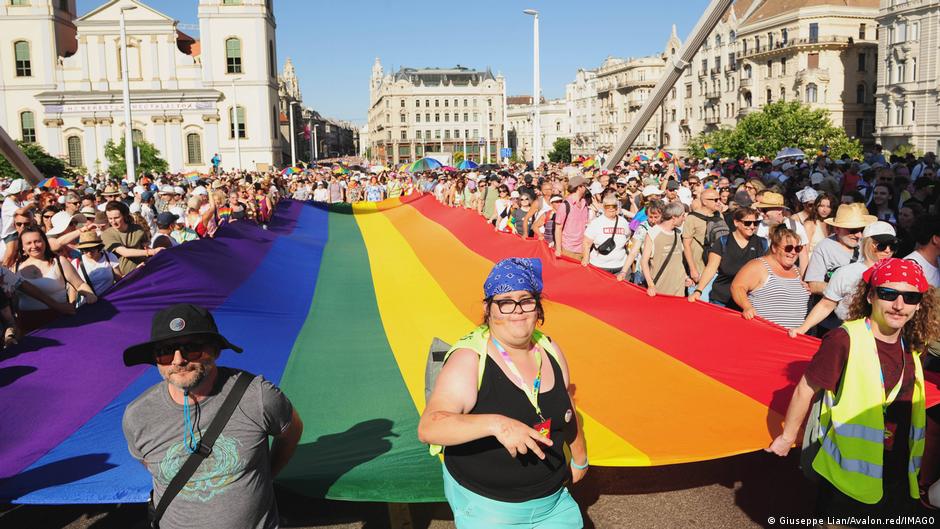
The European Court of Justice (ECJ) ruled on Tuesday that Hungarian LGBTQ+ legislation introduced in 2021 violates EU laws and values on several levels.
The controversial reforms – dubbed the “Revised Law” in Hungary and introduced under outgoing Prime Minister Viktor Orbán and his Fidesz party – sought to limit children’s access to information about transgender and gay issues and ease public access to the criminal records of sex offenders, among other changes.
Tuesday’s ECJ decision Hungary’s incoming government, led by Peter Magyar, who won a landslide election victory against longtime Prime Minister Orban earlier this month, will be pressured to change or abolish the laws “without delay” or face sanctions from Brussels.
Which laws did the ECJ consider to have been broken?
The court rejected all complaints filed by the European Commission against the law. It is the violation or violation of a series of fundamental laws or principles:
- EU laws guarantee the freedom to provide or receive information or propaganda, services related to homosexuality or gender deviation in this case
- Protection of a number of fundamental rights, including the prohibition of discrimination on the basis of sex or sexual orientation, respect for private and family life, and freedom of expression.
- The right to human dignity enshrined in Article 2 of the Treaty on the European Union – a principle the Court had not previously found a Member State to have violated
- The data protection standards contained in the EU’s General Data Protection Regulation (GDPR), the way criminal records of sex offenders are made publicly available in this case, were considered by the Court to be too vague and poorly restrictive.
Why did the ECJ consider the law a violation of the free provision and reception of services?
Hungary justified the new laws largely on the grounds of protecting children. The ECJ found that Member States had a degree of autonomy “in the absence of harmonized rules at EU level” in deciding what material, including audiovisual material, was “liable to impair the physical, mental or moral development of minors.”
It also says that countries have “some scope to protect the right of parents to ensure the education and teaching of their children in accordance with their religious, philosophical and educational beliefs.”
However, the Court also found that these rights needed to be balanced “with the prohibition on discrimination on the basis of sex or sexual orientation” guaranteed by Article 21 of the Charter of Fundamental Rights of the European Union.
It said the discriminatory aspect of the law was the criteria that any “depiction or promotion of deviation from self-identification consistent with the sex assigned at birth, gender reassignment, or homosexuality… whatever its specific content, is harmful to the best interests of the child.”
The ECJ said this approach “reveals a preference for certain identities and sexual orientations to the detriment of others, resulting in stigmatization, which is incompatible with the requirements flowing from a society in which pluralism prevails, from the prohibition on discrimination on the grounds of gender or sexual orientation.”
Why did the ECJ consider the law a violation of fundamental rights and respect for human dignity?
The court found that the law was inconsistent with the prohibition on discriminating against people based on their sex or gender identity.
“In particular, Hungarian law treats and marginalises non-cisgender persons – including transgender persons – or non-heterosexual persons as being harmful to the physical, mental and moral development of minors solely on the basis of their gender identity or sexual orientation,” the court said.
It also argued that the title of the law “links those persons with persons convicted of pedophilia,” adding that the connection was “designed to increase the stigma of the former and encourage despicable conduct toward them.”
It found the law to violate guarantees protecting human dignity by treating a group of people as a threat to society “solely on the basis of their gender identity or sexual orientation.” By establishing, maintaining or reinforcing their social “invisibility”, the law violated their right to human dignity, the court said.
This is the first time that the Court has found a Member State in violation of Article 2 of the Treaty of the European Union, which guarantees “the values of respect for human rights, including human dignity, freedom, democracy, equality, the rule of law and the rights of persons belonging to minorities.”
The court argued, “Hungary cannot legitimately rely on its national identity as a justification for adopting a law that violates the values mentioned above.”
Why did the ECJ consider the law a breach of data protection standards?
Finally, the ECJ found that the rules on making personal information of sex offenders publicly available are not in line with the General Data Protection Regulation (GDPR).
The ECJ said, “Although such access may be lawful in certain circumstances, the Court considers that Hungarian law does not provide a sufficiently precise definition of the conditions necessary for such access to provide for appropriate safeguards for persons authorized to access criminal record data or for the rights and freedoms of data subjects.”
Failure to comply with ECJ rulings of this nature, which typically involve either striking down or changing laws to the court’s satisfaction, can lead to financial penalties and other sanctions.
Edited by: Natalie Muller