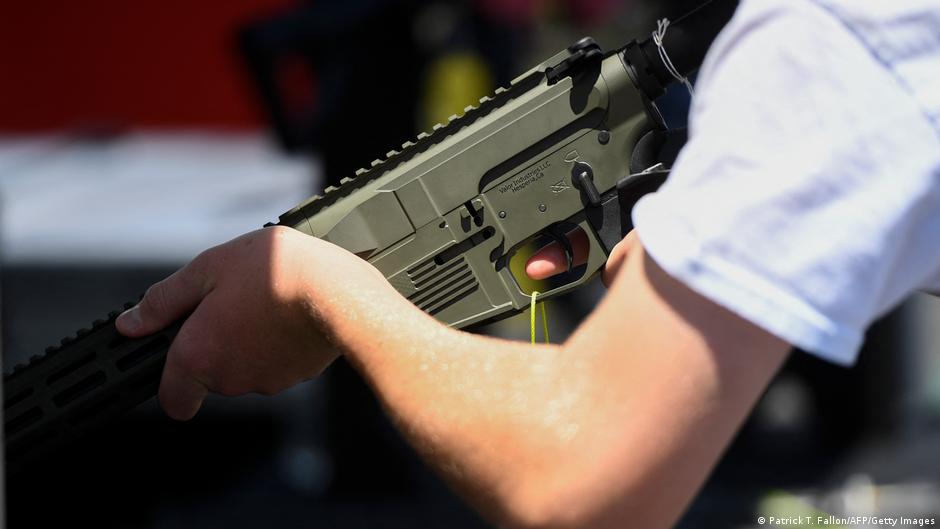
On an otherwise ordinary Thursday, a 14-year-old student entered a middle school in the southern city of Kahramanmaraş, opening fire in two classrooms, killing eight students and a teacher.
The shocking attack came two days after another school shooting in Siverek, Turkey’s Sanliurfa province, in which the gunman wounded 16 people before killing himself in a shootout with police.
Although such attacks often seem to appear suddenly, they are rarely spontaneous. Instead, mass shootings typically follow a narrative that involves routinely escalating complaints and missed opportunities to intervene.
What do we get wrong about mass shooters?
A shocking incident of violence like the one in Türkiye can emerge from anywhere. But experts say that this notion is misleading.
John Horgan, who directs the Violent Extremism Research Group at Georgia State University in the US, says the idea that attackers simply “nap” is one of the most persistent myths.
“That doesn’t happen,” he insisted. “There has always been a long history of trauma, grievances that grow over time, and major stressors such as rejection, or humiliation, which are the last straw in a turbulent life of pain, suffering and despair.”
Mental illness is not the primary factor
Another common misconception is that mental illness is the primary driver behind committing these atrocities. FBI consultant and San Diego Psychoanalytic Center faculty member, forensic psychologist J. Reed Malloy says this explanation is often too simplistic.
“Only a minority will be diagnosed with mental illness at the time of the attack,” he told DW. “In general, most targeted attacks are motivated by personal grievances – composed of elements of loss, insult, anger and blame – or personal grievances linked to extremist ideologies.”
According to James Densley, professor of criminology at Metro State University in Minnesota in the US, it is less a case of mental illness, and more a lack of “mental well-being” that causes personal distress.
“A crisis is not the same as a disease, and confusing the two stigmatizes millions of people who have nothing to do with it.”
When a personal grievance turns into public violence
For most people, feelings of rejection, failure, or humiliation subside at some point. But in some cases, they can become the center of a person’s identity.
“It starts with a wound, real or perceived,” Densley told DW. “Most people internalize that feeling and eventually move on. But some people get stuck. They keep thinking until that wound becomes their identity. At some point, that complaint becomes externalized, so it’s not that life hurt me, it’s that specific people did this to me, or that society did this to me, and someone has to pay.”
Horgan describes a similar trajectory—one that usually goes along with careful planning.
“Mass shooters do their homework,” he said. “They research their targets, they plan their strategy, and sometimes solicit feedback from fellow travelers online. The research also includes figuring out how to obtain weapons or materials to be used in an attack.”
From violent fantasy to reality
Even at this stage, most people will never actually act on their violent thoughts. The main question is why a small minority does this.
Horgan says that violent fantasies in themselves are not uncommon — and can even serve as a way of coping. The important thing is the decision to act on them.
“What differentiates those who engage in acts of public violence is their commitment to the imagination,” he said. “A commitment to make it real.”
Densley highlights another change that can occur in moments of crisis. “The catalyst is when a person, often suicidal, begins to identify with former attackers,” he said. “If they have access to a firearm, it’s the connection with others ‘just like them’ that crosses a psychological threshold – where dying and killing feel like the same act – that matters.”
Is it possible to prevent mass shootings?
The series of events points to a possible way to prevent such attacks, Densley said.
“In almost every case we studied, someone noticed something, a change in normal behavior. Whether it was a withdrawal from work or social life, or a strange social media post, or an attraction to guns that was new and intense. The warning signs were there.”
Horgan refers to such clues as “leakage” – the way attackers give away their intentions in advance through various warning behaviors.
“They may make jokes, or make threats, and coworkers are in an ideal position to witness that behavior,” she said. “The issue is not that people don’t see it. The point is that they fail to act on it. Some threats are literally word-for-word messages that explain what the attacker is going to do, but bystanders often don’t believe that the threats are real or credible.”
Meloy points to a key difference: “Targeted violence cannot be predicted because the base rate of such violence is so low,” he said. “However, it can be prevented.”
Why do people kill strangers?
Not all acts of mass violence follow the same pattern. While many attacks target strangers, others target people known to the killer.
“The most common targets of all violence are people known to the perpetrator,” Meloy said. “Targeted attacks on strangers do occur, but in a significant portion there will be a psychological or historical connection between the perpetrator and the targeted people or place.”
Densley says there is another important difference between private and public violence.
“When someone kills their own family, the victims are chosen based on who they are,” he said. “Large-scale public violence often reverses this. Victims are interchangeable.”
That change also changes the meaning of the Act. “It’s performative,” Densley said. “It’s about sending a message, to be seen and remembered. The psychology is closer to terrorism than domestic murder, even if there is no formal ideology involved.”
Edited by Derrick Williams