The study surpasses the 30% coding rate, a previous industry standard.
The threshold of qubits needed to commit Bitcoin would fall with this new paper.
Researchers from QuEra Computing, Harvard and MIT published a study on the arXiv website, a repository of preliminary scientific papers, which demonstrates a quantum coding rate greater than 50%: 2,304 physical qubits converted into 1,156 logical qubits.
This efficiency would reduce the number of physical qubits needed to build a computer capable of attack ciphers and cryptographic schemes such as those that protect Bitcoin and digital systems.
Physical qubits, which are the basic processing units of a quantum computer, constantly make errors due to their fragile nature. The solution is to group several of these physical qubits so that they “monitor” each other and can correct each other. This set is called qubit logical.
Historically, the problem has been the amount of physical components that need to be ‘sacrificed’ to consolidate a single logical qubit operational. A higher encoding rate allows you to optimize the hardware, achieving the same processing power with significantly less physical infrastructure.
According to the new paper shared on April 17, researchers identified new structural conditions that allow coding rates higher than 50% in hardware based on neutral atoms (a type of quantum processor that uses individual atoms suspended in a vacuum and controlled with lasers to store and process information).
The previous industry benchmark, according to the QuEra Computing, Harvard and MIT study, assumed rates of around 30%, which the study significantly exceeds, although the results are preliminary and have not completed peer review.
Implications for Bitcoin Cryptography
The team of the Qtonic Quantum company, a company in the sector, noted in his X account that a previous study by the Caltech Institute estimated that breaking the elliptic curve scheme or ECC (the cryptography upon which Bitcoin’s security is built) running Shor’s algorithm would require around 12,000 physical qubits and a 30% encryption rate.
Considering the new paperwhich achieved a rate of 50%, that threshold of physical qubits to break Bitcoin would fall, although Qtonic did not specify a figure. “The qubit floor for a cryptographically relevant quantum computer continues to fall”the company stated.
Within the ECC family, Bitcoin cryptography is based on the system called ECDSA (Elliptic Curve Digital Signature Algorithm) to protect the private keys with which users authorize transactions. This scheme is estimated to be potentially vulnerable to a sufficiently powerful quantum computer, although estimates of when this will be possible vary widely.
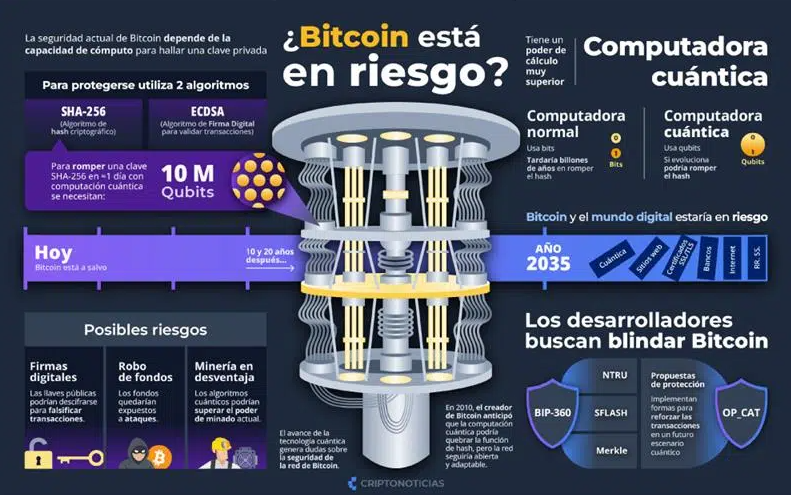
This new paper It joins a series of recent advances that compress that horizon. As reported by CriptoNoticias, Google Quantum AI published a report in which it reduced the quantum hardware necessary to achieve useful quantum computing in up to 20 times.
Likewise, the company Quantinuum revealed in a study that it achieved a 2:1 ratio for the construction of logical qubits from physical ones, marking a record never before achieved.
While none of these advances indicate that ‘Q-Day’, the day in which a quantum computer can compromise current systems, is imminent, the trend is consistent: each new paper ensures lowering the threshold.