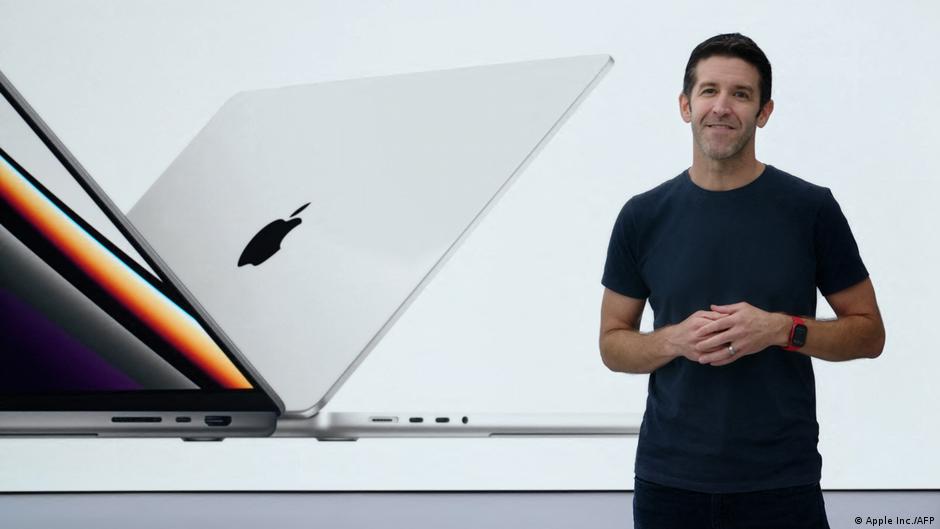
Just weeks after Apple’s 50th anniversary, the US technology giant announced on Monday that its CEO Tim Cook will step down in September, to be replaced by hardware engineer John Ternes.
Turnus will be stepping into some of the biggest shoes in corporate America. Cook is credited with building Apple into a $350 billion (€298 billion) company when it started at a valuation of more than $4 trillion today.
Ternus has acquired a tech giant that will need to maintain its premium edge – the iPhone recently reclaimed the crown of the world’s most popular smartphone by sales – while increasing the emphasis on artificial intelligence (AI).
At the same time, Apple faces intense competition, regulatory pressure and supply-chain challenges as it searches for the next phase of expansion beyond the iPhone.
In a media statement, Ternes said he was “very grateful” for the chance to lead Apple, adding that he was “full of optimism about what we can accomplish in the coming years.”
Who is John Ternes?
Instead of a designer focused on flashy aesthetics, Apple has turned to a hands-on engineering leader to guide the company in its next chapter of growth.
Turnus has spent more than a decade leading the engineering teams behind Apple’s core products – iPhone, iPad and Mac – while driving the development and launch of new categories including Apple Watch, AirPods and the Vision Pro headset. Although the latter disappointed, the first two soon became major hits for the company.
A quiet hardware expert, Turnus played a central role in Apple’s shift to designing its own chips rather than relying on outside suppliers like Intel. These chips are the small but powerful “brains” inside each device.
By building its own, Apple could make iPhones, Macs and other products run faster, use less battery and work more smoothly with its iOS software, helping the tech giant stand out in an increasingly crowded market and protect its premium margins.
Ternes joined Apple on the product design team in 2001 after working as a mechanical engineer at Virtual Research Systems, an early pioneer of virtual reality headsets. At Apple, he became vice president of hardware engineering in 2013 and senior vice president in 2021.
He holds a bachelor’s degree in mechanical engineering from the University of Pennsylvania.
Ternes is 50, the same age Cook was when he took over from Apple co-founder and visionary Steve Jobs.
Why should Turnus help Apple conquer AI?
Apple continues strong growth, yet it lags rivals in AI, a technology expected to change how people interact with their devices.
Rivals like Google, Microsoft, and OpenAI have launched more advanced generative AI chatbots. The iPhone maker’s upgrade to its own AI platform, Apple Intelligence, as well as the long-awaited overhaul of voice assistant Siri, have faced delays and have had to partially rely on other platforms like ChatGPT.
To catch up, Apple needs to make Siri smarter and more natural, so that it is able to handle complex requests easily and reliably. It also needs to build useful new AI features that work seamlessly into its devices, while taking full advantage of the powerful chips it designs.
Apple will also need to turn those AI capabilities into reasons for customers to buy new devices and pay for additional services, while creating new products like smart glasses, foldables or robotics that feel genuinely useful rather than experimental.
Ternus is a strong proponent of AI and, according to Bloomberg, recently reshaped its hardware engineering division around a new AI platform designed to help improve product development and device quality.
He’s also overseeing a new lineup of devices ranging from smart AirPods and glasses to camera pendants and new smart home products like facial-recognition screens, tabletop robots and security cameras.
What other challenges does Apple face?
Apple will also have to deal with slowing iPhone sales in key markets, particularly China, where local rivals like Huawei and Xiaomi have gained ground with attractive high-end phones, aggressive pricing and strong appeal among buyers who prefer domestic brands.
It also faces ongoing regulatory pressures in the United States – its largest market – and Europe, which could force changes to its app store, app payments and ecosystem rules, potentially impacting services revenue.
Supply-chain diversification away from China remains another long-term priority amid geopolitical tensions and potential new US tariffs. Apple has moved some production to India and Vietnam to reduce risk from trade disputes, but this has increased production costs.
Cook built unusually close ties with Chinese officials and suppliers over the years through frequent visits and public praise of local partners.
Ternus will need to maintain those relationships to protect sales and manufacturing in Apple’s second-largest market.
What has been the reaction to the Turnus promotion?
Apple’s stock fell slightly upon the announcement of the change at the top, as investors were aware that Apple had a succession plan in place.
However, the timing was a “surprise” to Dan Ives, head of global technology research at Wedbush Securities, as Cook had expected to remain CEO for another year.
“These are big, big shoes to fill,” Ives told US business channel CNBC, comparing Cook to Tesla chief Elon Musk and Microsoft CEO Satya Nadella.
Ives stressed the need for Turnus to prioritize Apple’s AI strategy, saying that Apple’s success would not be measured by new technology, but “how you monetize 2.5 billion iOS devices when it comes to AI.”
Analysts at Deepwater Asset Management believe Turnus “has been viewed as a credible successor for some time,” noting that he inherits one of Apple’s greatest assets: its culture.
“Turnus, after 25 years at Apple, is in a great position to lead this forward. Staying true to Apple’s culture should allow Apple to pursue AI more aggressively without compromising quality.
Chris Dever, who previously worked in Apple’s human resources department, described Turnus as a “profound ally”. wall street journal That “having a great product leader at the helm right now is a good future indicator for Apple.”
Edited by: Srinivas Majumdaru