
The USDC pool on Aave has been at 99.87% utilization for four days, with less than USD 3M available.
Some USD 300M in new loans were taken out after the hack by users trying to exit.
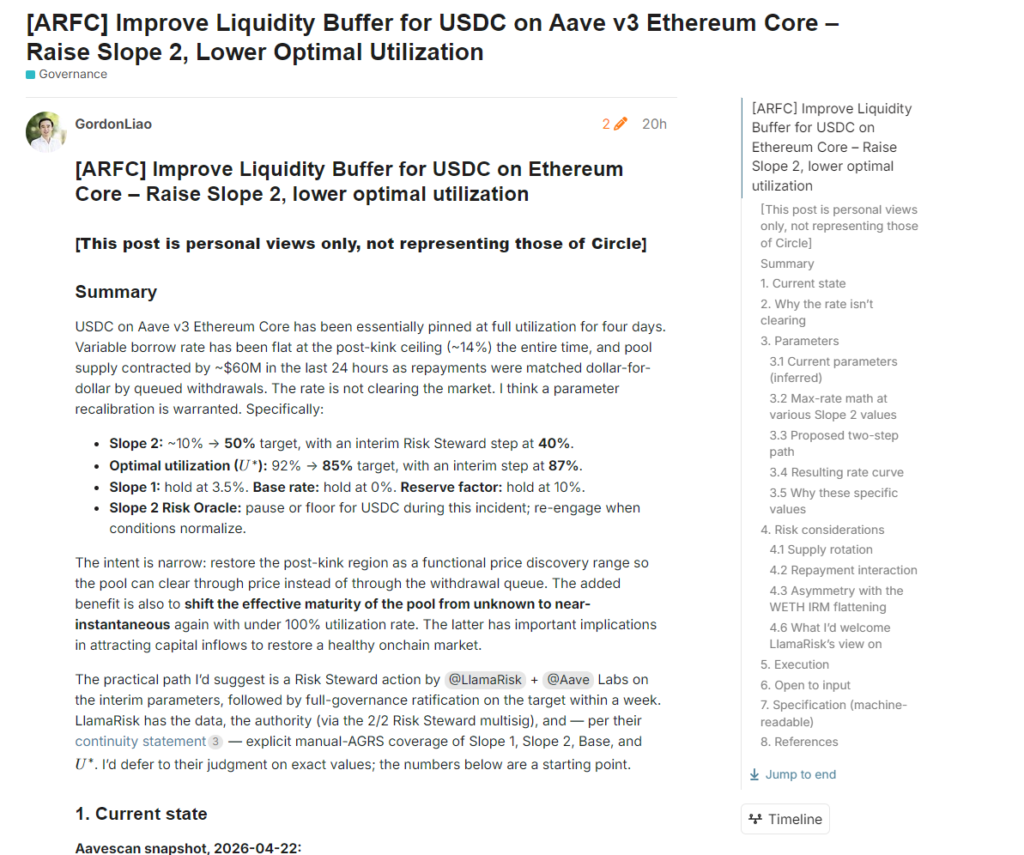
Circle presented an emergency proposal on Aave’s governance forum on April 22 to modify the interest rate parameters of the USDC pool, which has been paralyzed for four days with 99.87% utilization and less than $3 million available for withdrawals.
The measure seeks to unlock USD 1.9 billion in USDC trapped as a result of the Kelp DAO hack on April 18.
The reason why Aave was affected has to do with the fact that rsETH, issued by Kelp DAO, was accepted on this platform as collateral to borrow assets such as WETH or USDC. After the Kelp DAO bridge hack, that support disappeared, leaving Aave with real loans without effective collateral and generating bad debt, causing massive withdrawals from other users and causing loan pools, such as USDC, to be full, with loans that cannot be returned.
The proposal, signed by Gordon Liao, chief economist at Circle, proposes raising the parameter slope 2 from current 10% to 50%. He slope 2 defines how quickly the interest rate rises when the pool exceeds its optimal level of use: with the current value, the maximum rate that the pool can reach is 14% per year; With the proposed change, it would reach 53.5%. The proposal also contemplates lowering the optimal pool utilization from 92% to 85%.
The logic is that the current 14% is not enough to attract external depositors while the pool is frozen. An investor with USD 100,000 in USDC today receives about USD 12,000 annually, but without being able to withdraw whenever he wants. With rates close to 48%, That same capital would generate USD 48,000 per year —about USD 4,000 per month—, a return that justifies taking on the risk of temporary illiquidity.
If new depositors enter, attracted by that rate, the pool fills with fresh USDC, utilization drops below 100%, and those who were trapped can withdraw. The pool accumulates USD 1.89 billion in deposits against USD 1.89 billion in loans, and has contracted about USD 60 million in the last 24 hours, as repayments are immediately absorbed by queued withdrawals.
The proposal contemplates a first step via Risk Steward—rapid decision mechanism— followed by full governance ratification in five to seven days.
The measure has, however, a counterpart: anyone who has an active loan in USDC would also see their rate rise, from 14% to up to 53.5% as long as the pool remains saturated. The proposal assumes that these debtors are already in an emergency situation due to the hacking and are not going to repay the price of the credit. As soon as new capital arrives and utilization goes down, rates would automatically fall to normal levelsclose to 3% or 4%.
The hack that unleashed the crisis
The trigger was on April 18, when an attacker breached KelpDAO’s interchain bridge via a flaw in LayerZero’s messaging infrastructure, draining 116,500 rsETH—18% of the circulating supply—worth $292 million, the largest DeFi hack of 2026.
In the subsequent 24 hours, large holders withdrew more than $6 billion from Aave, pushing major pools to 100% utilization and leaving remaining depositors trapped. Blocked users then took out nearly USD 300 million in loanss against their own stable deposits, assuming losses, to try to exit the protocol through alternative means.
If the proposal is not approved or fails to attract new capital, Aave faces the risk that the pool contraction will continue indefinitely, deepening the flight of users to competing protocols that are already capitalizing on the void.