
James O’Beirne, developer of Bitcoin Core, believes that the key was not decrypted.
Alex Pruden, CEO of Project Eleven, dismissed criticism about the experiment.
The validity of an experiment that violated a key with 15-bit elliptic curve encryption (ECC) using quantum computing was questioned by James O’Beirne, developer of Bitcoin Core, who described the procedure carried out by researcher Giancarlo Lelli as a hoax.
The specialist assured this April 24 that the achievement awarded by the Project Eleven firm with 1 BTC does not represent a real technological advance or a breach of network security. Instead, it was a manipulation of pre-computed data on a reduced-scale ECC family key (with significantly fewer bits than the 256 bits used by Bitcoin), which has no impact on the integrity of current cryptography.
The promoting company presented the event as the largest public demonstration to date of the type of attack that threatens Bitcoin, Ethereum and more than 2.5 trillion dollars in assets, as reported by CriptoNoticias.
However, O’Beirne refuted this premise considering that the search space of 32,767 possibilities is insignificant for current technology.
O’Beirne’s main allegation centers on the researcher using classical computers—conventional computers like the ones we use every day—to solve the problem before using quantum equipment. The developer questioned the integrity of the process, asking, “How are you guys so gullible? “Like every other ‘application’ of Shor to date, this involves classical precomputation that encodes the solution to the problem into the quantum circuit itself.”
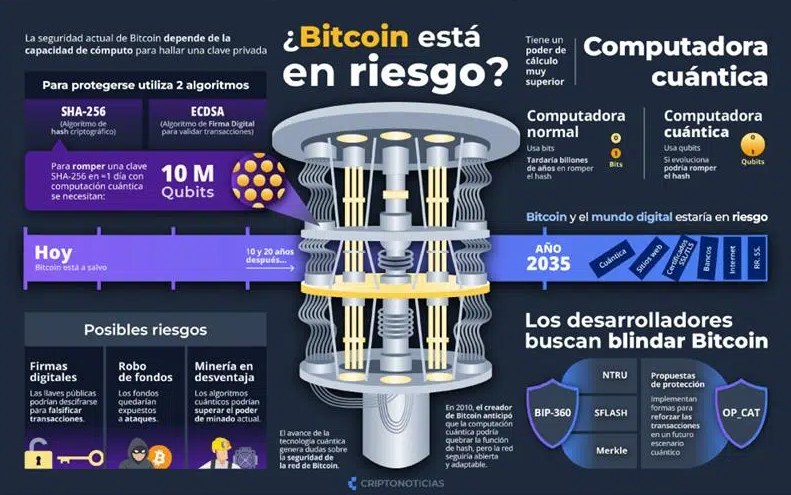
In technical terms, Shor’s Algorithm is the formula capable of violating the cryptography that protects Bitcoin. For this to be legitimate, the quantum computer must find the solution autonomously. However, O’Beirne maintains that The researcher designed the circuit so that it already contained the necessary cluesstating that “the response was already loaded into the system before we started.” Therefore, he insists that Lelli simply programmed the processor to “spit out an answer that he already knew.”
Even on social network marked with a community note which strips the experiment of its disruptive nature: «The method used to recover the 15-bit ECC key is based on the classical verification of results indistinguishable from random noise, which is equivalent to a classical guess. “While quantum threats are advancing, this does not demonstrate effective key breaking using quantum computing.”
Project Eleven defends itself against criticism
Faced with these criticisms, Alex Pruden, CEO of Project Eleven, a firm specialized in post-quantum security for digital assets, admitted the dependence on traditional methods but defended their relevance.
Pruden challenged the critics’ stance by asking, “You do realize that Shor’s algorithm, at any scale, depends on classical pre- and post-processing, right?” According to the executive, although the technique used is “not scalable” to larger keys, “that does not make it less quantum” nor does it detract from the demonstration.
This technical showdown leaves an open question about the proximity of a real crypto crisis. On the one hand, the industry is cautiously watching whether this experiment constitutes genuine progress toward Q-Day—the theoretical moment when quantum computing manages to breach global networks. On the other hand, suspicion arises of Whether this is simply a post-quantum security marketing ploybased on methods that, due to their lack of scalability and dependence on traditional calculations, do not represent a real threat to the robustness of Bitcoin in its current state.