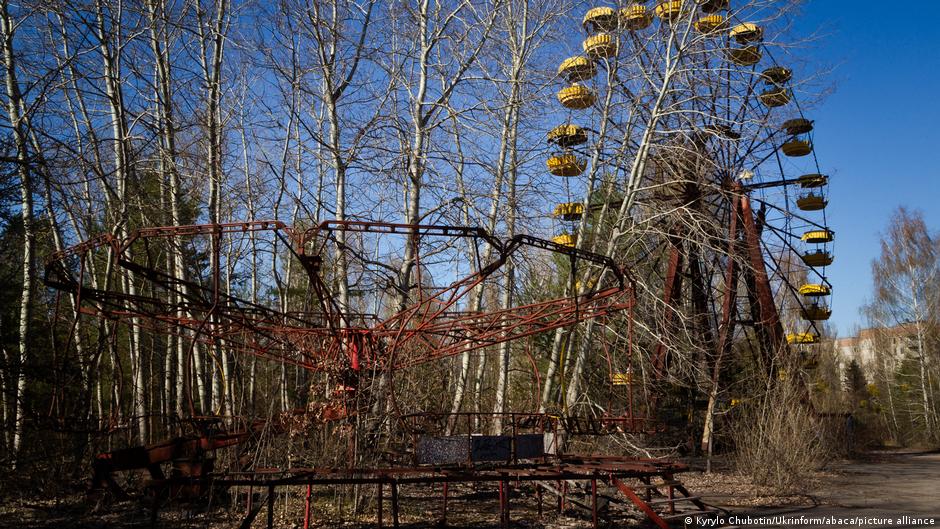
Abandoned vehicles turn red on the roadside. Children’s toys, remains of household appliances, crockery and faded signs in Russian warning about radioactivity levels are scattered across the front of the apartment block. The buildings are empty, the windows are broken, the doors are open.
Forty years ago, the Ukrainian city of Pripyat, also known as “Atomgrad”, was the pride of the Soviet nuclear power industry. The future looked promising. Pripyat was just 3 kilometers (2 mi) from the Chernobyl nuclear power plant, which the leadership of the then Soviet Union (USSR) had planned to build as the largest of its kind. It would have a total of 12 reactors, and Pripyat was where the workers and their families lived.
When reactor 4 exploded on April 26, 1986, the city had existed for only 16 years. Pripyat was composed of 160 buildings, containing 13,500 apartments, 15 kindergartens and five schools.
‘We didn’t know what the consequences would be’
Even after forty years the buildings are in dilapidated condition. Trees, bushes and vines have been taken over. Volodymyr Voroby leads a DW reporter through the forest.
“Here is Lesya Ukrainka Street, and our house, number 18A, is where I lived with my parents and elder brother on the ground floor,” says the 58-year-old. The staircase is large, with large doors, wide stairs and corridors.
The door to Voroby’s former apartment is open. He goes straight to his bedroom and picks up a record from the trash on the floor. It reminds him of the music his family listened to at that time. He also remembers how much he missed those fashionable new sneakers that he had forgotten and left in the closet when they were emptied.
We go out to the balcony. Worobey says, “That was my chair, with the padded foam seat. There was a lamp here… I read a lot of books here! We used to keep preserved objects under this cover, it was very practical.”
In the dark apartment corridor, we turn on the flashlights of our cellphones. Woroby looked at some shoes and said, “They were mine. They were given to us at the vocational college.”
A sign bearing the names of all the neighbors still hangs at the entrance to the block. Worobey doesn’t know what happened to him after he was fired. He never saw any of them again.
Worobey was 18 years old in April 1986. He was working as an electrician for a state company, and the day before the accident he was laying electrical wires in reactor block 4. This was the reactor in which the explosion occurred.
Voroby did not hear the explosion, and the next morning he tried to go to work as usual, but the buses did not come. He and a friend headed towards the power plant, and when they reached there they saw the building in ruins. Worobey says, “Then we didn’t know what had happened, or exactly where it had happened. It wasn’t the smoke that was affecting us, but the heat. It was like a river of heat rising into the sky.” “A man came on a bike and told us it was dangerous to stay here. So we went home.”
It was not until the evening that he heard from his brother, who worked at the power plant, about the accident and the impending evacuation. “At first we thought it would just take a few days,” recalls Worobey. His family left Pripyat on the evening of 26 April in a packed train. “From the train window we could see the ruined Reactor 4. We didn’t think about it then; we didn’t know what the consequences of this accident would be, or that we would never return home.”
‘Atomics should be workers, not soldiers’
We walk through the center of Pripyat to the Prometheus movie theater. It was here that Volodymyr Voroby used to hang out with friends. Fallen beams have blocked the entrance to the movie theater’s main stage. On the wall of a room opposite hang faded photographs of long-forgotten Communist Party masters.
In the center of Pripyat, Soviet symbols are everywhere. Symbols of Soviet Ukraine still decorate the roofs of two apartment blocks, and on another huge metal letters read: “The atomist must be a worker, not a soldier.”
Voroby says that the entire Soviet nuclear power was predicated on this idea. In universities and institutes, in the training given to workers at the power plant – everyone was always told that the nuclear energy of the USSR is the safest in the world. No one could ever imagine that a reactor could explode. Worobey says, “We were told that a radiation accident was not possible. Precautionary measures were taken to cover every situation, and everything was carefully calculated. It never occurred to us that an accident could happen.”
That was why most residents of Pripyat and Chernobyl, including power plant workers, knew nothing about the real dangers to health and the environment. They certainly didn’t know the extent of the radioactive contamination, says Worobey. “Anyone who knew anything provided very little information. These were still Soviet times. One careless word could ruin your career.”
Was a culture of obedience partly to blame for the disaster?
Worobey wonders whether the Chernobyl disaster would not have occurred if the authoritarian Soviet leadership style had not also existed in the nuclear industry. In addition, a similar accident at the Leningrad Nuclear Power Plant in 1975 was suppressed.
A year after the disaster, Voroby was called up for military service. Later, he studied engineering and moved to Slavutych. This city was built on the site of Pripyat. From there, he went to the Chernobyl power plant every day, and worked his way up from mechanic to foreman. He headed the Department of Thermal Automation and Metrology for 11 years.
No electricity has been produced at Chernobyl since 2000, but decommissioning of the power plant continues today. There are now facilities on site to enable the safe removal of radioactive fuel and the processing of radioactive waste. A new protective enclosure, the New Safe Confinement, was placed over the exploded Reactor 4 and a hastily constructed concrete “sarcophagus” was constructed to contain it in 1986. Barely six years after completion, this protective shield was damaged in a Russian drone strike in February 2025, and is now said to have lost its primary confinement capability.
‘History may have taken a different path’
Before the full-scale Russian invasion of Ukraine in February 2022, tourists were able to visit Pripyat’s Ferris wheel, familiar throughout the world as a symbol of the deserted city, on organized tours of the exclusion zone. It never came into operation, as the official inauguration was scheduled for May 1, 1986 – International Workers’ Day. Volodymyr Voroby smiles, “Don’t believe the story that no one has ever been on it. Students from my vocational college, including me, were used as test subjects. So I’ve been on it.”
He admits that he still does not know what dose of radiation he was exposed to in 1986. “You can apply for a certificate that tells you that, but I don’t want that.” How much did the nuclear disaster change their lives? He says that at the age of 18, he did not have any specific plans yet. Now, however, looking back at events 40 years later, he feels: “As if in those days everyone was moving in one direction, but suddenly turned and went a different path.” That’s why, he says, “If the Chernobyl disaster had not happened, the history of the world and Ukraine would have taken a different direction.”
This article was originally written in Ukrainian.
Edited by: Katherine Shear and Wesley Dockery