
Open interest increases, reflecting greater use of leverage in the market.
This market behavior increases the volatility in the price of bitcoin.
The CEO of CryptoQuant, Ki Young Ju, explained in the early hours of today, April 27, 2026, that the behavior of bitcoin (BTC) was being driven by the futures market, in a context where real demand does not accompany the price movement.
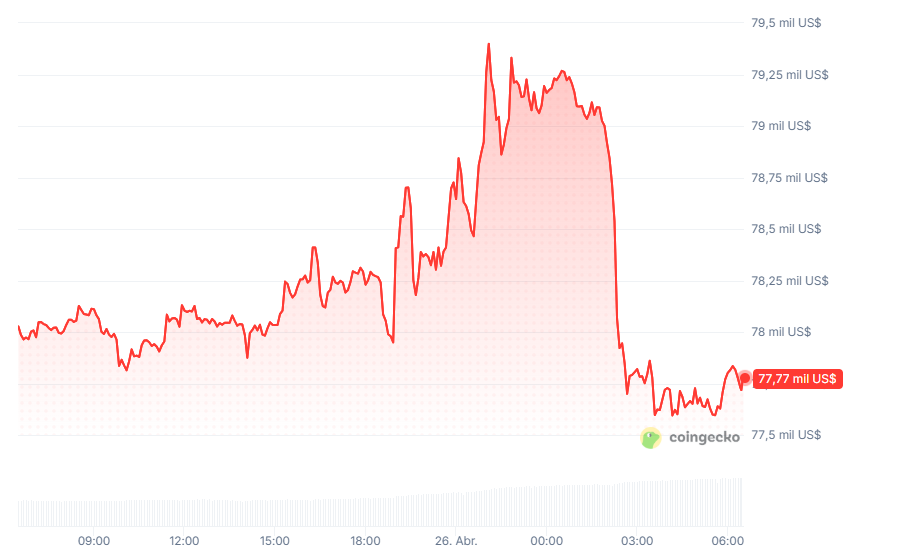
While the businessman and analyst was writing that, the price of the digital currency was approaching USD 79,000, but then had a rapid fall to the current 77,700.
The following graph shows how the price movements of bitcoin have been during the last 24 hours.
In his most recent analysis, Ki Young Ju express: “Open interest is rising, but apparent on-chain demand remains net negative, despite exchange-traded fund (ETF) flows and Saylor purchases.”
The warning comes after several days marked by institutional purchases. As CriptoNoticias reported at the end of April, BTC spot ETFs in the United States recorded nine consecutive days of capital inflows between April 14 and 24, for a total of $2,114 million. For its part, Strategy, the company led by Michael Saylor, bought 34,164 BTC that same week and raised its treasury to 815,061 BTC.
However, for Ki Young Ju, these flows are not enough to validate a sustained recovery if apparent chain demand remains in negative territory. In other words, although ETFs and Strategy provide institutional buying pressure, The market has not yet shown a simultaneous recovery between spot demand (spot) wide and activity in futuresa condition that has historically marked the end of bearish cycles.
The analysis is based on a graph that compares the evolution of the price of bitcoin with futures demand and spot demand in a cumulative 30-day window.
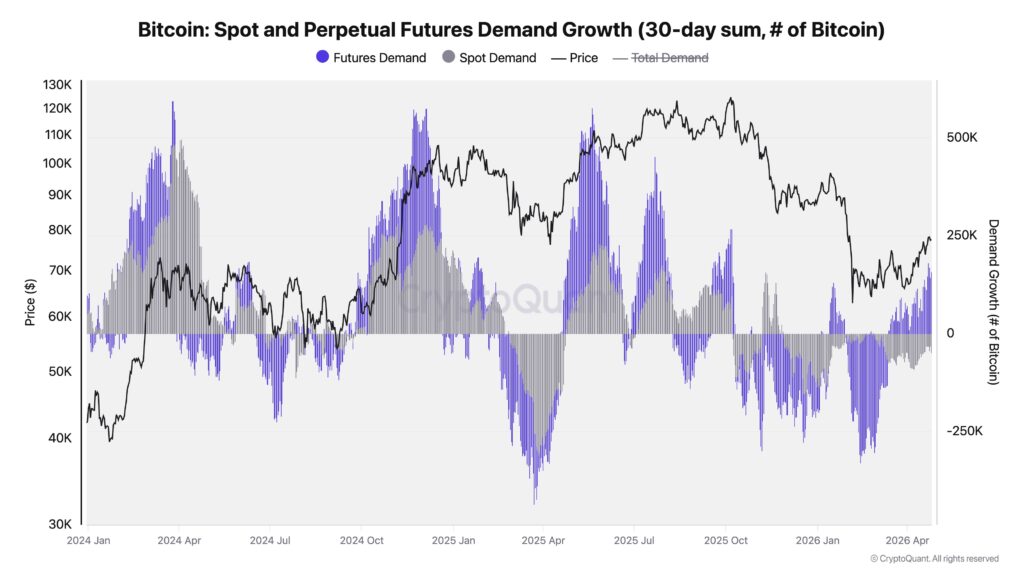
In that graph, the black line represents the price of the digital asset, while the blue bars correspond to futures demand and the gray bars reflect spot demand.
This reading shows a clear divergence in the most recent sections. The blue bars (futures) move into positive territory, indicating an increase in derivatives activity and the use of leverage. Instead, the gray bars (spot) remain weak or at negative values, suggesting that there is no equivalent buying pressure in the spot market.
This imbalance implies that the price movement would be sustained by speculative positions rather than by organic demand for the digital asset. In this context, the growth of open interest (key indicator of the futures market) reinforces the idea that there is more capital exposed in derivatives, but not necessarily backed by actual purchases.
For the CEO of CryptoQuant, this type of behavior has already been observed in previous cycles. “Historically, bear markets end when both spot and futures demand recover,” he explained, referring to patterns observed in previous cycles such as those of 2018 and 2022.
The warning introduces doubts about the solidity of the current scenario. If spot demand does not keep up, the market could be more exposed to episodes of volatility, especially in the face of liquidations in leveraged positions.
In that sense, the evolution of BTC in the short term will depend on whether real demand manages to align with the growth of derivatives. Otherwise, futures-based momentum could prove insufficient to sustain a consistent uptrend.