
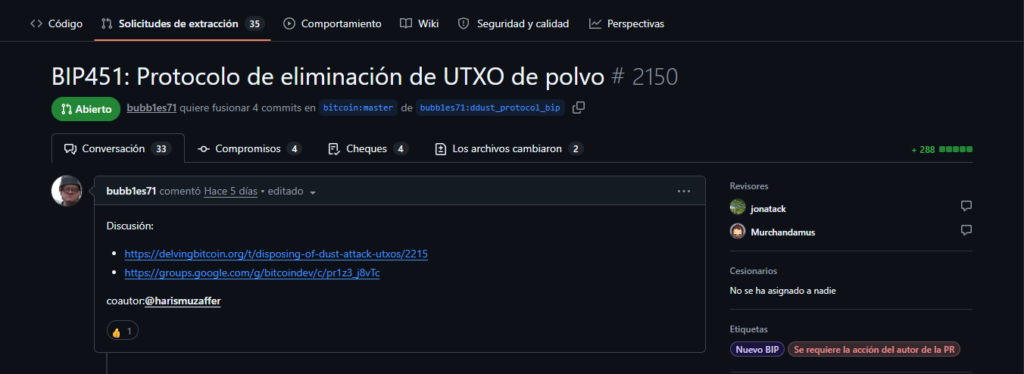
The BIP-451 proposal was incorporated into the official Bitcoin repository and received an identifier number on April 28. Its author, the developer known as “bubb1es”, defines in his initiative a standard protocol for wallets to permanently eliminate dust funds (dustin English) created by privacy sniffing attacks.
A dust attack occurs when a malicious actor sends minimal amounts of bitcoin (called dust, because they are so small that they barely cover the fee for a transaction). to addresses you want to track. If the user spends that dust along with other own funds, he unintentionally reveals that Those addresses belong to the same walletdestroying the separation he sought to maintain.
While modern wallets solve the problem by blocking those funds so they are never spent, according to the BIP-451 proposal, that solution is incomplete. This, because the blocked funds remain on record in Bitcoin’s set of unspent outputs (UTXO), a list that all nodes in the network must keep updated to validate transactions. Every dust UTXO that accumulates without being removed bloats that list, increasing the memory and storage requirements of the nodes that support the network.
Additionally, according to the creator of BIP-451, future risks are not limited to the size of the network. A software update, key reset, or migration to another wallet could accidentally unlock those funds. An heir who does not know the origin of the dust could spend them without knowing that it compromises the privacy of the wallet.
BIP-451 proposes removing them instead of blocking them. According to the document, the mechanism consists of constructing a transaction that spends the dust UTXO using its entire amount as a network fee, without transferring value to any address.
The output of that transaction is an OP_RETURN, a type of instruction in Bitcoin that explicitly marks that there is no recipient. The result is that the UTXO disappears from the chain permanently, without revealing links between addresses.
The viability of this mechanism was enabled by the reduction of the minimum retransmission fee introduced in Bitcoin Core 30, which dropped to 0.1 satoshis per virtual byte (sat/vB), which allows very small amounts to be enough to cover the commission of a delete transaction.
The risks that the developer himself recognizes
According to him document According to BIP-451, the implementation of the protocol in wallets has four specific risks:
First, if only one or a few wallets adopt it, deletion transactions create a digital footprint that identifies its users, the opposite problem of the one it seeks to solve. Second, if a wallet transmits multiple delete transactions at the same time, that could reveal that they all belong to the same user.
Third, if network fees rise, those transactions could remain unconfirmed and need to be retransmitted when commissions go down.
Finally, and fourthly, the process of signing deletion transactions could be confusing or uncomfortable for users of wallets with multiple signers or hardware signing devices.
The practical usefulness of BIP-451 will ultimately depend on how many wallets adopt it, while its incorporation into the official Bitcoin repository marks the beginning of the debate on its implementation or not.