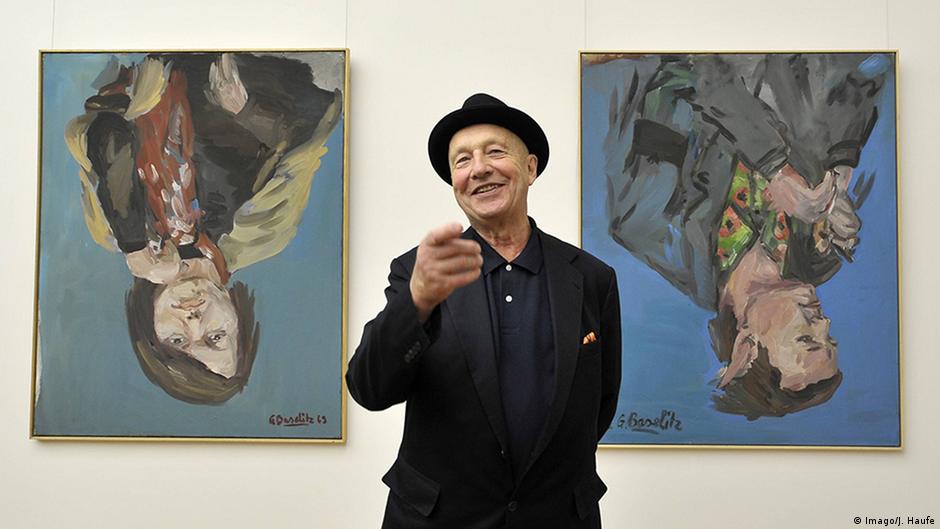
Throughout his life, the internationally renowned East German-born artist defied conventions: Georg Baselitz, renowned for his expressive, figurative paintings and sculptures, died on April 30 at the age of 88.
When a young and rising artist is kicked out of the Academy of Arts, it can either mean an early end to their career or the beginning of a life on the world stage. The latter happened to Georg Baselitz.
In 1956, Hans-Georg Bruno Kern moved from his hometown, Deutschbaselitz in the state of Saxony, to East Berlin to study art. But his career as an art student was short-lived because the 18-year-old refused to work at an industrial site in Rostock – a job that was expected of students in the former communist East Germany. He decided that he would like to paint in the style of Pablo Picasso.
At that time, he was able to travel from East to West Berlin – the Berlin Wall was not built until 1961 – where he became acquainted with the abstract art movement that was prevalent in the German art world at the time. However, rather than follow that artistic style, Baselitz turned to expressive realism.
In 1961, he chose a pseudonym and courted controversy once again with paintings that did not fit into the conservative traditions of the time. “During this time, I was a stubborn, unruly and strange man who rejected everything,” Baselitz told his friend Bianca Jagger in a 2014 interview. Interview magazine.
Two of his paintings, “The Naked Man” and “The Big Night Down the Drain”, sparked a scandal in 1963 and were confiscated as a result. Two gallery owners based in Baselitz and Berlin had to testify before the Berlin State Court and then the Federal Court for presenting obscene material. Both paintings depict a figure with a giant penis, which to some viewers suggests masturbation. Ultimately the trial was suspended.
It is unclear whether the scandal was promoted by Michael Werner, a gallery owner said to have encouraged sensational reports of the issue, which resulted in the works being seized. Whether the allegations were true or not, Werner became an important player in Germany’s art market, and Baselitz suddenly managed to sell his paintings.
Baselitz had by then established his image as a rising rebel, a reputation that followed him throughout his life. She also promoted the image by making controversial statements, for example arguing that women cannot paint, which is why prices for her works remain low on the art market, and calling the Documenta international contemporary art exhibition a “Paralympics”. Such controversial comments helped maintain his maverick reputation – but as an irritating sexist.
young and fashionable
In 2015, in protest against the planned revision of German law on the protection of cultural objects, Baselitz withdrew works loaned to German museums. That law was later relaxed, stating that entire museum collections were no longer allowed to be exported, which meant that artists, collectors, gallery owners and auction houses were only allowed to sell artworks in Germany.
Baselitz’s opposition was understandable as his works sold for hundreds of thousands of euros around the world, with some older works going for more than €1 million ($1.17 million). “I want to stay in fashion, stay young,” he told Germany. mirror News magazine in 2013. In 2025, he was ranked third in the German Kunstkompas art ranking of the most important contemporary living artists.
His habit of frequently reinventing himself and his art contributed greatly to Baselitz’s fame.
In the mid-1960s, Baselitz created approximately 60 paintings known as “Heroes” within a very short period of time. Baselitz told Jagger in a 2014 interview that he was “misundertaking” 30 of these paintings because he was tired of the boring images. For him, the paintings were like a complete biographical work.
What happened next made them world famous and unique: Baselitz conceived the works as inverted paintings.
He said, “Now I didn’t have to invent monstrous things. I could just take a picture of an apple tree or an eagle and paint in a realistic, conservative style.” “By turning the images upside down, it was no longer necessary to apply pressure to the painting.” Thus they changed the viewing habits of the public, sharpened perceptions and made people wonder: Is everything in the right place? And what is it all about?
Even though the rebel artist has had a powerful influence on Neo-Expressionist painters around the world, particularly through his paintings confronting the horrors of World War II, he underestimated his impact on society: “The idea of changing or improving the world is alien to me and seems ridiculous,” he once said. “Society works without the artist, and always has. No artist has ever changed anything, for better or worse.”
This article was translated from German.