
In the first stage, the end user will not see immediate operational improvements.
In the medium term, possibilities for improving service open up.
May 4, 2026 will be marked in the financial history books as the day that remittance giant Western Union decided it did not want to end up in the graveyard of companies that ignored the future, with Blockbuster as a popular and recent example.
That day, the 175-year-old company launched its stablecoin, US Dollar Payment Token (USDPT), on the Solana network.
To understand the reason for this launch and why it would be the company’s salvation, you must first look at the real numbers.
Western Union’s Adjusted Operating Margin fell from 19-20% recorded in recent quarters to just 13% in the first quarter of 2026.
Adjusted earnings per share fell to $0.25, down from $0.41 in the year-earlier period.
The core transfer business, which represents 86% of its total revenue, recorded 6% declines in revenue compared to last year.
In summary, although Western Union is not in free fall, it is being pressured by fintechs, neobanks and cryptocurrencies.
This pressure has a structural cause: remittances through traditional monetary rails They cost about 6% of the money sentaccording to the World Bank.
To stay relevant, Western Union subsidizes commissions in some countries. For example, the cost of sending money from the United States to Argentina with Western Union, according to its website, is similar (and may even be slightly more convenient) to sending USDT and exchanging it for pesos at a local exchange.
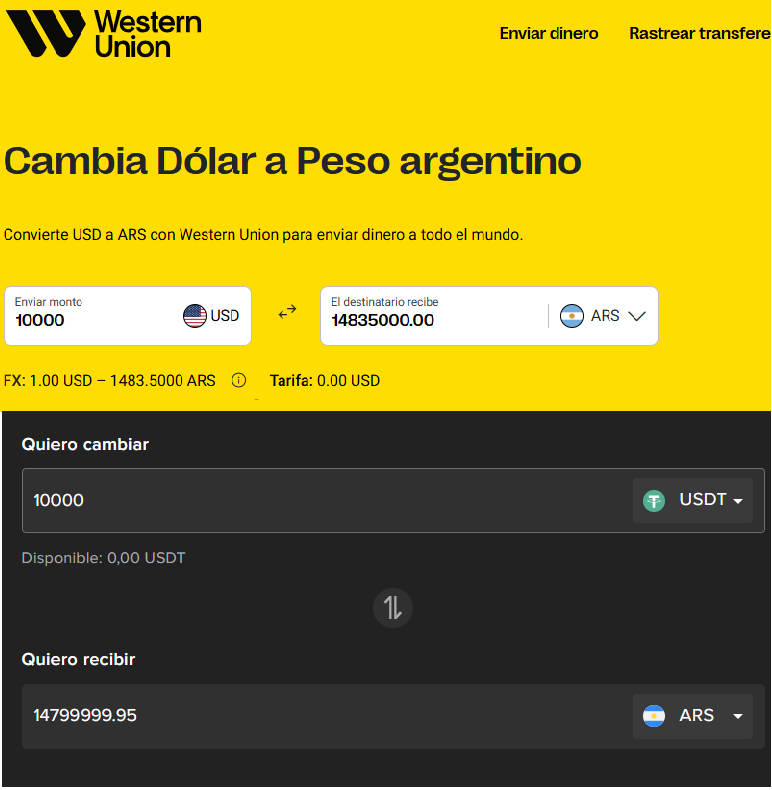
This means that the company, in many places, is cutting profit margins to avoid losing customers. The result: you earn less per transaction (as shown by the aforementioned financial statements) and still lose ground.
Hence the urgency of the May 4 movement. What USDPT promises to change first It’s not the average customer experience at the counter.but the invisible pipe that makes the system work underneath, with the goal of Western Union remaining a profitable company.
It is worth clarifying that, in other places, Western Union does not subsidize shipments and charges a commission ranging from 0.5 to 4% of the total amount of money sent.
The first beneficiary of this movement is the company itself.
CEO Devin McGranahan it was explicit on the Q1 2026 earnings call: The initial launch will not be consumer-facing, but rather as an alternative to the SWIFT interbank network that Western Union uses today to settle transactions with its agents.
In other words, The first beneficiary of the savings is not the one who sends money to his family in Colombia or Venezuela. It’s Western Union itself.
And here something appears that should be pointed out. Just because a company reduces its operating costs does not mean that those savings reach the customer immediately.
The history of the financial sector is full of technological efficiencies that remained on corporate balance sheets without moving rates to the public a single cent. For example, CriptoNoticias has reported that Visa and Mastercard use payment rails with cryptocurrencies, without this meaning a reduction in costs for end users.
Venezuelan specialist Aníbal Garrido, director of the Blockchain, Trading and Crypto (BT&C) Academy at the Andrés Bello Catholic University (UCAB), points out that Western Union is trying to save its business in the face of the advance of fintech and stablecoins, which already operate 24/7.
«I don’t think it is an innovation, it is rather a competitive expression. Western Union is seeing how its traditional business is eroded and is launching its asset along the same paths as what is now displacing its model. It will use blockchains to make what it already has more efficient, which is its global distribution. “It is the total validation of a model,” said Garrido in dialogue with this information portal.
In any case, it would be unfair to be left alone with skepticism, because the plan has genuinely interesting elements for the end user, in the medium term.
One of these elements is that by removing reliance on SWIFT’s own banking hours and one- or two-day settlement times, Western Union could enable near-instant payments, available 24/7.
And the plan goes even further in time: Western Union is preparing a card that will allow payments with stablecoins (probably with USDPT) during 2026.
We are living a MWUGA (“Make Western Union Great Again”) moment
In summary, paraphrasing the slogan Donald Trump’s campaign, the launch of USDPT in Solana could “make Western Union great again.”
blockbuster had the opportunity to buy Netflix for 50 million dollars in 2000. He did not take it, not because of lack of money, but because of corporate arrogance. Western Union isn’t making that mistake: it’s embracing technology, and that deserves recognition.
But There is an important difference between adopting Solana (or any other cryptocurrency) to survive and use it to serve better. In the coming months we will see if Western Union takes the step to improve service that its users are waiting for.
Disclaimer: The views and opinions expressed in this article belong to its author and do not necessarily reflect those of CriptoNoticias. The author’s opinion is for informational purposes and under no circumstances constitutes an investment recommendation or financial advice.