
USD 547 billion is secured in the Ethereum ecosystem.
In digital finance, Ethereum will be “indispensable for institutions,” says CoinShares.
Ethereum, a network founded on July 30, 2015, has been around for more than 10 years. With the price of its cryptocurrency, ether (ETH) at more than $2,000, some investors might think that it is too late to enter this market.
The following chart shows how the price of ETH has moved since its launch:
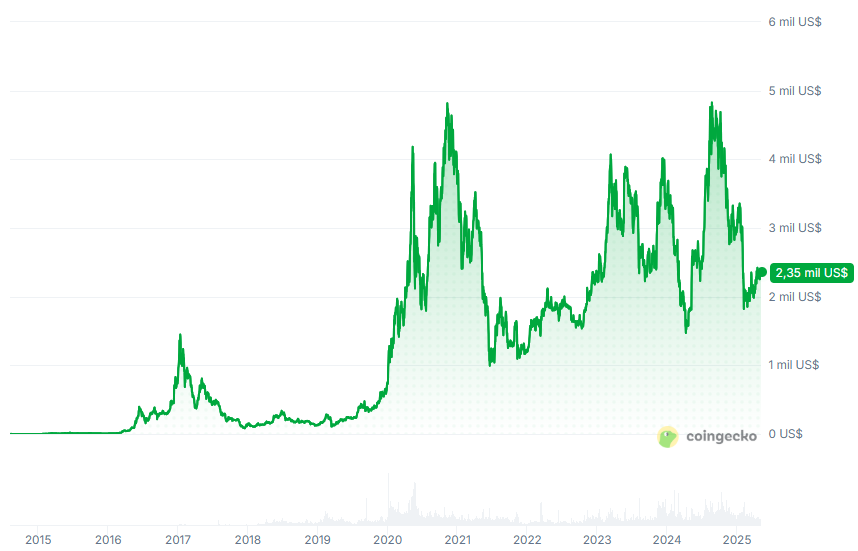
Gone are the days when each ETH could be purchased for less than $10!
But digital asset management firm CoinShares disagrees with the idea that it is too late. For this company’s analysts, Ethereum is still an early investment opportunity.
This is how they express it in a analysis published by the company on May 5, 2026. The firm’s central argument is based on the fact that few investors are paying attention to the infrastructure that increasingly supports digital finance and is becoming a key component for the future global financial system.
Most investors focus on applications. Few pay attention to the infrastructure. But ultimately every financial system is based on one question: who ensures that money stays where it belongs? In traditional finance, the answer is central banks, clearinghouses, and decades of regulation. In digital finance, Ethereum is an increasingly important part of that answer. Invisible to users. Essential for institutions.
CoinShares, investment and financial analysis company.
The CoinShares report explains that Ethereum functions as the layer where smart contracts are executed, value transfers are finalized, and financial instruments are settled. Unlike the traditional system, these operations occur “not between institutions that trust each other, but between any person, governed entirely by a code that is always executed in the same way.”
The firm highlights that “Ethereum is not just a database. “It is a system designed specifically to make interference economically irrational.”
CoinShares especially highlights the consensus protocol used by Ethereum which is proof of stake:
To participate in validating transactions on Ethereum, you must lock a significant amount of ETH as collateral, a process called staking. Validators who process transactions honestly earn rewards. Validators who attempt to cheat or manipulate the registry lose their guarantee permanently. The system is designed so that the cost of attacking it always exceeds any potential gain.
CoinShares, investment and financial analysis company.
The company explains that the staking mechanism creates an investment dynamic where validators not only assume risks, but also obtain a portion of each transaction fee processed by the network. The higher the activity on Ethereum, the higher your profits will bepoints out the firm.
Precisely, this activity already shows considerable magnitudes that support the CoinShares thesis.
Currently, the Ethereum ecosystem has 547 billion dollars in insured value (which includes ETH in circulation, staked and tokens).
And Ethereum is very present in current trends in the financial industry such as tokenization. This network hosts 54% of the global market share of tokenized real-world assets (RWA), as reported by CriptoNoticias.
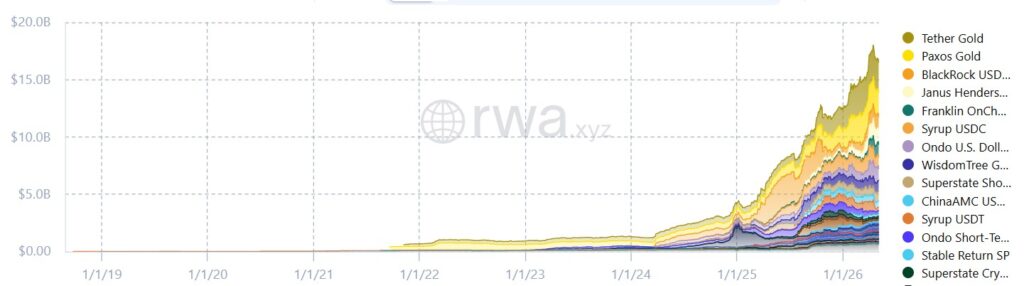
CoinShares detects that “the institutions building the next generation of financial infrastructure have made their decision. The use of Ethereum is growing. “It is no longer an experiment, but a solid foundation that guarantees a new generation of applications.”
The opportunity, according to the analysis, lies in “owning settlement infrastructure while it is being built, not after it has become the norm”.
While the CoinShares report does not set a long-term price target for ETH, it does make it clear that there is a lot of growth potential. The company is convinced that the transition from legacy systems to programmable settlement, which uses code instead of intermediaries to complete transactions, is already underway for large financial institutions.