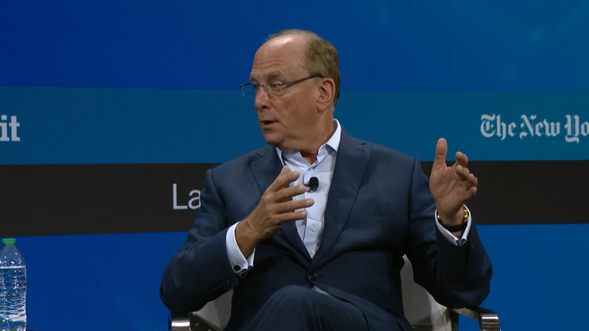
BlackRock CEO Larry Fink stated on May 11, 2026 that he sees a “great opportunity” for investment in Venezuela, amid Wall Street’s renewed interest in the country’s assets and the start of talks to restructure its foreign debt.
The statements come after the United States authorized Venezuela to hire financial advisors to negotiate approximately USD 60,000 million in bonds in default, a step considered key for the country’s eventual return to international markets.
“I am quite optimistic about the opportunity to invest in Venezuela,” Fink said. during a panel on capital markets held in New York. The executive added that the country could be “returned to its former glory” thanks to its energy resources and the increase in global demand for infrastructure for artificial intelligence.
It is worth noting that the investment thesis seems to be focused primarily on energy. Fink highlighted that the rise of AI is raising global demand for electricity faster than available supply, favoring countries with hydrocarbons, hydroelectric capacity and solar potential.
In the Venezuelan case, this could first translate into investments linked to oil, energy infrastructure and industrial modernization. However, Another possibility also arises within the financial sector: the arrival of asset tokenization models promoted by large American firms.
Although Fink did not directly link bitcoin (BTC) to Venezuela, there is a possibility that a future financial restructuring could incorporate tools based on cryptocurrency networks to facilitate the issuance and negotiation of financial assets.
Let us remember that this scenario finds certain advanced ground in Venezuela, where stablecoins are already part of multiple commercial operations. Recent data indicates that more than 1,000 Venezuelan companies use USDT and USDC for payments, imports and access to liquidity, while sector representatives estimate that close to 30% of commerce and services already operate with cryptocurrencies, as reported by CriptoNoticias.
Likewise, during the 2026 Global Crypto Summit, academic Orlando Germán explained that several Venezuelan companies began to use stablecoins to export and import after facing blocks or delays in international transfers.
Even so, BlackRock’s interest does not necessarily imply a commitment to bitcoin as a national strategic asset. The focus seems oriented towards energy, sovereign debt and network use as financial infrastructure to move institutional capital more efficiently.
For now, the movement reflects a broader change: Venezuela once again appears on the radar of large international funds after years of financial isolation. If the restructuring process advances and improves access to global capital, the country could try to reposition itself as a relevant player in strategic sectors linked to energy, infrastructure and financial digitalization.