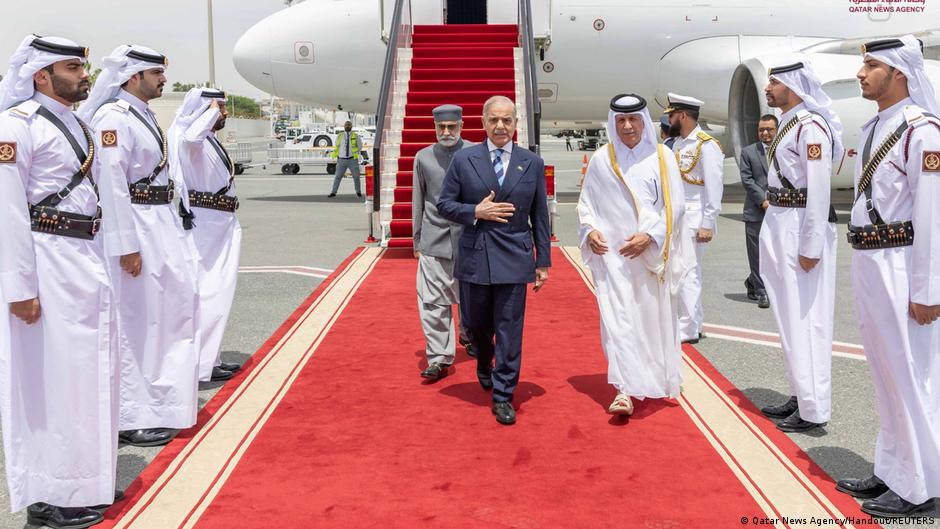
Mediation efforts between America and Iran are going on at a clip in Doha, the capital of Qatar. In recent days, Qatar’s Prime Minister and Minister of Foreign Affairs Sheikh Mohammed bin Abdulrahman Al Thani has held talks with officials from Iran, Saudi Arabia, Pakistan, Turkey, Kuwait and others to discuss “regional tensions” and “efforts to de-escalate tensions in the region”.
Over the past week and weekend, Al Thani also met with US Vice President JD Vance, US Secretary of State Marco Rubio and White House envoy Steve Witkoff as part of efforts to permanently end the war with Iran, according to the news outlet. Axios.
While the Qatari Prime Minister has repeatedly said that Doha fully supports Pakistan’s leading mediation role, this shows that the Gulf state is rapidly expanding its diplomatic reach.
“Qatar is playing an important role behind the scenes,” Sanam Vakil, director of the Middle East and North Africa program at London-based think tank Chatham House, told DW.
“They are important in bridging the divide between Tehran and Washington despite the war and Iranian attacks,” he said. He said Doha still has good relations with the Trump administration and is effectively playing the role of complementary mediation.
This view has been echoed by US officials, who said, according to Axios, that the Qataris “have been particularly effective in negotiations with Iran.”
Anna Jacobs, a Gulf analyst and non-resident fellow at the Arab Gulf States Institute (AGSI), a Washington-based think tank, also points out that “Qatar has a long history and experience of mediating the US and Iran, as well as an in-depth knowledge of the Gulf regional security landscape that Pakistan does not have.”
In his view, the US would want to lean more towards Qatar’s mediation as Iran moves forward.
Qatar’s strategic position
Qatar will also benefit domestically from successful mediation between the US and Iran.
“Doha’s mediation efforts are prioritizing de-escalation as well as reaching a practical agreement between the US and Iran that can keep the Strait of Hormuz open and safe for commercial shipping,” Jacobs told DW.
The small Gulf state, a close US ally, was heavily targeted by Iranian missiles and drones following US-Israeli attacks on Iran in late February. Qatar has hosted the largest US military base in the Middle East – Al Udeid Air Base outside Doha since 2001.
Qatar, the world’s second-largest liquefied natural gas (LNG) producer, also had to suspend production in March after Iran attacked its main gas facility, Ras Laffan. Doha has also been hit hard by Iran’s closure of the Strait of Hormuz, which has halted oil exports from Qatar, Bahrain and Kuwait, and sharply restricted shipments from Oman, Saudi Arabia and the United Arab Emirates.
“Qatar is one of the countries most affected by the closure of the strait as it depends on this vital trade route for almost all of its LNG exports,” Jacobs told DW.
On Sunday, signs emerged that those efforts are already reducing tensions. financial Times On February 28, for the first time since the war began, a tanker carrying Qatari liquefied natural gas for Pakistan passed through the Strait of Hormuz, according to commodity analytics firm Kpler.
On Tuesday, Qatari outlet Doha News reported that a second LNG tanker was en route to the Strait of Hormuz from Pakistan. News agency Reuters said Iran approved the transfer to build trust with its mediators Qatar and Pakistan.
History of mediation efforts in Doha
For decades, Qatar has positioned diplomacy and mediation as a cornerstone of its regional strategy and national identity.
Doha has close ties to Washington, a strong working relationship with Tehran – which supports Hamas in Gaza, Hezbollah in Lebanon and the Houthis in Yemen – as well as the Taliban in Afghanistan, the Muslim Brotherhood in Egypt, Libyan militias and non-state actors in Syria.
Anna Jacobs argued in a recent statement, “Qatar has maintained relations with rogue states, terrorist groups, and other non-state actors for many years, often at the request of the United States.” op ed On the website of the Institute of Arabian Gulf States.
However, despite years of experience and past success, it is ultimately up to the US and Iran to end the current conflict, Jacobs told DW.
“And it still seems far away,” she said.
Burcu Ozcelic, a senior research fellow at the British think tank Royal United Services Institute (RUSI), agrees.
“It takes two tangos: President Trump faces a heavily wounded but resilient Iranian regime, and perhaps he’s working on borrowed time, but Tehran has turned Operation Epic Fury into an inconvenient standoff,” he told DW.
“The binary dynamics of war have placed structural constraints on regional diplomatic peacemakers like Qatar,” Ozcelik said. He believes that the failure of Islamabad and Doha to get out of this quagmire is not due to lack of good intentions, but rather that success and failure are being matched in the historical confrontation between the US and Iran that has been going on since 1979.
“It shows what regional actors and ambitious middle powers can achieve to advance negotiations on a conflict that is militarily, strategically and economically dominated by the US and Iran,” he told DW.
“This means that ensuring that the Gulf’s interests and concerns are reflected in the negotiations is essential to long-term stability after any agreement,” Ozcelik said.
Edited by: Cai Nebe