BIP-110 is a soft fork proposal for Bitcoin that aims to mitigate the use of arbitrary data.
In Lopp’s vision, nodes that activate the new version of Knots will disappear.
A day after the release of the new version of the Bitcoin Knots client (29.3.knots20260508), which activates the BIP-110 soft fork proposal by default, developer Jameson Lopp today (May 12) unveiled a public timer that tracks how many blocks are left until activation. In Lopp’s vision, nodes running this version of Knots will be excluded from the Bitcoin network.
In his post on will be forked off the grid in August. So I created a handy countdown timer so we can watch the disaster together.”
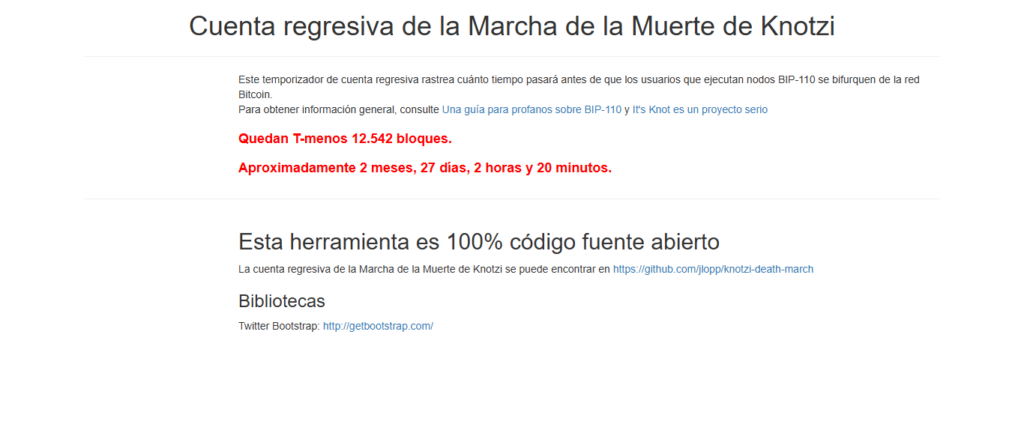
The tool created by Lopp is available on GitHub and is ironically named “Knotzi’s Death March.” At the time of this publication, the counter ticks 12,542 blocks remaining for BIP-110 activation, equivalent to approximately 2 months and 27 days:
BIP-110, known as Temporary Soft Fork to Reduce Data, seeks to restrict the use of Bitcoin to record non-financial data such as images, text or files, as reported by CriptoNoticias.
For operators who upgrade to Knots 29.3.knots20260508, the specific effect will be that their node will reject transactions with arbitrary data that exceed the limits established by that proposal. According to Lopp, a node with those rules active would lose consensus with the main chain and would be involuntarily isolated from the network.
The impact depends on how many nodes adopt the new version
As CriptoNoticias explained, the integration of BIP-110 into Knots does not activate that proposal in Bitcoin. For its rules to have an effect on the network, a critical mass of nodes and miners would need to adopt the latest Knots software update voluntarily and signal in favor of the change.
In that context, Bitcoin Core, the client that runs most of the nodes (with more than 77% of public nodes), does not include BIP-110, and, although Knots is the second most used client in Bitcoin (22%) and has registered increasing adoption since the beginning of 2025, its participation is still a minority compared to that of Bitcoin Core. If the proportion of nodes adopting the new version is low, the effect of the fork would be limited to that segment without altering the operation of the main network.
Thus, the fate of the proposal depends on the social and operational consensus of the networknot a centralized technical decision.