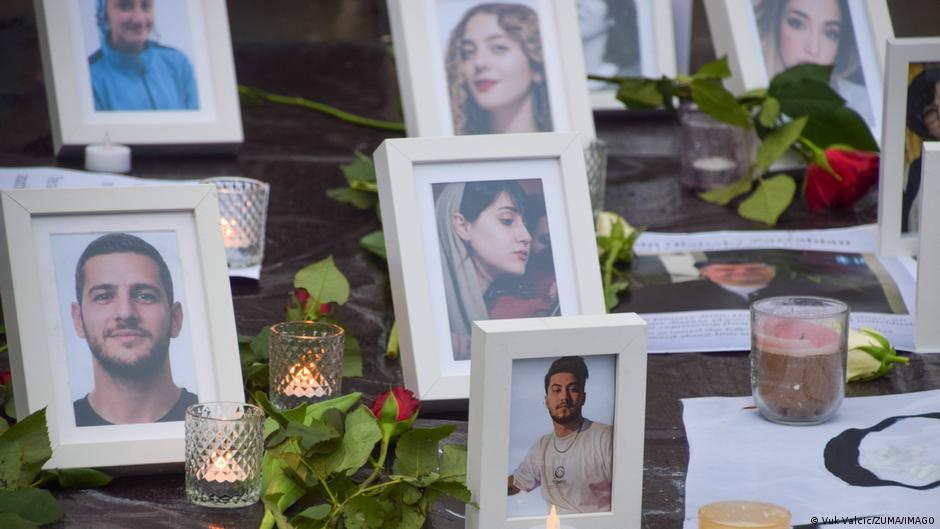
“We are watching the human rights situation in Iran with great concern,” Mahmoud Amiri-Moghadam tells DW.
Norwegian-Iranian neuroscientist is the founder of the NGO Iran Human Rights.
He added, “The almost daily executions of political prisoners, protesters, and people accused of espionage are particularly worrying.”
In 2025 his organization found that Iran hanged at least 1,639 peopleWhich represents an increase of 68% compared to last year and averages four to five executions per day.
Since the latest US-Israel war with Iran began in February, the Middle Eastern nation has become the focal point of global politics. Most attention has focused on geopolitical concerns and particularly the Strait of Hormuz, through which about a quarter of the world’s crude oil and oil products were shipped before the blockade. However, in the meantime, Iran’s internal affairs are being widely ignored.
“In a situation when the international community is paying little attention to human rights violations in Iran, the Islamic Republic is taking advantage of additional leeway to execute prisoners while keeping the political costs as low as possible,” says Amir-Moghadam.
The number of executions recorded in 2025 was the highest in 35 years, and a continuation of the increase that began in 2022 following nationwide “Women, Life, Freedom” protests. People now talk about an atmosphere of fear.
Thousands of citizens arrested in Iran
Since the start of the US-Israeli war with Iran, UN human rights chief Volker Turk says more than 4,000 individuals have been arrested in Iran on national security-related charges. At least 21 of these have been hanged.
Ex-user Syed Ziadin Nabawi, also known as Zia Nabawi, wrote, “I can hardly imagine what effect the successful executions of the past few days have had on the atmosphere of the political wards of the prison.” The popular human rights activist is one of the few people who is still sporadically active on social media despite severe limitations.
Since late February, Internet access has been largely disrupted, as the government stepped up a crackdown against VPN connections and satellite terminals that would be able to circumvent state censorship. This has made it more difficult to communicate within the country as well as from within the country to foreign countries.
“Through cooperation with colleagues in Iran – and it is very difficult to contact them – we have learned that there is a rapid increase in court cases of political prisoners, as well as less transparency,” human rights lawyer Saeed Dahgan told DW. “This means the death penalty can be imposed and imposed more quickly.”
Dehghan, who lives in Canada, is the founder of the legal professional collective 1Kalameh Legal Network, where he and fellow Iranian human rights lawyers work to document human rights violations.
He says there are many independent lawyers who are campaigning for political issues and have been arrested or summoned. According to accounts, security officers were systematically intimidating them and working to detain dissidents and protesters.
“The pressure on political prisoners suffering from illness has increased,” he says. “An example is Nargess Mohammadi, who recently suffered a heart attack.”
Nobel Peace Prize winner Mohammadi was recently transferred to a clinic in Tehran after his prison sentence was suspended on bail. Reports describe his health condition as serious.
Dehghan argues that other political prisoners in poor health should also be entitled to medical leave or conditional release for health or humanitarian reasons.
‘Dialogue based on human rights’
Dehghan and other human rights advocates are warning that Iran’s government could repeat mass executions due to political instability. For example, immediately after the Iran–Iraq War (1980–1988), thousands of political prisoners were executed.
Now, hundreds of protesters arrested during nationwide protests at the beginning of the year are facing charges that could carry the death penalty.
Amiri-Moghadam says, “It is important that the international community gives a much higher priority to the state of Iran and its people. They need to make it a topic in negotiations with the Islamic Republic.”
He argues that a halt to executions and the release of political prisoners should be the main conditions for negotiations.
“Ultimately,” he says, “it is the people in Iran who will bring about fundamental change.”
This article was translated from German.