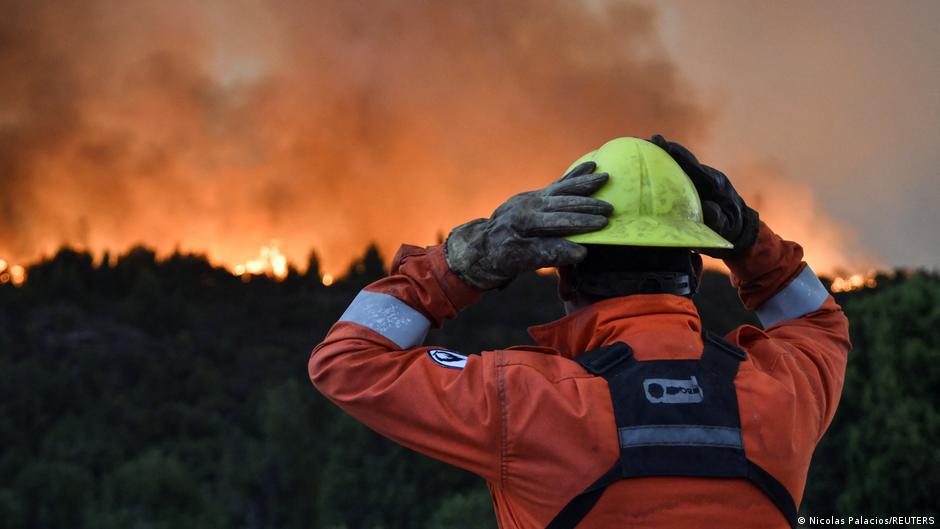
The world could see a “particularly severe year” of wildfires due to climate change and a potentially strong El Niño weather phenomenon after the first few months of 2026 broke records, researchers warned Tuesday.
“The global fire season has gotten off to a very fast start this year,” said Theodore Keeping, an extreme weather researcher at Imperial College London, part of World Weather Attribution (WWA), a network of climate scientists.
Wildfires have scorched 50% more than average for this time of year, he said, and the current area burned by wildfires globally is 20% more than the previous record since tracking began in 2012.
Almost all countries in West Africa and the Sahel region have seen record-breaking burned areas.
“In total, 85 million hectares [around 328,000 square miles] “Fires have burned across Africa this year, compared to the previous record of 69 million hectares,” Keeping said.
Heavy rain provides more fuel for subsequent wildfires
During the last growing season, these areas received unusually high seasonal rainfall, leading to grass growth that fueled fires.
“In addition, the severe drought and heat waves we have seen over the past few months mean that fires are more likely to occur in greener, generally less fire-prone areas,” Keeping said.
This shift from wet to dry, known as “hydroclimate whiplash,” is increasing in West Africa, he said.
The other major contributor to the global fire season has been Asia, with large-scale wildfires spreading across India, Southeast Asia, and northeastern China. Asian wildfires have burned nearly 40% more than the previous record year.
The United States and Australia have also experienced unseasonably high burned areas so far in 2026.
Scientists predict ‘super’ El Nino for 2026
This all comes ahead of a potential “super” El Niño that is expected later this year. The El Niño weather phenomenon is a natural climate pattern and warm phase of the trade winds in the Pacific Ocean that affects global weather.
Forecasts say there is a 61% chance that El Nino will emerge during the May–July period And if not, wait at least till the end of the year.
“If a strong El Niño develops the potential for damaging extreme fires could potentially exceed the highest in recent history,” Keeping said.
This is really worrying, especially from a health perspective, says Jamila Mahmood, executive director and physician at the Sunway Center for Planetary Health at Sunway University in Malaysia.
“Wildfire smoke is not normal pollution,” he said. He said fine particles (PM2.5) emitted from fire smoke can be 10 times more harmful to health than traffic emissions.
A 2024 study by the British Medical Journal The Lancet It was found that 1.5 million deaths each year were linked to air pollution. The number of deaths is expected to increase in the coming years as climate change causes more frequent and intense forest fires, the study said.
The global climate is more unbalanced than at any time in history. The World Meteorological Organization warned in March that greenhouse gas concentrations, which come mainly from burning oil, coal and gas, are causing warming of the atmosphere and oceans and melting ice caps.
“Climate change won’t go away unless we do something about it,” Mahmood said.
El Nino meets warm climate baseline
“Although El Nino could lead to very extreme conditions later this year, it is not a reason to panic,” said Friedrich Otto, professor of climate science at Imperial College London and co-founder of WWA.
He said El Niño comes and goes as part of a natural cycle, but it is now happening on an increasingly warm baseline in a dramatically changing climate.
Water temperatures in the central equatorial Pacific Ocean are projected to reach or exceed 3 degrees Celsius (5.4 degrees Fahrenheit) above average in the second half of this year, they said.
“This El Nino is sitting on top of decades of accumulated warming. And compounding is the issue,” Mahmood said.
The previous 2023–2024 El Niño peaked as one of the fifth strongest on record. El Nino acted as a turbocharger on top of human-induced climate change, making 2024 the hottest year on record and, in turn, giving rise to heat waves and other devastating weather extremes.
While WWA scientists have studied more than 100 extreme weather events so far, Otto said human-induced climate change has had a major impact on the likelihood and intensity of extreme weather events.
She points to cases such as the massive wildfires across Europe last year or the extreme rainfall events around the world or the ongoing extreme drought in Syria and Iran, where El Nino played no role at all.
But planetary warming will only get worse unless we stop burning fossil fuels, Otto said.
Unprecedented heat waves despite cooling La Nina?
Australia also saw record-breaking heat, although El Niño’s counterpart, La Niña, was still in full swing, which would theoretically have had a slight cooling effect on the Australian summer.
“Human-induced climate change overshoots the signal,” said WWA’s Otto.
This comes as governments have quietly backed away from climate commitments, Mahmood warns, with some behaving “as if the climate crisis was a chapter one.”
“Climate change is reason to panic,” Otto said. Ideally, he said, in a constructive way, by acting quickly to reduce global emissions and reverse the warming that is already happening.
“And we know what to do about it. We have the knowledge and technology to move far away from fossil fuel use,” Otto said, referring to renewable energy and storage technologies.
Edited by: Jennifer Collins