
These wallets already hold 67% of the circulating supply of the ADA cryptocurrency.
At current prices, 1 million ADA is equivalent to approximately $260,000.
Wallets with at least 1 million units of the cardano cryptocurrency (ADA) set a new accumulation record.
This is reflected in the data on-chain provided on May 13, 2026 by the Santiment firm. These great forks They already jointly control 25,090 million ADA (6.6 million dollars)equivalent to 67.47% of the circulating supply.
As seen in the following graph, These investors have been steadily accumulating ADA since December 2023despite the sharp price drop recorded by the cryptocurrency in recent months.
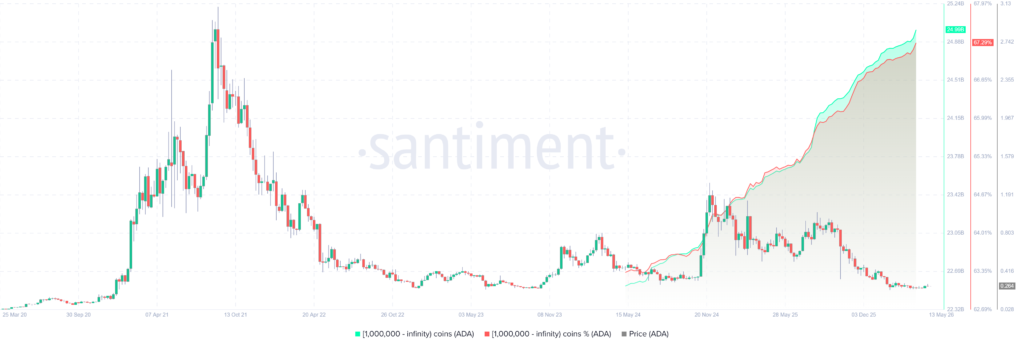
The graph shows three variables: the price of ADA, the total amount of coins accumulated by wallets with more than 1 million ADA, and the percentage of the supply controlled by these large holders.
While the price of ADA fell to $0.2641 (91% below its all-time high reached in 2021), accumulation by these wallets continued to grow steadily.
The firm highlighted that this behavior is especially striking because ADA lost around 71% of its market capitalization during the last nine months.
Even so, larger wallets continued to increase positions amid the bearish context.
As CriptoNoticias has explained, this type of address is usually associated with whales and sharks, Terms that are used to describe large holders with the ability to influence liquidity and market behavior. It is worth clarifying that, although for bitcoin it is defined exactly what a whale is (addresses with 1,000 bitcoin or more), there is no such precise definition for other cryptocurrencies.
Santiment interpreted the trend as a sign of long-term accumulation. That is, these actors understand that Current prices represent attractive levels to continue increasing exposure to ADA.
The accumulation process also coincides with a stage of technical expansion within the Cardano ecosystem. Since December 2023, the network has made progress in various improvements aimed at scalability, privacy and interoperability.
One of the most relevant developments is Hydra, Cardano’s layer 2 solution designed to increase transaction processing capacity. During tests and demonstrations conducted between 2025 and 2026, Hydra exceeded one million transactions per second (TPS) in experimental scenarios and recorded more than 100,000 TPS in public tests.
In parallel, Cardano continues to work on Ouroboros Leios, an evolution of its Ouroboros consensus protocol aimed at increasing speed and efficiency without compromising the decentralization of the network. The improvements are part of the scalability roadmap planned for 2026.
Another recent focus was Midnight, the sidechain focused on privacy developed within the Cardano ecosystem. The network began public deployment between March and April 2026 following its initial launch in December 2025. Midnight uses zero-knowledge proofs (ZK proofs) to enable transactions and smart contracts with greater privacy and control over shared data.
Although the growth of these wallets does not guarantee an immediate price recovery, it does show that a relevant part of the ADA supply continues to be concentrated in large investors even in a context of market weakness. Some of that buildup could be tied to Cardano developments in areas like scalability, privacy, and interoperability.