The luxurious lifestyles of autocrats and dictators are often exposed only after their fall. The cases of Romanian dictator Nicolae Ceaușescu and former Ukrainian President Viktor Yanukovych are particularly striking examples. The footage of Ceaușescu’s extravagant gold-plated bathroom has seared itself into Romania’s collective memory.
Now the decadence of Hungary’s ousted leader Viktor Orban and his associates is also being exposed. On Monday, Prime Minister Peter Magyar published videos from Orban’s official Buda Castle residence and two ministries, showing spacious, luxuriously furnished rooms.
But not only this. Orbán, who likes to talk about how he grew up in a village and his humble roots, had decorated his official residence with about 100 valuable paintings from the Hungarian National Gallery. While visiting the residence, Prime Minister Magyar said that it reminded him of the Ceaușescu era.
One of these revelation videos has been viewed more than eight million times in a single day – no small feat, given that Hungary has a population of just under ten million.
Highlighting the prosperity of Oban and its elite as Hungary went into decline may seem to some outside observers a populist move by the successful government. Yet, for many Hungarians, viewing this footage has generated not only anger, but also a sense of satisfaction at seeing the former elite exposed.
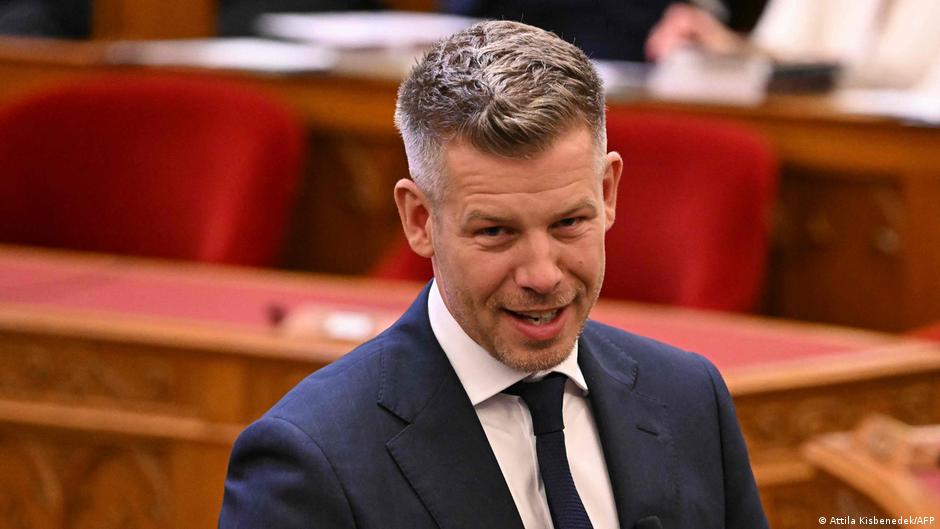
It is likely that Hungary’s new leader Peter Magyar will continue to chart a new political path. At his swearing-in ceremony at the Hungarian Parliament on Saturday, Magyar left no doubt that he wanted to see far-reaching systemic change, saying that reconciling divided Hungarian society was his top priority.
This will require achieving justice, the Prime Minister said, which cannot be done without exposing the Orbán system and coming to terms with it, in both a moral and legal sense.
a symbolic day
Magyar declared Saturday “regime change day”, with Hungarian journalists once again allowed to report from parliament – a privilege largely eliminated under Orbán’s rule.
As her first official act, new parliamentary president Agnes Forsthofer ordered the EU flag to be flown again on the building, 12 years after it was removed. For the first time, Hungary’s unofficial Roma anthem was played by a group of Roma and non-Roma children during a parliamentary session.
Peter Magyar’s inaugural speech became a tirade against the previous government – unlike anything heard in the Hungarian Parliament, not even in 1990. Deposed leader Orbán did not find the courage to attend parliament, even though it is customary for outgoing and incoming heads of government to shake hands there.
Later that day, well-known Roma pop singer Ebolya Olah sang the sad and patriotic song “There is a country, Hungary” on Parliament Square. He had not sung it for several years because Hungarian nationalists had denied him the right to sing it as Romney and threatened him at concerts.
However, on Saturday, thousands of people gathered in the part of Parliament Square that was once cordoned off to hear Olah sing in one of the most poignant and symbolic moments of the day.
cabinet of experts
On Monday and Tuesday, things continued in much the same way with the announcement and swearing in of cabinet ministers, completing the formal transfer of power after 16 years of Orbán rule in just over a month.
As is also new in Hungary, the cabinet consists almost exclusively of well-known experts in their respective fields, who until now have had little or nothing to do with politics. Former diplomat and energy expert Anita Orban now serves as the country’s foreign minister, while a former oil company manager is in charge of the economics ministry, and an orthopedic surgeon serves as health minister. Prominent lawyers as well as finance, education and IT experts have also joined the cabinet.
Some parts of the new government’s agenda were already known, such as plans to create an independent anti-corruption authority and an office for the recovery of illegally acquired assets. Magyar and his minister Balint Ruff have now announced one of the most extensive investigations ever into government spending in Hungary. Furthermore, in this case, the authorities are ready to publish a list of the names of Hungary’s former state security agents – a project that has been repeatedly delayed for the past 30 years.
None of these announcements will upset any other EU state and will count as normal democratic practice. But in post-Orbán Hungary, creating a more independent judiciary, promoting government dialogue with civil society and the media, establishing a fair, transparent electoral system, restoring the autonomy of universities, and opening broader debates on gender equality, abortion and gay marriage seem almost revolutionary.
The Magyars held their first government meeting in the southern village of Opusztaszár, where Hungarian nomadic tribes are said to have pitched their tents in 896 – a prelude to the later establishment of the Hungarian state. Today, the region is affected by severe drought, the topic will be discussed in the first cabinet meeting.
Overall, Magyar has set higher standards for himself and his government than any other Prime Minister of Hungary since 1990. One of the first tests will be how his announced massive pay cuts fare. For context: Deposed Prime Minister Orbán earned the highest salary of all European leaders relative to the country’s average salary.
This article was translated from German.