Stablecoins are consolidated as a stability tool against inflation.
The integration of Venezuelan public banks into Binance’s P2P system marks the most tangible advance
The cryptocurrency ecosystem in Venezuela has begun to show renewed dynamism in 2026marked by a more flexible political environment, the recent partial relaxation of international sanctions and a massive use of stablecoins as an everyday exchange mechanism. And, although a formal wave of “landing” of large niche companies has not yet been observed, an increase in strategic movements and approaches to the local financial system is evident.
The most concrete advance so far is carried out by Binance, which recently integrated Banco de Venezuela, Banco del Tesoro and Banco Digital de los Trabajadores within its P2P system, allowing users to operate directly with local bank accounts to buy and sell cryptocurrencies. But There are other companies that could be interested in expanding their service portfolio. towards the country, let’s see it.
Those who are already there and those who show interest
In addition to Binance, the cryptocurrency platform Crixto and the financial services platform with digital assets Kontigo operate in the country, both of which have formal authorization. of the National Superintendency of Crypto Assets and Related Activities (Sunacrip) to operate within Venezuela, which makes them two companies regulated under the local legal framework.
In it Christ’s casethe company maintains a current operating license for the exchange of cryptoassetswhich allows you to carry out cryptocurrency purchase and sale operations, conversion between digital assets and fiat money, as well as custody and payment services, under state supervision. For its part, Kontigo received the renewal of its license until 2027allowing it to continue operating legally in the country with similar functions, including cryptofiat exchange, payment gateway and OTC services.
Another relevant actor is Upholdthe bitcoin (BTC) and cryptocurrency exchange, which began this May 13, the formal reactivation of its services in Venezuela after almost four years of absence in the country.
In parallel, there is the Qash neobankwhose co-founder Ami Spiwak announced exclusively to CriptoNoticias that the company formally began operations in the country, specializing in the use of stablecoins linked to the dollar, functioning as a financial bridge so that Venezuelan companies can access services in US banking.
Now, The future of Venezuela looks a little optimistic by some important global actors who have mentioned the possible financial potential of the Caribbean country, as stated by Larry Fink, CEO of BlackRock, who recently indicated that he perceives investment opportunities amid discussions on debt restructuring and greater financial openness.
For his part, the unexpected visit of Fred Ehrsam, co-founder of the largest exchange in the United States, Coinbase, and the investment firm Paradigm, to the main headquarters of the Bank of Venezuela (BDV) in Caracas, where he held meetings with Actors in the Venezuelan banking system have begun speculation about the possible interest exploratory of the big capitals of Silicon Valley in the local market, as covered by CriptoNoticias.
Beyond business movements, Venezuela has been functioning for years as a laboratory for forced cryptocurrency adoption, as analysts explain. Inflation, the loss of value of the bolivar, and restrictions in the banking system drove the use of stablecoins—mainly USDT—as a savings, payment, and transfer tool.
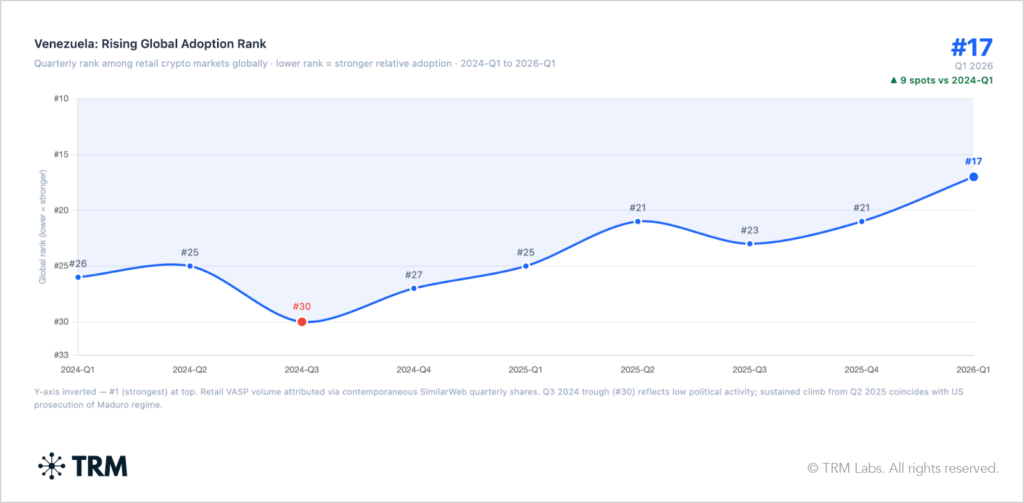
In fact, different adoption reports indicate that the country has climbed positions in the global ranking of cryptocurrency use, as indicated in this chart. TMR Labswith a significant volume of retail operations on P2P platforms, where cryptocurrencies, such as USDT, dominate the majority of transactions linked to the bolivar.
However, the scenario continues to be one of transition. The most tangible advance so far is the integration of Binance with public banking, while the rest of the companies remain between strategic exploration and regulatory waiting.
In this sense, Venezuela is not yet in a consolidated investment phase, but in an intermediate stage where the opportunity seems to exist, but is conditioned by regulatory, sanctioning and structural risks.
The outcome will depend on three key variables: internal political stability, the evolution of Sunacrip licenses and the future direction of OFAC sanctions. Meanwhile, the country continues to consolidate itself as one of the most unique and observed markets in Latin America.