
Digital asset investment firm Grayscale warned on May 14, 2026 that a prolonged high interest rate scenario in the United States could put pressure on bitcoin (BTC) and other cryptocurrencies, while driving the tokenization of traditional financial assets and increasing revenues for issuers of stablecoins like USDC.
In a report prepared by Zach Pandlthe company maintained that the American inflation accelerated again to close to 4% annuallydriven primarily by rising energy and gasoline prices. According to the analysis, this context would limit the ability of the Federal Reserve (Fed) to reduce interest rates in the short term.
Likewise, Grayscale believes that the new Fed president, Kevin Warsh, will maintain a high rate monetary policy for longer. In fact, the market currently does not expect rate cuts until September 2027.
The report highlights that underlying inflation measures also continue to above the Fed’s target. The core CPI index stands at 2.7%, while the core PCE – the US central bank’s preferred metric – is around 3.3%.
For Grayscale, this environment creates “headwinds” for bitcoin. The firm explains that, like gold, the currency created by Satoshi Nakamoto It is an asset that does not generate returns. Therefore, higher real rates raise the opportunity cost of holding bitcoin versus dollar-denominated instruments that do offer interest.
Even so, The company maintains a positive long-term view for bitcoin due to regulatory factors and the advancement of legislative initiatives such as the Clarity Law in the United States, recently approved, as reported by CriptoNoticias.
Another of the effects pointed out by Grayscale would be the acceleration of the tokenization of fixed income assets. The report compares returns within decentralized finance with traditional instruments and concludes that many tokenized assets They offer more attractive returns.
As an example, he mentions that USDC loans on Aave generate returns close to 3.6%, while short-term corporate bonds reach approximately 4.5%. According to the firm, this difference could encourage investors and issuers to bring more traditional assets into cryptocurrency networks.
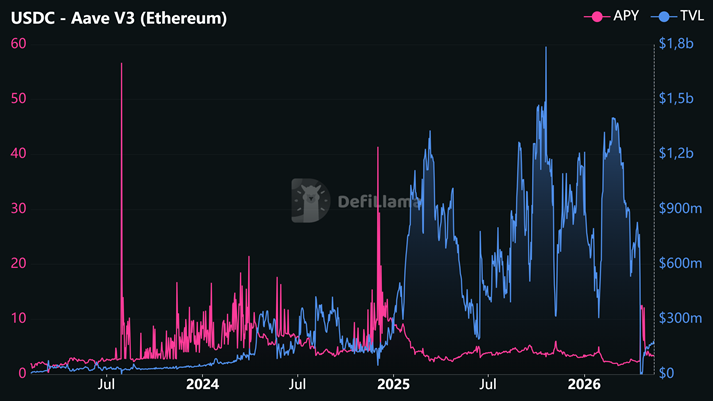
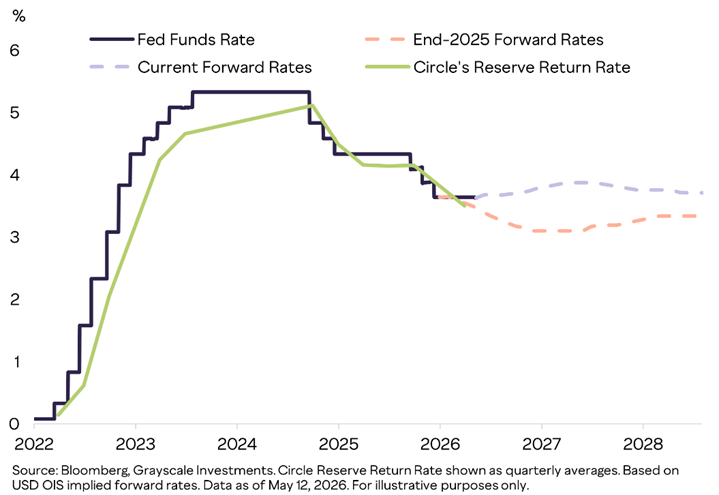
The report also notes that stablecoin issuers such as Circle They would directly benefit from a prolonged high rate scenario. These companies maintain reserves in interest-bearing financial instruments, although the Genius law would prevent them from transferring those returns directly to users.
Grayscale estimates that each 25 basis point increase in short-term rates could add about $190 million annually to Circle’s revenue, as the chart below indicates.
It is worth highlighting that not everyone in the industry shares Grayscale’s vision on the prolonged impact of high rates on bitcoin. Some industry leaders believe that growing institutional and corporate adoption will end up weighing more on the price than the Federal Reserve’s monetary policy. Michael Saylor, CEO of Strategy, has repeatedly argued that bitcoin will continue to appreciate in the long term thanks to the entry of companies, ETFs and institutional investors, even in complex macroeconomic environments.
A similar position is maintained by Anthony Pompliano, who stated in January 2026 that the market would be exaggerating the effect of inflation and the Fed’s decisions on bitcoin. In recent interviewsPompliano argued that factors such as the institutionalization of bitcoin, integration with traditional finance and structural demand have more weight in the behavior of the asset than short-term inflationary cycles.
Finally, the analysis reflects a change in narrative within the cryptocurrency market. Instead of focusing solely on bitcoin as a hedge against inflation, the sector begins to prioritize products with performancestablecoins and tokenized real-world assets (RWA).
If rates remain high until 2027, as markets currently project, segments linked to tokenized fixed income and stablecoins could capture a growing share of institutional capital, while bitcoin will depend more on regulatory factors and global liquidity to sustain its demand.