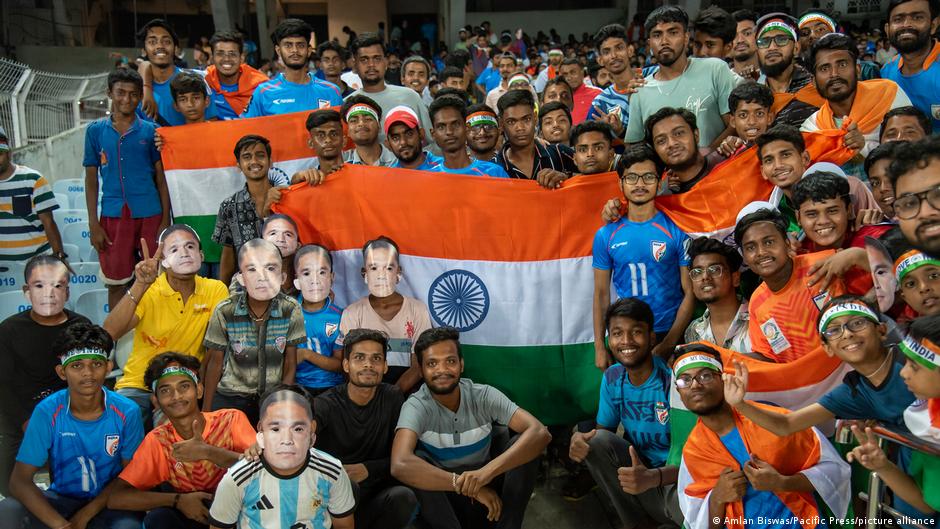
Just weeks before the start of the 2026 World Cup, India is without a broadcast deal. Negotiations are reportedly ongoing, the constraints with time zones and cost expectations are obvious, but there is also a feeling that FIFA has misunderstood its two biggest markets.
“The Indian market is kind of a cruel market,” Nandan Kamath, one of India’s leading sports lawyers and a key figure in the country’s sports policy, told DW. “It’s the numbers rather than the will.”
Broadcasters in India rely more on advertising revenue than subscriptions. The tournament received good viewership in Qatar, but it did not bring any profit to Viacom18, the Indian media giant that holds the rights. Furthermore, the premium customer base for most services is too small to generate large profits. FIFA will probably have to lower its expectations to reach its desired scale.
“To get scale, everyone has to rationalize subscriptions,” Kamath said, before referencing Netflix and Formula One. Both had to change their original ideas to reach the desired audience. For example, a Netflix subscription can now cost 199 rupees per month (about $2.50), while F1 offers a season pass for 899 rupees ($10).
not a competitive market
“I don’t know if we’ve really seen broadcasts meet the market. Usually these rights are sold where there’s a lot of competition where people deal with FOMO [fear of missing out]And he is not here right now,” Kamath said.
With only JioStar (which absorbed Viacom18 following the Reliance-Disney merger in 2024) and Sony, there is no competitive market for the rights. And then there is cricket.
“India is a sports market that has evolved on cricket,” Kamath said. “Without question, the FIFA World Cup will not be in the top two rights sold in India; those will be the IPL and ICC rights. And it’s a very unique thing for any market to not even be in the top two.”
If FIFA wants to finish in the top two, it will have to pay more attention to the landscape.
“Cricket is a perfect ad-supported sport, where it’s broken down to every three or four minutes. And that’s completely different to football,” Kamath explained. “I don’t think there are enough breaks in the game to really create a credible advertising market.”
Time and place are a factor
Time zone is also a factor. Most of the games will start when India is sleeping. Four years ago, there was a time difference of only two and a half hours between India and Qatar in Qatar. There is also the country’s apparent desire to host the Olympics, which pushes football further down the priority list. It also doesn’t help that the India men’s football team has never played a World Cup before, and were eliminated in the second round of qualifying for this edition.
“There is a perception that cricket is king, the Olympics are the next aspiration and FIFA is an entertainment product,” Kamath said. “There are too many hurdles at the moment in the bridge between participatory football, the ambition of hosting and watching.”
Ultimately, Kamath thinks a compromise will be reached, but FIFA will have to be more innovative in the future if it really wants to thrive in the Indian market.
“It could be virtual advertising, or better integration of Indian sponsors,” Kamath said. “You may need to find new models to accomplish this, but I don’t see the desire to subscribe and pay huge sums of money in four or eight years.”
FIFA’s greed a problem in China?
After several weeks of doubt and negotiations, national media in China reported on 15 May that a broadcast deal for the next two World Cups (men’s and women’s) had been agreed.
“China, basically, has always been passionate about this game“In the past, even if Chinese men were not eligible, China Central TV (CCTV) would always broadcast,” Xu Guoqi, a professor at the University of Hong Kong, told DW.
Guoqi, an expert on the role of sport in China and has written books about the importance of sport in the country, believes part of the problem is FIFA’s inability to understand the region.
Guoqi said, “The time difference is not really an issue because historically, except recently in Qatar, it has always been in some other place, so we all have to stay up very late.” “I think FIFA has become greedy. It’s a business deal, right? For FIFA, it’s a huge loss for Chinese men if they don’t watch the games.”
Given that, according to FIFA, around 20% of linear TV reach in Qatar came from CCTV, it is understandable why football’s governing body is so keen to have a presence in the Chinese market.
The absence of the men’s team – which lost in the third round of qualifying and last appeared at the World Cup only once, in 2002 – currently seems less decisive for the Chinese market. This is partly because there are still The four Chinese companies that are sponsoring the tournament, but also because watching the World Cup remains a source of pleasure for many people.
“In 1999, when NATO bombed a Chinese embassy, the Chinese government decided to cancel the broadcast of the NBA games,” Guoqi said, referencing the work of his book “Olympic Dreams: China and Sports.”
“Chinese youth denounced the Americans in front of the embassy during the day, and in the evening, they denounced CCTV with the argument, ‘We hate American imperialism, but we love the NBA.’ The NBA belongs to the world. It tells you something about that new Chinese mentality, because it’s an absolute joy for them, basketball or football.”
This article was updated shortly after publish to reflect the news that China has secured a broadcast deal for the 2026 and 2030 World Cups.
Edited by: Janek Speight