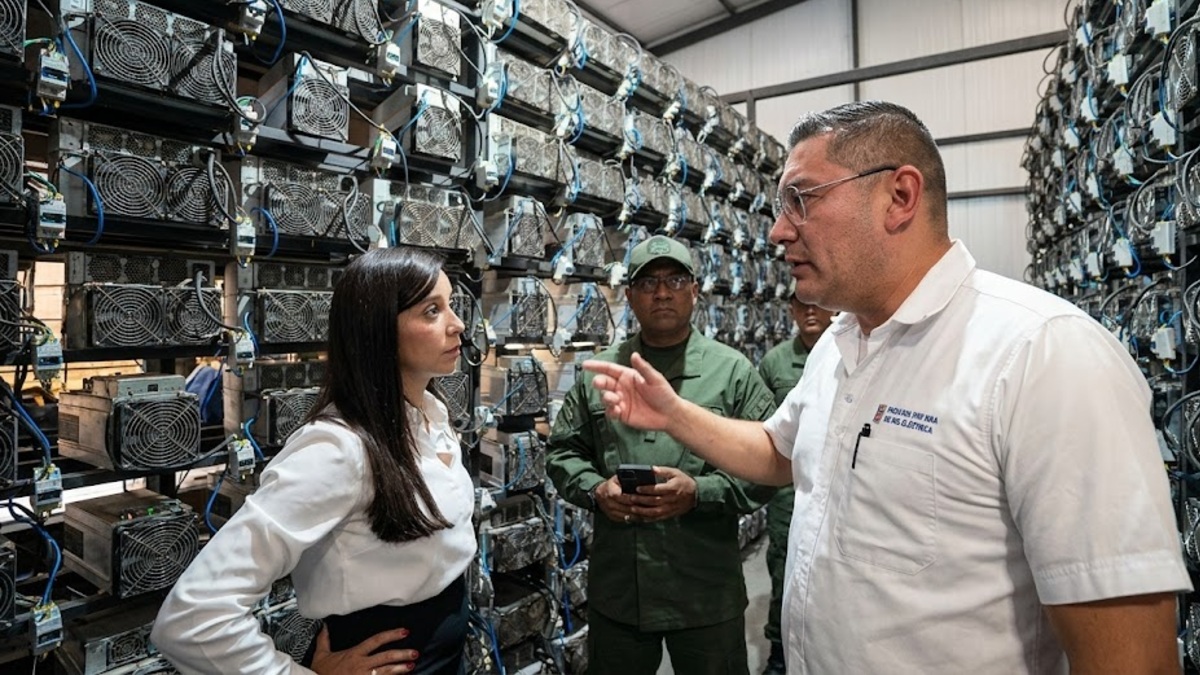
According to the authorities, it is an “illegal” farm whose consumption is approximately 10 megawatts.
The miners were “causing a significant impact on the national electrical system.”
On Monday, May 18, Venezuelan authorities dismantled a Bitcoin mining farm in the San Vicente Industrial Zone, located in the city of Maracay, Aragua state, in the center of the country.
The technological complex had approximately 4,000 Application Specific Integrated Circuit (ASIC) equipment—mostly MicroBT’s Whatsminer M30S model—and industrial cooling systems.
According to the official report, the installation generated an estimated consumption of between 8 and 10 megawatts (MW)which, according to them, caused a “severe impact and structural damage” to the protection systems of the National Electrical System (SEN).
The on-site inspection was coordinated by the Scientific, Penal and Criminal Investigations Corps (CICPC), in joint work with the Central Comprehensive Defense Strategic Region (REDI), the Aragua Comprehensive Defense Operational Zone (ZODI) and the Bolivarian National Guard (GNB).
It was reported that the operation was done under the instructions of the president in charge of Venezuela, Delcy Rodríguez, and was attended by the governor of Aragua, Joana Sánchez, along with the vice minister of Electric Energy, Brigadier General Vianney Rojas.
Vice Minister Rojas explained that the data center operated clandestinely and directly affected the stability of the electricity supply of the region.
The officials explained that, in addition to the direct consumption of the energy load demanded by 4,000 ASIC machines in continuous operation, the technical incidence and fluctuations of these equipment constantly altered the protections of the electrical network, increasing instability in the distribution of public energy.
This procedure responds directly to the ratification issued by the Ministry of Electric Energy on May 7, 2026, through which the absolute prohibition of Bitcoin mining was maintained throughout Venezuelan territory.
The State justified the restrictive measure due to the crisis and widespread saturation of the energy sector, reflected in a historic peak in national demand that reached 15,579 MW, while 35% of the country’s homes face daily power outages.
The detection of this infrastructure in Maracay was the result of the so-called “Operation Hunter”, an information collection plan carried out by military and police intelligence agencies. This strategy of pressure on digital ecosystem operators has been reinforced at the national level through economic incentives.
In regions such as the state of Carabobo, the local government has implemented reward schemes of up to $1,000 in exchange for citizen complaints that allow clandestine mining centers to be located within the communities, as reported by CriptoNoticias.
Background and control measures in Venezuela
The case of the San Vicente Industrial Zone joins other recent interventions carried out by the State security forces. On May 13, 2026, officials from the Criminal Investigation Service (SIP) of the Guaicaipuro Municipal Police and the Bolivarian National Guard dismantled another Bitcoin mining farm in a home in the Piedra Azul urbanization, in Los Teques, Miranda state.
On that occasion, the seized batch totaled 204 technological elements, among which were 70 high-power miners of the Whatsminer M30S models from MicroBT and Antminer from Bitmain, in addition to 61 printed circuit boards (PCB) with specialized microprocessors for hashing calculations and 17 high-performance switching power supplies, as reported by this medium.
The current situation generates a debate regarding the structural causes of the failures of the National Electrical System. While official spokespeople justify seizures and police deployments as essential energy security actions to stop energy smuggling, interruptions in electrical service still persist for more than a third of the population.
The inclusion of financial rewards for civil prosecution shifts regulatory oversight toward active social surveillance with the goal of completely eradicating the use of Bitcoin technology in the country’s most critical electrical circuits.
In the future, the dismantling of the farm in Aragua It is emerging as one of the most significant actions of the government after the legal annulment of the industrial and residential mining activity of this digital asset.
The inspection measures suggest that controls will remain rigid in industrial and urban areas to try to contain the vulnerability of the Venezuelan electricity distribution infrastructure.