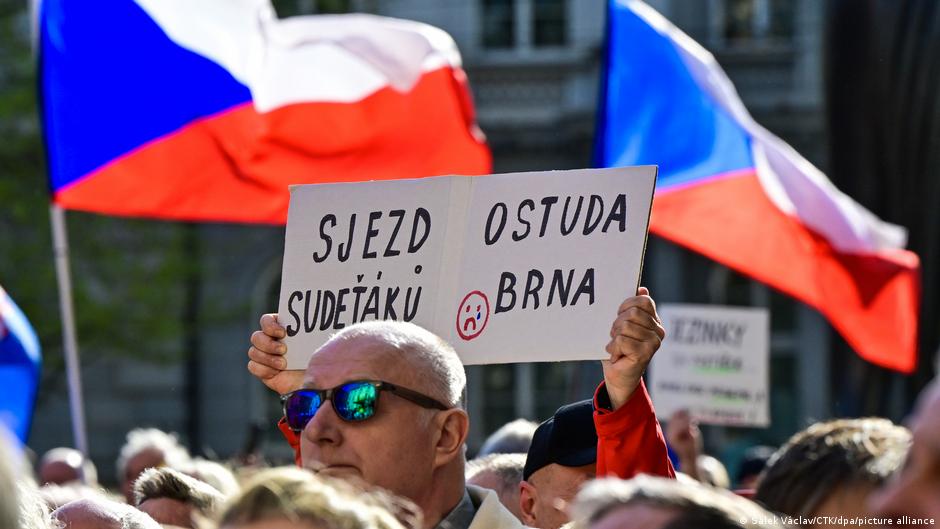
The annual Sudetendeutsche Tag meeting of ethnic Germans and their descendants expelled from Czechoslovakia after World War II will take place in the Czech city of Brno from 22 to 25 May as part of the Meeting Brno festival of reconciliation.
But the incident has sparked protests and a parliamentary declaration warning against what some Czech lawmen call “historical revisionism” and “relativization of Nazi crimes.”
“The Chamber of Deputies expresses its opposition to the holding of the 76th conference of the Sudeten German Country Team [Sudeten German Association] “On the territory of the Czech Republic, taking into account the historical context and the fact that attitudes questioning the post-war settlement have long been visible in parts of this movement,” read the declaration passed in the lower house of the Czech Parliament on Friday.
The resolution, which was symbolic and non-binding, passed by 73 votes to none, with four abstentions.
boycott in parliament
Centre-right opposition parties boycotted the debate and accused the ruling coalition – which also includes the far-right SPD party – of exploiting the issue for political gain.
Prime Minister Andrej Babis has apparently changed his stance on the incident. He recently said that the gathering in Brno is “not a fortunate development”, while previously referring to it in neutral terms as a civil initiative that the Czech government was not dealing with.
This incident also led to protests in Brno. About 500 people attended a demonstration organized by the SPD in April.
The SPD strongly opposes this gathering and accuses Sudeten German organizations of trying to overturn Bene’s orders after the war, which confiscated German property and stripped the citizenship of ethnic Germans.
This accusation is rejected by Bernd Posselt, president of the Sudeten German Association, the main organization representing Sudeten German expellees. Posselt has emphasized that the Sudeten German Association no longer wishes to challenge the post-war order and described the event as an effort at reconciliation.
In 2015, the association made some significant changes to its charter, removing references to compensation and land reclamation, among other things.
Posselt, a former MEP from Bavaria’s conservative Christian Social Union, told DW that the organization wants an honest discussion of the past. He has since complained about the parliamentary announcement and insisted that the gathering would go ahead.
Organizers of the meeting Brno festival also issued a statement saying that despite the controversy the gathering would go ahead as planned.
‘A very important meeting’
“I think that at a time when wars and nationalism are on the rise around the world, this meeting between us and our Czech friends is very important,” Posselt told DW by telephone from Munich.
“This shows that as Europeans and Central Europeans we have learned from history – including the Sudeten Germans,” he said.
Posselt said, “Our first aim is to look at history objectively. We strongly condemn what the German Nazis, including many Sudeten Germans, did against the Czech people. But we also ask the Czech people – and our many Czech friends – to look at the dark points of their history.”
“It is also about dealing with the moral aspects of history as well as recognizing 800 years of productive cooperation in the country.”
Focus on reconciliation
The gathering is being hosted by Meeting Brno, a civic initiative focused on Czech-German reconciliation and remembrance of both Nazi crimes and post-war expulsions.
It invited the Sudeten German Association, which usually holds its annual meeting in Bavaria, to gather in the city this month.
“The question is not why the Sudeten German meeting is being held here, but rather why it has never been held here before, because this is their country of origin,” said Petr Kalousek, co-founder of Meeting Brno.
“All these people, or their ancestors and families, lived with us – or we lived together – in the same country for more than 800 years,” he said.
painful past
For more than a decade, the festival has organized the so-called Peace, Coexistence and Reconciliation March, retracing the route of the Brno Death March of May 1945, when thousands of ethnic Germans from Brno were driven out of the city and marched toward the Austrian border.
The issue remains highly sensitive in the Czech Republic due to the role of many Sudeten Germans in the destruction of interwar Czechoslovakia.
In the country’s last democratic elections before the war in 1935, nearly two-thirds of Sudeten Germans voted for the pro-Nazi Sudetendeutsche Party, which advocated the annexation of Czechoslovakia’s German-speaking border areas into the Reich.
Following the Nazi occupation and the horrors of the war, approximately three million German speakers either fled or were expelled from Czechoslovakia.
The expulsion was given the green light by the Allied powers and formally approved at the Potsdam Conference of 1945.
Historians estimate that 15,000 to 30,000 ethnic Germans died due to violence, disease, suicide, and harsh conditions in connection with their expulsion from Czechoslovakia.
Protest and support in Brno
At a recent heated meeting of the Brno city council, a local councilor voiced his opposition to the gathering and said, “We do not forget what happened before, in the post-war period. We do not forget the destruction of Czechoslovakia, the occupation, and the lives of millions of people destroyed, including my grandmother.”
He added, “The Sudeten Germans present themselves as champions of reconciliation. But those who could demand that reconciliation are long dead. And we have no right to speak or act for them.”
Despite increasing political pressure and protests, Brno mayor Marketa Vankova has continued to support the assembly.
Security is expected to remain tight at the Brno exhibition grounds where the meeting is being held. Bavarian state Prime Minister Markus Söder and Germany’s Interior Minister Alexander Dobrindt are both still expected to attend.
Meanwhile, Czech President Petr Pavel has taken the Meeting Brno festival under his auspices.
Czech media on Monday quoted the office of the President of the Republic as saying that Pavel had given his patronage to the festival, as he had done in the previous two years. Prague Castle said the project aims to promote honest dialogue and sharing of stories and historical experiences.
Edited by: Angiel Flanagan