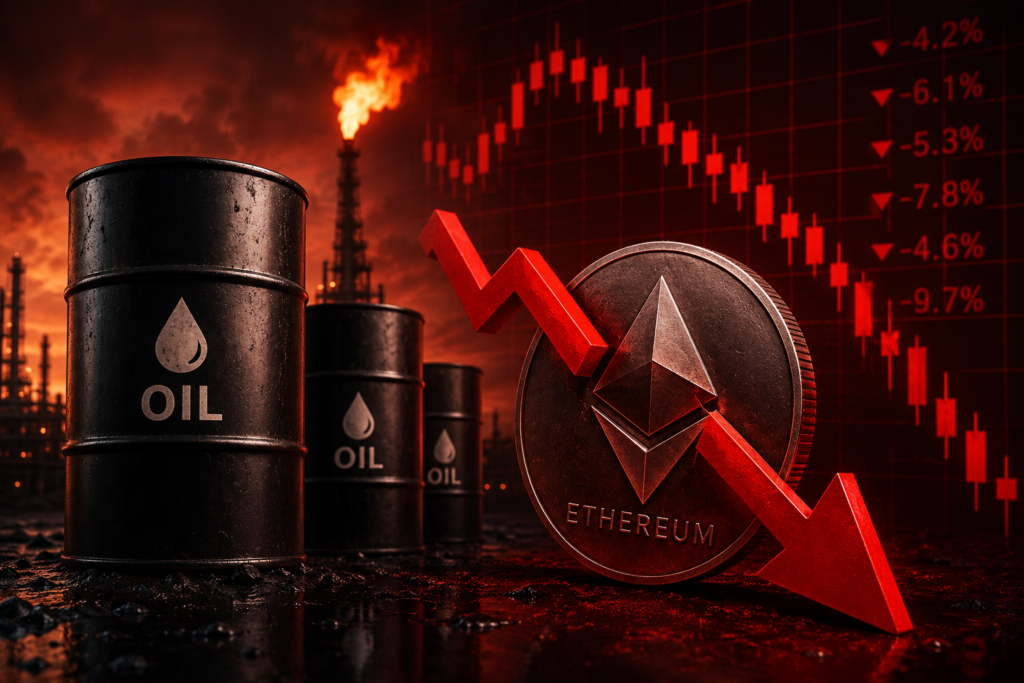
Ethereum (ETH) is going through a period of weakness marked by macroeconomic factors and international geopolitical tensions. That’s what Tom Lee, co-founder of Fundstratwho stated that one of the main elements that is affecting the performance of the asset is the sharp increase in oil prices registered in recent weeks.
The second largest cryptocurrency on the market fell to a minimum intraday of USD 2,097 during the day on Sunday, its lowest level since April 7. Subsequently, ETH managed to stabilize around $2,116accumulating a daily drop of close to 2.9%.
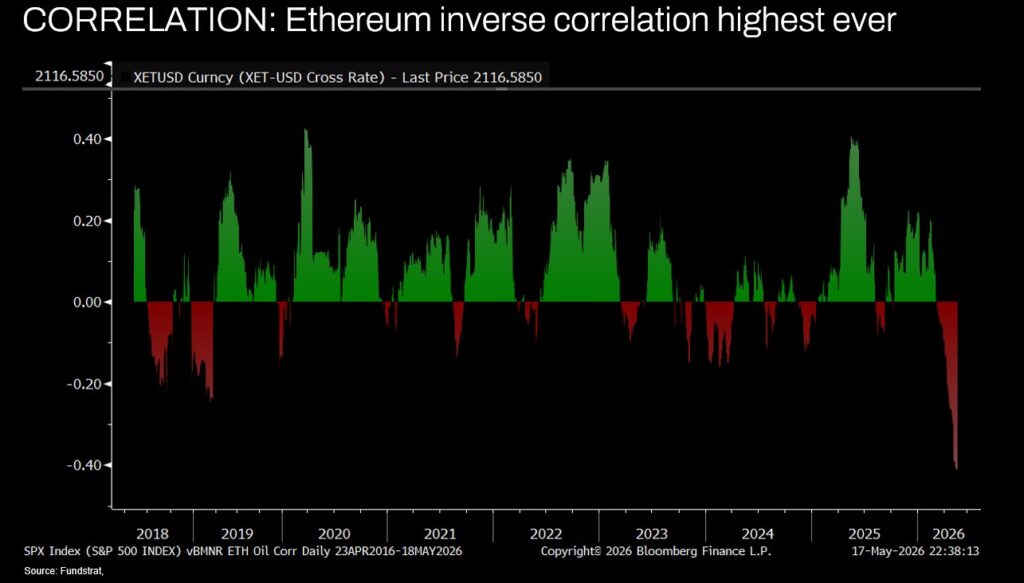
Through posts on X, Lee explained that the recent behavior of crude oil and Ethereum has shown an increasingly marked inverse correlation. According to the analyst, while oil continues to advance driven by geopolitical uncertainty in the Middle East, ETH maintains a sustained bearish trend within the market.
The executive assured that in the short term, the increase in oil became the main obstacle for Ethereum. In his opinion, the rise in energy prices and the increase in risk aversion end up especially affecting more volatile assets, such as cryptocurrencies.
The rise in oil coincides with a new escalation of tension related to the Strait of Hormuzone of the most important sea routes for global energy trade. The possibility of interruptions in international supply raised barrel prices rapidly in recent weeks. Brent crude oil traded close to $111 per barrel on Monday, accumulating an approximate advance of 16.4% over the last month.
For Lee, this context ended up directly affecting investors’ appetite for Ethereum. As indicated, The advance of oil in recent weeks coincided with a progressive fall in the price of ETHreinforcing the inverse relationship between both assets.
However, the executive considers that an eventual correction in the price of crude oil could open space for a recovery of Ethereum. Despite the recent weakness, he described the current scenario as “short-term tactical noise,” insisting that ETH’s structural fundamentals remain solid.
Despite the short-term bearish scenario, Lee maintains that Ethereum’s structural thesis remains sound. The analyst considers that the most important narratives for the network continue to be the tokenization of real-world assets and the growth of agentic artificial intelligence. In this sense, projected that ETH could reach a range between USD 9,000 and USD 12,000 towards the end of 2026supported precisely by the growth of institutional tokenization and the adoption of the network linked to artificial intelligence.}
Analysts suggest other factors
Other analysts and financial firms in the sector believe that the recent pressure on Ethereum responds to a broader combination of factors, beyond the oil rally. Reports from entities such as Citigroup and Standard Chartered have warned of a deterioration in institutional appetite towards ETH, accompanied by capital outflows from ether-linked ETFs and increased market preference for bitcoin. Added to this are the increase in ETH reserves on exchanges, sales by large investors and a macroeconomic environment marked by greater risk aversion, factors that continue to limit the performance of the second largest cryptocurrency on the market.
In the future, the projection for Ethereum remains bullish in the long term, but with large differences in the short and medium term. In recent Reuters reports, Citi cut its 12-month target for ETH to $3,175, with a bullish scenario of $4,488 and a bearish scenario of $1,198; The firm argued that Ethereum is very sensitive to user activity and institutional flows, although it sees support in stablecoins and tokenization.
Standard Charteredon the other hand, maintains a more optimistic vision and said that 2026 will be “the year of Ethereum”, with a projection of $25,000 by the end of 2028. The bank justified this thesis due to the greater use of the network, the growth of stablecoins and institutional adoption.
What is certain is that the currency’s recent behavior reflects how the cryptocurrency market continues to be exposed to both macroeconomic factors and international geopolitical tensions, even as positive long-term expectations for the ecosystem persist.