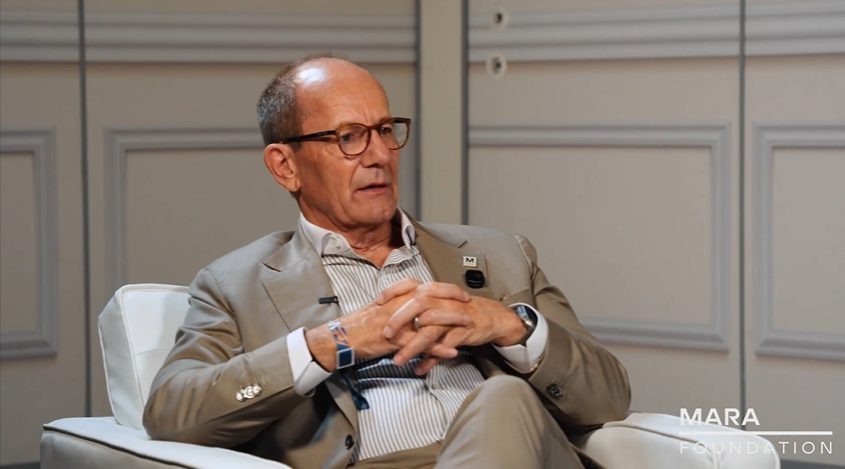
Thiel also considered that “we need to implement procedural changes to be ready.”
MARA Holdings launched the MARA Foundation to fund the maintenance of the Bitcoin code.
Fred Thiel, CEO of the company Mara Holdings (MARA), stated that the risk of quantum computing for Bitcoin is “minimal” in terms of the network’s transaction history, and that the real danger is concentrated in wallets with exposed public keys.
The statements were made in an interview published on May 18 in which Thiel also explained that the new MARA Foundation is an organization aimed at financing the maintenance of the Bitcoin code, preparing the network for quantum risk and promoting education about Bitcoin in developing countries. This Foundation, as reported by CriptoNoticias, was launched at the end of last April.
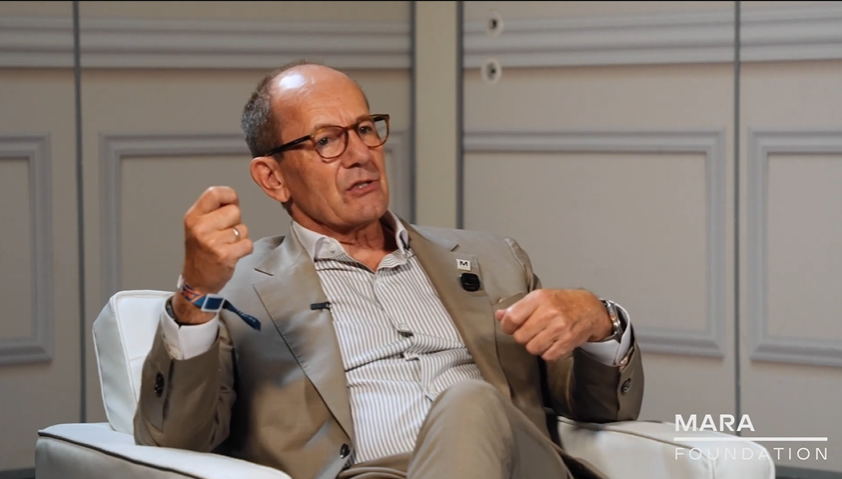
The danger of quantum for Bitcoin lies in old addresses, according to Fred Thiel
“In the Bitcoin ledger itself, because it is symmetric, the quantum risk is minimal. Even if quantum computing advances at the speed of light, it is still minimal, basically on the mining side. The risk is really in these wallets (on old addresses),” said Thiel.
In those old Bitcoin address formats that Thiel points out, for example Payment to Public Key (P2PK), every time a wallet makes an outgoing transaction, its public key is permanently recorded in the blockchain and, therefore, visible to any attacker seeking to apply a quantum attack.
Deriving that private key from the public key should be computationally impossible, but that’s exactly the kind of problem quantum computers can solve efficiently, Thiel said.
Modern addresses that have not yet spent funds keep your public key hiddenwhich eliminates that attack vector as long as they remain unused. The CEO of MARA believes that users should use these addresses to store their bitcoin and, if they have to make a payment, switch to an address that has not revealed their public key.
Faced with this quantum risk, Thiel also considers prior preparation relevant:
We need to implement procedural changes to be ready. What you don’t want is for an attack to occur and not have a response. And if you can mitigate the risk of an attack by already having a publicly known mechanism, making it less attractive to execute, you may never have to wage war. You simply set up a big enough threat. It is, unfortunately, something like mutually assured destruction.
Fred Thiel, CEO of MARA.
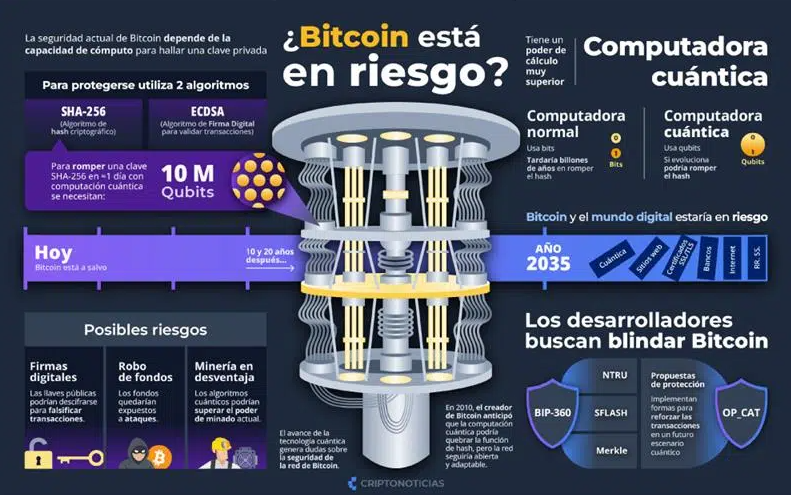
The scope of quantum risk for digital systems, according to Thiel
Thiel extended quantum risk beyond Bitcoin to gauge the scale of the problem:
All the technology that protects your bank accounts, your health records, everything that’s in your cloud accounts, all those systems with passwords and usernames, are typically RSA based, where it’s very difficult to create the key but, once created, it’s simple to unlock it. And quantum computers are really good at breaking that.
Fred Thiel, CEO of MARA.
RSA operates under the same asymmetric logic as ECDSA: the difference from classical computing is that a sufficiently powerful quantum computer would not need brute force to break that scheme, but would solve the underlying mathematical problem directly.
Therefore, Thiel points out, The risk is not exclusive to Bitcoin but structural to most of the global digital infrastructure. The businessman points out that the day that Google or Microsoft change their HTTPS certificates for quantum-resistant technology, it will be the definitive sign that the risk is imminent.
Additionally, the quantum danger, Thiel warned, is not limited to an eventual public attack when quantum computing matures. According to the executive, nation-states have been collecting encrypted internet traffic for years with the hope of deciphering it in the futureonce they have the necessary quantum capacity. That means that sensitive data transmitted today under asymmetric schemes could already be stored for a deferred attack, even if that attack is not yet executable.
The protocol as a community project
The MARA Foundation, according to Thiel, responds to the fact that “there are just a handful of people who are the ones who really do the heavy lifting: reviewing improvement proposals, scheduling them, putting them in the queue, doing quality control, putting them in the test environment. “All of this is done by a handful of people who are actually volunteers.”
To describe the maintenance he believes the protocol needs, Thiel used an analogy: “If we want Bitcoin to thrive, we need to make sure that, just like a bonsai plant, we are pruning, trimming, adjusting and making small modifications. Her core is very solid, but she needs to be taken care of. “It needs a little maintenance, it needs to go into the shop from time to time for a little adjustment.”