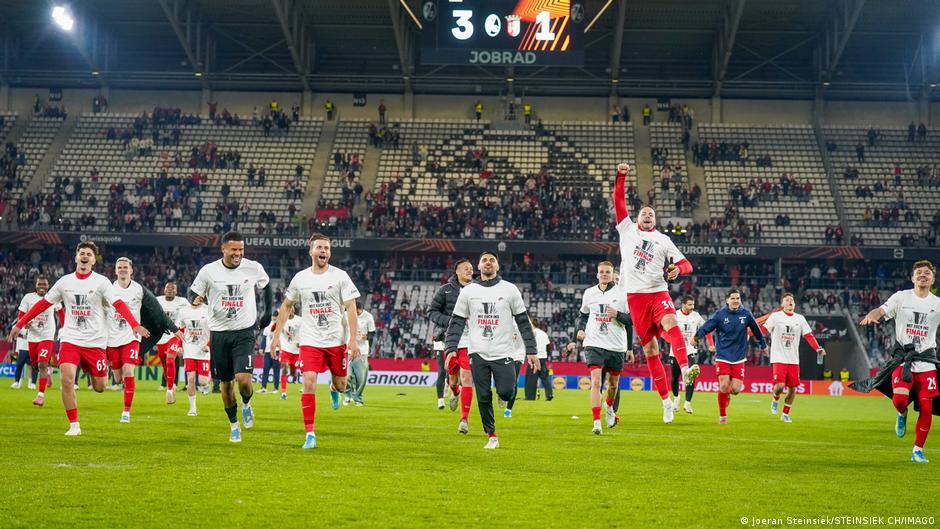
When putting into context the significance of Freiburg reaching their first European final, the words of Bayern Munich head coach Vincent Kompany seem most relevant.
“I think so too [Freiburg’s success] Kompany recently said, “It embodies everything that is positive about football. This is a small club that is developing itself with its own resources.” What Freiburg is doing is a great example for many other clubs.”
Much has been written about the small club from Baden-Württemberg in recent years. A local club at its core, Freiburg has evolved from a team bouncing between divisions into an established Bundesliga side.
Despite a first-ever German Cup final in 2022 (ending in a dramatic defeat on penalties), a Europa League tie against Juventus the following year and a new stadium in 2021, Freiburg has never strayed from the local club’s core values. They are prudent with their business, growth has always felt natural, and ultimately, in an age of staggering financial power, remain that rarest of all things in football: a sensitive club.
Youth Development, Wealth Management, Cultural Vibrancy
Freiburg has an excellent record of developing youth players. It is estimated that 60 or more players currently in the top three divisions were either developed by the club or have played for the club. Then in recent years the club has shown financial restraint. Beyond his approach in the transfer market – his record signing is Ritsu Dou in 2022, for a reported fee of just over €10m ($11.6m) – his management of the books is truly an example for others.
In 2025, Freiburg recorded a profit of €11.8 million despite not playing in Europe, where prize money is higher. Therefore, unusually, Freiburg has no bank liabilities.
Noah, a 26-year-old fan who has held a season ticket for 20 years, believes this management helped steer the club through the coronavirus pandemic, at a time when historically more powerful clubs like Schalke and Borussia Mönchengladbach were struggling.
“I would go so far as to say that without the pandemic, this dramatic increase would not have happened, because other clubs would have been able to continue operating as usual,” Noah told DW.
Plus, there’s the way the city and the club work together.
“There are cafes in Freiburg where you know players go,” Noah said. “They don’t live a closed life. You can see them walking around town and you can say hello. I think that’s why many players stay at a club for years rather than taking the next step, even if they could.” Matthias Ginter and Vincenzo Grifo are the two most obvious players who both left but returned. Both have played their best football at Freiburg. “The club knows me, and I know the club,” Griffo summed it up. Pforzheim Courier Newspaper. “I feel like I never left.”
Head coach connection is also the key to development
The club’s success and recognition are also linked to their charismatic, emotional and outspoken head coach Christian Streich, who departed in 2024 after 12 years in charge. Streich regularly spoke about social issues in Germany and often lamented football’s place in the world. Now, the club is quietly enjoying its tenth consecutive season in Germany’s top flight, with a chance to win a major European trophy and qualify for the biggest showdown in club football, the Champions League.
“With Christian Günther, who is now the club’s all-time leading scorer, with Vincenzo Grifo, who is our all-time leading scorer, and now with Nico Höfler, who has been the face of this club for years and who is about to play his last game for the club in an international final in Istanbul, it is emotional,” said Noah, who described the season as “incredible”.
And then time is given to the head coaches. Current head coach Julian Schuster was not only a former assistant coach, as is often the case at the club, but he is also just the fifth Freiburg head coach since 1991. In the same time frame, Hamburg has 28 (not including the interim). Schuster has followed several others and made a seamless transition as head coach.
“I remember him as a player, as our captain. I still remember him doing his bicycle kicks. Then, in 2022, he was in the end zone in Hamburg for the German Cup semi-final and singing loudly,” Noah explained on why he is such a natural fit.
A fairy tale ending in sight?
In this European race, Freiburg finished seventh in the league stage, before Genk, Celta Vigo and Braga made the finals. Their rivals are Premier League side Aston Villa, whose team has a market value of around €550m – more than double that of Freiburg.
It would not be an exaggeration to say that they are Dalits.
“To be completely honest, I’d be a little bit scared about what would happen if the club actually won a game like that,” Noah said, admitting that his Freiburg DNA is probably getting the better of him. “With the growing success of the club and the ever-increasing number of members—I worry that eventually it will become a question of how do we maintain our identity and maintain realistic expectations.”
The hardest thing for Freiburg fans to handle over the next few days will be emotion, not expectation.
“The chance to share this with the people I have stood with since I was a little kid, with the people with whom I have experienced all this, with whom I traveled to Sandhausen, with whom I traveled to Koblenz, and who have been with me in all those away games, even in the second division, and who have been with this club for years… it is surreal, and it makes me really happy and emotional,” Noah said.
Edited by: Matt Pearson