Blaming mining for electrical problems is propaganda.
Foreign capital wants to invest in Venezuela, but with stable rules.
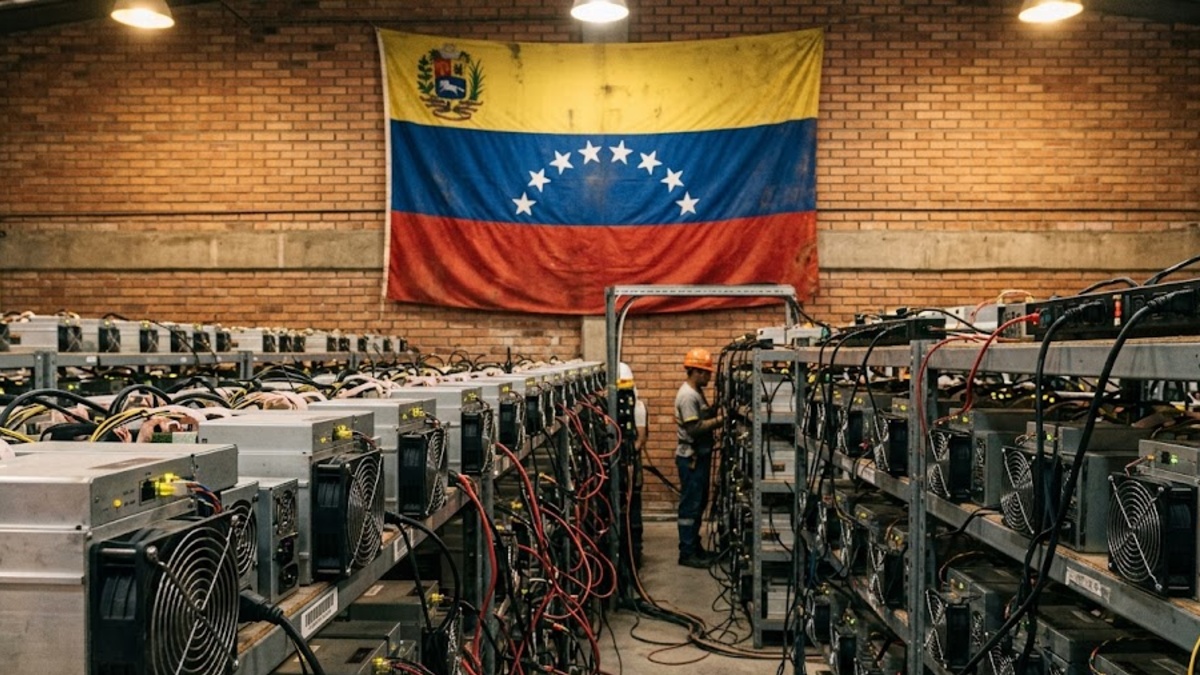
On May 18, the Vice Minister of Electrical Energy of Venezuela, Brigadier General Vianney Rojas, traveled to the San Vicente Industrial Zone, in Maracay, to participate in person in the dismantling of a farm with 4,000 ASICs that consumed between 8 and 10 megawatts as part of what they have called “Operation Hunter.”
That same day, Hashrate Index published that Venezuela burns gas equivalent to 344,000 barrels per day in the Orinoco Belt, Maracaibo and the Oriente, enough energy to exceed Bolivia’s entire hashrate if it were used. The same day. The vice minister was chasing ten megawatts lit while two gigawatts burned in the openwithout anyone going to turn them off. Mega against Giga. And no one is going to go, because that fire is not illegal: it is the current operation of PDVSA.
The government’s relationship with Bitcoin mining has been alarmingly variable. “Hunt” between 2014 and 2017, when equipment was seized house by house. Timid legalization with Decree 4,196 of September 2020 and the creation of the Comprehensive Registry of Miners under the control of Sunacrip. The PDVSA Crypto episode, opaque until today. The fall of Sunacrip in 2023, which left legal miners in a limbo where they had a license, but no state counterpart to talk to, without direction or clarity.
And now the absolute veto of May 7, 2026, reinforced with the so-called “Operation Hunter” and rewards of USD 1,000 for citizen reporting—more than four times the average monthly income of a Venezuelan.
Hayek had an uncomfortable point to admit: economic calculation is not a problem of intelligence, it is a problem of rules. Where the rules change every two years, industry is not built, shadow markets are built. And what the ruling party built, without fully intending to, is exactly that: a mining industry condemned to clandestinity by decree.
It is advisable to read the official justification carefully. The statement from the Ministry of Electric Energy speaks of “severe impact and structural damage” and “fluctuations that alter the protections of the network.” But the The Venezuelan electricity crisis is not caused by a few warehouses with ASICs. It is caused by a transmission infrastructure that has lost the capacity to transport what it generates. Venezuela has up to 17.75 GW of installed hydroelectric capacity, but only 8.5 GW is dispatchable through the 765 kV network, whose infrastructure has more than 60% of its components exceeding its useful life.
Of every 100 MW that leaves Guri, only 40 MW reaches Venezuelan homes. The rest evaporates in obsolete lines, people stealing copper, unmaintained substations. That was not caused by the miners. This was caused by a decade of disinvestment in the only thing that physically sustains the country: infrastructure.
Irony is crowned by the India Urquía plant. Four Siemens SGT6-5000F turbines. USD 2,178 million invested in its day. Stop. Because? Because there is no currency for maintenance contracts. Accusing Bitcoin mining—which all in all contributes 5 exahashes per second, around 0.47% of the global hashrate—of the instability of the national electrical system is a mistake.
The study Rethinking Load Growth from Duke University’s Nicholas Institute demonstrated that flexible loads—and Bitcoin mining is the quintessential flexible load—make it possible to integrate up to 76 gigawatts of new demand into the US electrical grid, equivalent to 10% of the national peak, with just a 0.25% voluntary reduction in consumption per year. That is to say: Loads that can be turned off when the grid requests it are not a threat, they are the buffer.
Texas, where ERCOT integrates miners in response to demand, saved billions stabilization during the heat waves of recent years: when residential demand rises, miners shut down in seconds and return megawatts to the grid, sometimes charging for doing so. Then, when demand is low, they come online again, maintaining consumption stability.
The theoretical point is simple. Bitcoin mining is the only 100% interruptible, 100% relocatable, 100% modular industrial load on the planet. An aluminum factory does not turn off when light is needed for Maracay’s air conditioners. An ASIC yes. An artificial intelligence data center needs uptime close to 100%; a miner happily operates at 60% if that suits the network. That difference—technical, not ideological—is what makes Bitcoin mining beneficial to the power grid.
Meanwhile, the rest of the region does the math without so much drama. Alps, an Italian operator that already runs 15 EH/s globally, is going to deploy 127 MW in an idle thermoelectric plant in Cochabamba to reach 8.5 EH/s of Bolivian hashrate. Francesco Buffa, its CEO, has already said publicly that he would look at Venezuela if the market opened.
What for Bolivia is direct foreign investment in a thermoelectric plant that would otherwise rust, for Venezuela is a farm raided by the Bolivarian National Guard under “Operation Hunter.”
The burned gas of the Faja equivalent about 2 GW of generating potential. At the CapEx costs of the industry—between USD 350,000 and USD 1,000,000 per megawatt in mining infrastructure with associated gas—we are talking about between USD 700 million and USD 2,000 million in foreign private investment that could enter the country in joint ventures such as those already operating with Chevron in Texas, with oil companies in Nigeria, with Eni and Shell in other geographies. A clear license, a reasonable tax on profits in BTC or its equivalent in dollars, and the Venezuelan treasury would capture fresh foreign currency without touching a single megawatt of the residential network.
This is what the ministry decided to ban on May 7. And here the question stops being technical and becomes political. Why does a State that desperately needs foreign currency, that has thermoelectric infrastructure stopped due to lack of dollars for maintenance, that faces daily blackouts in a third of homes, pursue precisely the only industry capable of capitalizing on its surpluses?
Taxing a legal industry produces more revenue, year after year, than confiscating 4,000 used Whatsminer M30S machines in one go. The account is elementary.
What is missing is not resources, nor geography, nor even foreign capital willing to come. What is missing are clear and lasting rules over time.
The government is rejecting with its own hands the only global industry willing to enter Venezuela right now with capital, technology and dollars on the table.
Washington relaxed the OFAC GL 48A and GL 49A licenses in March to allow US companies to provide services to the Venezuelan electricity sector. Meanwhile, mining machines are seized and rewards are offered to informers. Bitcoin mining may be the solution to stabilize the Venezuelan electrical grid; You don’t have to hunt it.
Disclaimer: The views and opinions expressed in this article belong to its author and do not necessarily reflect those of CriptoNoticias. The author’s opinion is for informational purposes and under no circumstances constitutes an investment recommendation or financial advice.