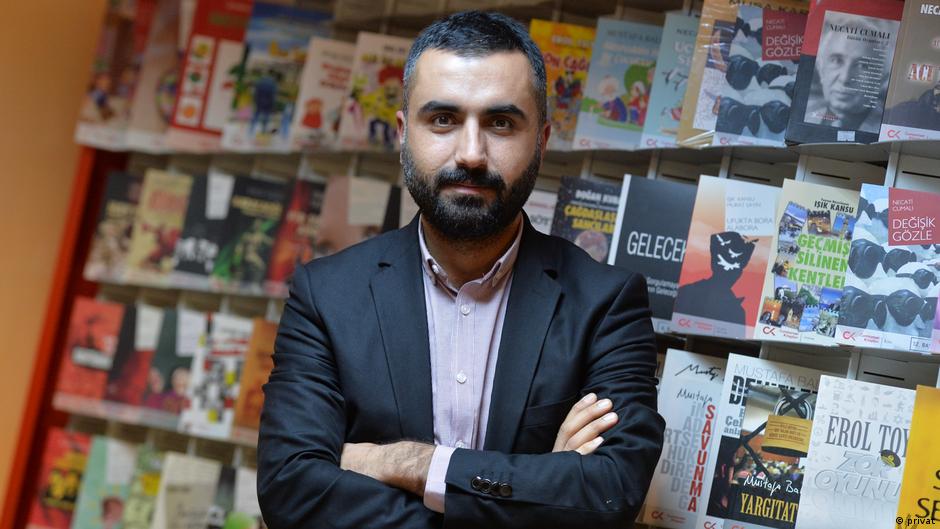
DW correspondent Alikan Uludag, accused of publicly insulting President Recep Tayyip Erdogan in a total of 22 social media posts, spreading disinformation and insulting state institutions, will appear in court for the first time on Thursday.
Uludağ was arrested at his apartment in Ankara on 19 February and transferred to Istanbul, where he was held in pre-trial detention. Although he is being held in Istanbul, his trial is taking place in Ankara. Despite his specific request to present his defense in person, Uludağ is only allowed to participate in the proceedings via video conference.
DW described the arrest as a ‘targeted attempt to intimidate’
Uludağ’s case is considered particularly notable, as he is one of the few remaining journalists in Turkey who focuses on reporting on the judiciary and court proceedings.
Following his arrest, DW Director General Barbara Massing described the allegations against him as baseless. He described his arrest as a “targeted attempt at intimidation” and said his case shows “the extent to which the government is widely suppressing press freedom.” Masing emphasizes that Uludag has an excellent network and access to key sources. From the government’s perspective, he said, this is what could make them an uncomfortable and potentially dangerous voice.
Erol Onderoglu, the Turkish representative of press freedom watchdog Reporters Without Borders (RSF), said Uludag was being “arbitrarily targeted by a judiciary beholden to those in power.” He said that Uludağ, whom he described as a “serious journalist known for investigating matters of public interest”, may have angered those in power with his investigation.
Uludag himself considers his arrest a deliberate attempt to prevent him from continuing his work. He has previously reported on contradictions in the indictments and inconsistencies in the testimony of key witnesses, topics he claims to have covered impartially.
He said, “I have not deviated from my journalistic work. I believe that most of the members of the judiciary themselves are concerned about the increasing politicization of the proceedings.” “I will continue to pursue the truth. I do not accept any allegations.”
The journalist also described his time spent in custody as a contradictory experience. While the opportunity to see daily prison life and the mental state of prisoners up close is personally difficult, she said, it is also journalistically important to her work as a justice correspondent.
press freedom under pressure
Uludağ is not the only Turkish journalist to be detained or face political pressure. Since his arrest in February, there have been a number of prosecutions against media professionals, resulting in more convictions than journalists typically receive in an entire year.
The state of press freedom in the country is grave: In RSF’s 2026 World Press Freedom Index, Türkiye dropped four places And is now ranked 163rd out of 180 countries. Censorship, legal restrictions and the fear of criminal prosecution are becoming a part of everyday life for journalists in the country. According to RSF, fundamental guarantees of press freedom are being eroded around the world but this process is particularly evident in Turkey.
Turkish Journalists Association (TGS) has called Widespread pressure and repression against media professionals. This includes preliminary investigations, criminal and civil trials, as well as physical and verbal attacks on journalists and media outlets.
TGS has warned that state interference against media outlets is increasing, saying these are not isolated cases but a structural problem. The principles of the rule of law are being increasingly weakened, and constitutional guarantees are losing their importance. Journalistic work in particular is being repeatedly targeted by criminal and administrative legal measures.
According to TGS, Turkey is among the countries where charges such as “disinformation,” “insult to the President” and “defamation of state institutions” are routinely used to suppress critical reporting. The data clearly shows that these are by no means isolated cases.
15 journalists, media persons detained
Article 217/A of the Turkish Penal Code, which came into force in 2022 and is often publicly referred to as the “censorship law”, plays a central role in this context. It criminalizes “the public dissemination of misleading information” and is seen by critics as a tool that has had a chilling effect on journalistic practice.
The most prominent cases in recent months, in addition to Uludağ, include the investigation against Ismail Ari, a reporter for the leftist opposition newspaper Birgun. Proceedings were initiated against both of them on the basis of similar allegations.
Although journalists are often ultimately acquitted, arrests, threats of imprisonment, legal fees, and court proceedings lasting months have a lasting deterrent effect. A number of media professionals have been prosecuted or are currently being prosecuted under this provision. Critics argue that this shows that legal proceedings themselves have become a tool of punishment.
According to TGS, as of 27 April, 15 journalists and media persons were in detention. These included Atkin News Agency reporter Pinar Geyip, who was arrested on charges of “membership in an armed terrorist organization” and “propaganda for the organization.” Specifically, the case involves alleged ties to the Marxist–Leninist Communist Party, which is banned in Turkey. His research, interviews, and the funerals he covered were used as the basis for the charges.
While Uludag awaits his first hearing, his primary concern is that he is currently unable to report on potential human rights violations within the prison system – that is, on people whose cases he might have covered as a journalist under different circumstances.
This article was originally written in German.