
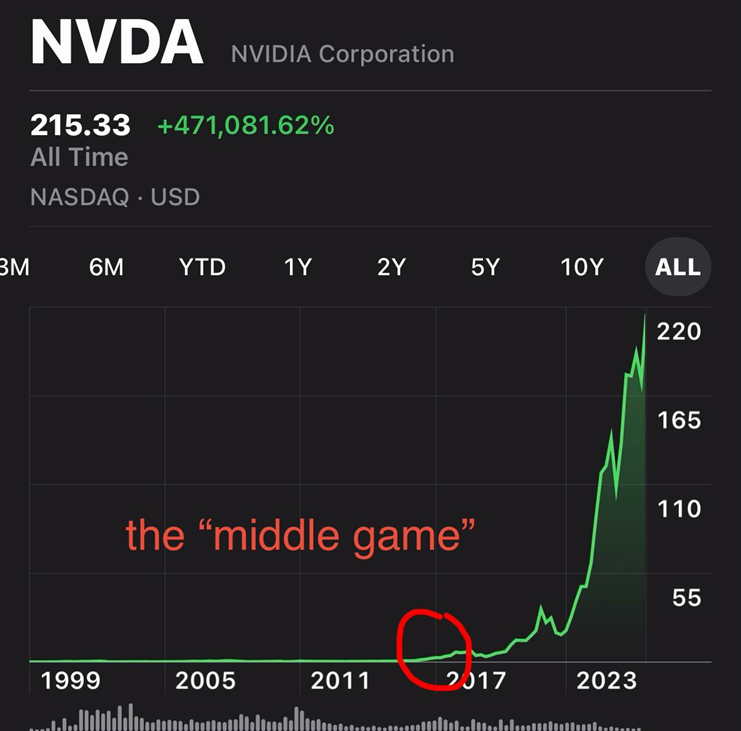
The director of the Bitwise company, Jeff Park, stated in a publication published on May 24, 2026 that the cryptocurrency market would be entering its “most bullish” phase, when compared to the period prior to NVIDIA’s takeoff before the boom of artificial intelligence.
In his analysis, he maintains that the sector is going through a turning point where The infrastructure is already built, but mass adoption has not yet materialized due to regulatory frictions and incomplete integration with the traditional financial system.
In this context, the manager describes the current moment as a “narrow window in which a revolution is visible to some, but not to others”, an idea that he uses to illustrate how certain technological infrastructures may remain undervalued until the market incorporates them en masse.
The central comparison of his thesis is based on the case of NVIDIA, a company that for years developed its parallel computing ecosystem and its CUDA architecture—launched in 2006— without immediate massive demand. That previous work ended up being key when the rise of artificial intelligence turned that infrastructure into a pillar of the new global technological cycle.
Additionally, Park revisits a 2015 conversation between NVIDIA CEO Jensen Huang and Tesla CEO Elon Musk as analogy of the current moment. In that exchange, both discussed the potential of artificial intelligence and autonomous driving at a stage in which mass adoption or widespread applications did not yet exist.
The manager uses this example to reinforce his thesis that Technological revolutions are often evident long before the market fully incorporates them. In that sense, he maintains that the cryptocurrency ecosystem is in a phase comparable to artificial intelligence before its commercial explosion.
A growth marked by three phases
The Bitwise executive divides the evolution of the sector into three phases. The first, from 0 to 10 mph, corresponds to the initial adoption of cryptocurrencies as digital money and a permissionless transfer system. The second, from 10 to 50 mph, represents the current stretch, where the industry is trying to integrate with the traditional financial system. The third, above 50 mph, would be the stage in which chain capital markets are consolidated as the standard infrastructure of the global financial system.
According to Park, The intermediate section is the most complex. It is the point at which technology comes into direct contact with regulatory frameworks such as AML and KYC, as well as legacy banking systems and fragmented reporting structures that slow its institutional adoption.
In his words, “money in a pre-internet financial infrastructure is colliding with compliance requirements like AML and KYC, creating needs for accuracy and speed that current systems do not yet address.”
However, it is important to highlight that there are variables that, although the executive does not deny, he does not consider them in his thesis, such as the possibility that regulation in Europe or the United States evolve towards more restrictive frameworks than expectedor that part of the traditional financial infrastructure advances through closed digitalization systems without the need for public cryptocurrency networks.
Added to this is that the duration of this intermediate phase could extend for more years than the retail market is willing to support from a psychological point of view, something that has historically influenced the premature exit of investors in technological transition phases.
For the moment, Bitwise’s approach leaves the market in a reading of structural transition rather than a speculative cycle. If the parallelism with NVIDIA is maintained, the sector would not be close to its maturity, but still in a phase prior to mass adoption.