“We’re quite busy on the production side of things,” Inna Hilgenberg told DW. She is deputy head of the packaging department at Dr. Wolff, a medium-sized cosmetics and pharmaceutical company based in Bielefeld. Behind her, black and red shampoo bottles are filled as they slide down the conveyor belt. “It is not so easy to write instructions while being busy with these tasks,” he said.
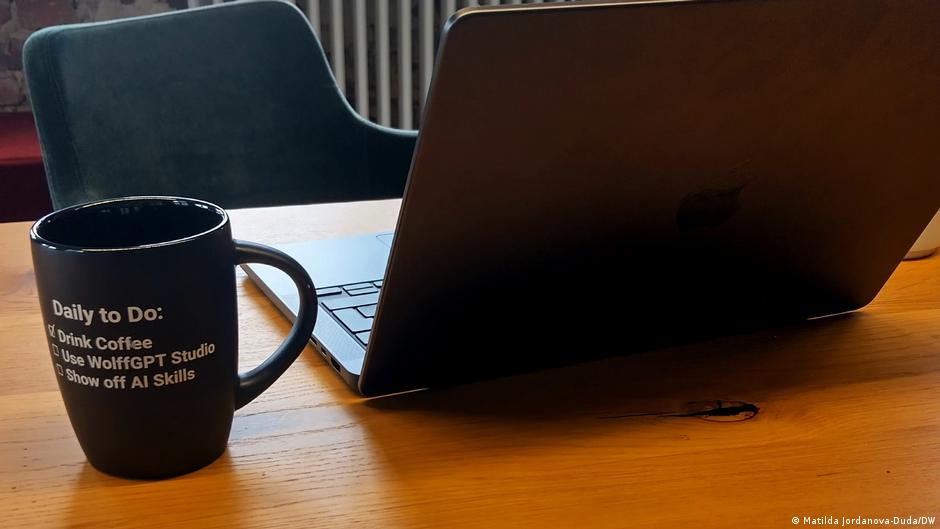
That’s why Hilgenberg has come to appreciate her company’s own artificial intelligence (AI) tool, WolfGPT, which she uses practically every day. Her job includes scheduling and directing employees in the filling and packaging department, as well as ensuring cleanliness and safety standards are met. He relies on WolfGPT to write workflows, design presentations, edit Word files and Excel spreadsheets. “I only see benefits in AI,” she told DW.
Many employees of the company had already started using ChatGPT in their free time and would prefer to use it at work as well. However, data of any company cannot be shared Public Large Language Model, or LLM. That’s why Dr. Wolff developed an in-house AI model based on an existing LLM. It is connected to selected company systems and data and hence, sensitive company data remains secure.
In Germany, larger companies are more likely to use AI than smaller companies. According to a study of future technologies conducted by IFAA, the Düsseldorf-based institute of applied science, manufacturers commonly use AI to generate text, images and code. The study found that more than 40% of companies surveyed already use AI, with 37% planning to do so.
According to IFM, a German institute that tracks small and medium-sized enterprises, increasing competitive pressure is forcing many small and medium-sized enterprises (SMEs) in the manufacturing sector to consider using AI to increase productivity and efficiency. It found that reservations in the workforce have slowed the widespread adoption of AI.
Dr. Wolfe’s employees embrace AI
Hilgenberg was one of the first employees to adopt AI at Dr. Wolfe. She completed an online training course at the company’s AI Academy and now supports others on her team who want to use the technology. About 110 of the company’s 930 employees worldwide are such AI leaders.
“They are ordinary colleagues who don’t necessarily have a technical background,” Zhuo Li, the company’s AI manager, told DW.
These AI pioneers spend about 10 hours a day watching short instructional videos and completing small tasks to get up to speed.
Topics covered include how to create good signals and what happens to the data in the LLM. They then spend part of their time identifying potential AI applications in their daily work and developing and testing prototypes for them.
They also assist colleagues who want to learn more about AI. “We have been able to find people in each team who have good ideas, a deep interest in the topic, and a willingness to share their knowledge,” Li told DW. “We encourage everyone to try what AI can do.”
A silver bullet?
SMEs are using AI to overcome the shortage of skilled workers and attract young talent. According to the IFM, LLM allows companies to carry out certain tasks and thus reduce the workload on employees, as well as the need for specialists.
The institute found that 25% of companies surveyed already implement AI. For example, a painting contractor uses a robot to prime large surfaces, while digital assistants help plan transportation routes in a refrigeration area.
According to OECD data, only 6% of SMEs across Europe currently use AI. A 2024 OECD study found that slow digitization, poor connectivity and misunderstanding of the potential benefits of AI were some of the barriers to why companies were not adopting LLMs. But the IFM also said some workers may already be using AI chatbots without notifying their employers.
‘AI agents are in use in almost all sectors’
Dr. Wolfe also teaches his employees how to create AI agents using the in-house WolfeGPT platform to perform specific tasks. These include answering specific IT support questions, standardizing international invoices, and creating social media posts.
“We already have AI agents in use in almost all fields,” Zhuo Li told DW. “While some agents are only useful to two people, others are shared with entire departments,” Caroline Bauch, an AI communications expert in the company’s human resources department, told DW. “They make the job a lot easier.” She said she has already created several AI agents herself.
“There is a high level of acceptance,” Bauch said. “When WolfGPT went down for several hours, we all realized how much we already depend on it for work.”
According to company data, about 90% of employees working at computer workstations have completed AI training modules since the fall. “These courses are completed during working hours,” Bauch said. “So we’ve kept the lessons short so everyone can complete them at their own pace.”
Administrative, creative tasks are ideal for AI applications
So far, AI has been used primarily to support administrative and creative tasks at Dr. Wolfe, although work is underway on LLM applications in the production sector.
Anyone in the company can take AI classes, as everyone benefits from a basic understanding of the LLM, whether this knowledge is used at work or in a private context. Factory workers and warehouse workers simply need to find a computer workstation.
Dr. Wolfe is eager for his employees to learn about and apply AI, as the family-run business faces competition from powerful corporations in Europe, Asia, and the Americas.
This article was originally written in German.