To a large extent, the boost comes from USDT activity on Tron.
Solana went from 6 million to 3.4 million daily users between February and May.
As of today, May 26, 2026, the Tron network has 4.5 million daily active users. With this figure, the platform consolidates an upward trend that allowed it to take first place from Solana, a network that led the sector at the beginning of the year, but is now suffering a marked slowdown in its internal activity.
The leadership change was consolidated on May 9. On that date, Tron registered 3.7 million daily users compared to Solana’s 3 million. Daily active users measure the number of unique addresses that transact during a day, a key indicator for evaluating actual network adoption.
At the beginning of the year, Tron maintained a stable base of between 3 and 3.3 million daily users, showing lateral behavior during February and March, according to signature data Artemis. However, in mid-April it experienced strong bullish momentum.
This accelerated growth led Tron to reach 4 million users in mid-May, before setting the current recordas seen in the graph.
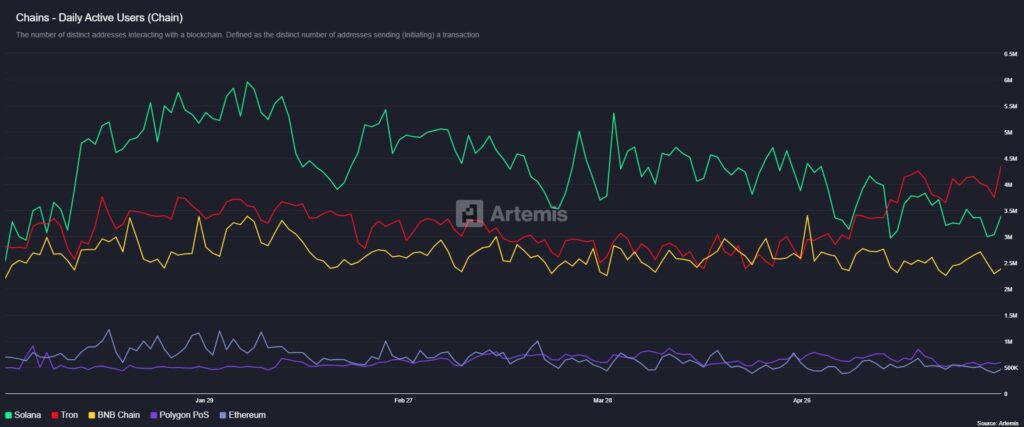
On the contrary, Solana began the period with a clear dominance of between 4.5 and 6 million daily users in January and February. Starting in March, this network entered a downward trend that worsened with a sharp drop in April. Currently, Solana is in second place with a range of between 3 and 3.2 million users.
BNB Chain remains in third place. This network did not alter the main dispute and fluctuated consistently between 2.2 and 2.8 million users daily throughout the analyzed period.
Further behind in the daily activity count are the Polygon and Ethereum networks. Polygon, a secondary infrastructure designed to make transactions more efficient than Ethereum, currently registers 590,000 daily active users. For its part, Ethereum, computes a total of 454,000 active users in their daily work.
USDT is responsible for the huge adoption of Tron
Tron’s massive growth is driven by its low transaction fees and high technical performance. These features fostered massive adoption aimed at transferring and storing value through the use of the USDT stablecoin.
Tron’s dependence on this asset is almost absolute. Currently, the global stablecoin market has a capitalization of $322 billion, of which $189 billion corresponds to USDT. The Tron network hosts 88,862 million of these tokens, representing almost 50% of the entire global supply of USDT.
This concentration is reflected internally in the network. According to data from the TronDAO organization, USDT dominance within the Tron network itself is 97%, displacing almost any other digital asset on that infrastructure.
During the first quarter of 2026, Tron recorded a total transaction volume of $2 trillion. Of that amount, 1.96 trillion dollars corresponded exclusively to operations with stablecoins, as reported by CriptoNoticias. These data confirm that users They use the network mainly as a fast and economical payment channel to move these types of cryptoassets..
While Tron largely leads in the number of daily active users due to the massive use of USDT, Solana still supports a diverse ecosystem of decentralized finance (DeFi) and tokens in constant exchange. For example, Solana records high volumes on decentralized exchanges — reaching 1 billion dollars a day —, with protocols that facilitate loans, perpetual contracts and liquidity.
In contrast, Tron’s leadership is presented in a concentrated and dependent manner. Its internal activity belongs almost exclusively to a single asset, which shows that the network is not used massively to interact with complex smart contracts or various decentralized applications, which are the technical fields where Solana regularly stands out.
The current panorama consolidates Tron as the preferred global infrastructure for the transfer and storage of value through stablecoins (specifically USDT). However, looking to the future, the challenge for the network founded by Justin Sun will be to diversify its ecosystem to not critically depend on USDT hegemonywhile Solana will have to resolve its current bearish trend and regain appeal to everyday users if it wants to capitalize again on the high historical volume it still possesses.