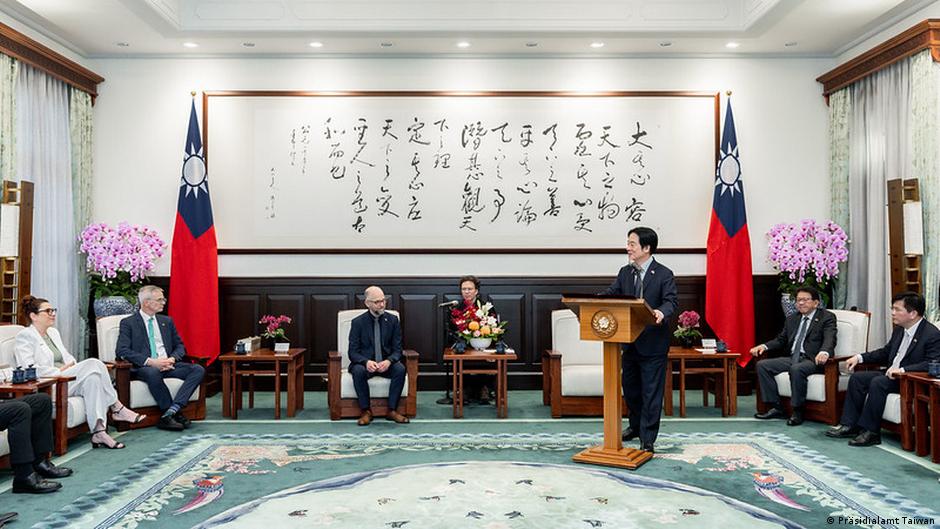
While German Economic Affairs Minister Katharina Reich is visiting Beijing, a delegation from the Bundestag, the lower house of Germany’s parliament, is in Taiwan.
The Berlin-Taipei Parliamentary Friendship Group, a cross-party association of parliamentarians that promotes international exchanges, has traveled there to “strengthen economic and cultural cooperation with one of the region’s most important democratic partners”, the Bundestag said in a statement.
The Green Party’s Till Steffen is leading a five-member delegation that also includes MPs Klaus-Peter Wilsch and Markus Reichel from Chancellor Friedrich Merz’s conservative Christian Democrats (CDU), as well as Rainer Kraft from the far-right Alternative for Germany (AfD) and Mandy Ising from the Left Party.
The nine-day visit has drawn criticism in Beijing. Chinese Foreign Ministry spokesman Mao Ning said that China has always opposed any form of official exchanges between its diplomatic partners and Taiwan.
Beijing views self-ruled Taiwan as a breakaway province that will one day be “reunified” with the mainland.
German MP rejects criticism of Beijing
“It is in Germany’s interest to keep a balanced position and not rely solely on China,” said delegation leader Steffen. Economic dependence on China – for example in batteries for electric cars – has put Germany in a difficult position, he said.
“It’s OK to do business with Beijing, but we should not be dependent on China,” Stephan said. “So at the same time it is important to maintain close ties with other countries. So it is a good thing that we are running a joint research project with Taiwan on the batteries of the future.”
AfD’s Kraft points out that before German reunification in 1990, China maintained diplomatic relations with both the Federal Republic of Germany (FRG) and the German Democratic Republic (GDR) at the same time.
Although Germany does not maintain official diplomatic relations with Taiwan, it has economic, cultural and research ties with the island.
Craft also emphasizes the economic dimension.
“It is very important for Germany to be Taiwan’s partner,” he told DW. “Taiwan is a global leader in the semiconductor sector. Semiconductors are essential for the future economy – for artificial intelligence and data centers. Given our economic challenges, Germany must not miss the opportunity to remain economically strong in the future.”
economically interconnected
Taiwanese semiconductor giant TSMC is building a new factory in the east German state of Saxony from 2024.
In collaboration with German companies Bosch, Infineon and NXP, chips will be produced in the city of Dresden for the European market from 2027.
The total investment amounts to €10 billion, which AfD sees as a successful example of how Taiwanese investors are creating new, high-quality jobs in Germany.
Taiwanese President William Lai Ching-te also praised the TSMC project in Dresden.
Lai welcomed the German delegation, saying, “This milestone not only strengthens industrial cooperation between Taiwan and Europe. It is also Taiwan and Germany’s contribution to ensuring the global supply chain and the shared principle of democratic values.”
Lai thanked the Berlin-Taipei Parliamentary Friendship Group for helping Taiwan achieve greater international participation.
“Based on its historical experience, Taiwan, like Germany, values universal rights such as democracy, freedom and the rule of law,” Lai said.
“In view of the rapidly changing international situation, we know that the rules-based international order can only be sustained through cooperation between partners and peoples,” Lai said. In doing so, he alluded to mainland China and deliberately avoided using the words “country” or “nation”.
Balancing peace and deterrence on Taiwan
Beijing has said it prefers “peaceful reunification”, but has often used threatening statements and has not ruled out using military force if Taiwan declared independence.
“Chancellor Merz always says: ‘We want to be able to protect ourselves so we never have to.’ And this also applies to Taiwan,” said delegation leader Stephan.
Merz was referring to the increased security threat posed by Russia and the United States’ limited willingness to support Europe in the event of conflict.
“Of course Taiwan has to prepare itself. But the biggest threat to Taiwan is that other countries look the other way. And we won’t do that,” Stephen said in an interview with DW.
“We will do no favors to anyone who harms Taiwan. We will keep Taiwan in our sights and we will work together with Taiwan. It will be for our mutual benefit.”
Germany and Taiwan have not changed their positions, he said.
“It is China that has changed, and the United States. There is no substitute for close cooperation in many areas between Germany and Taiwan.”
This article was originally written in Chinese