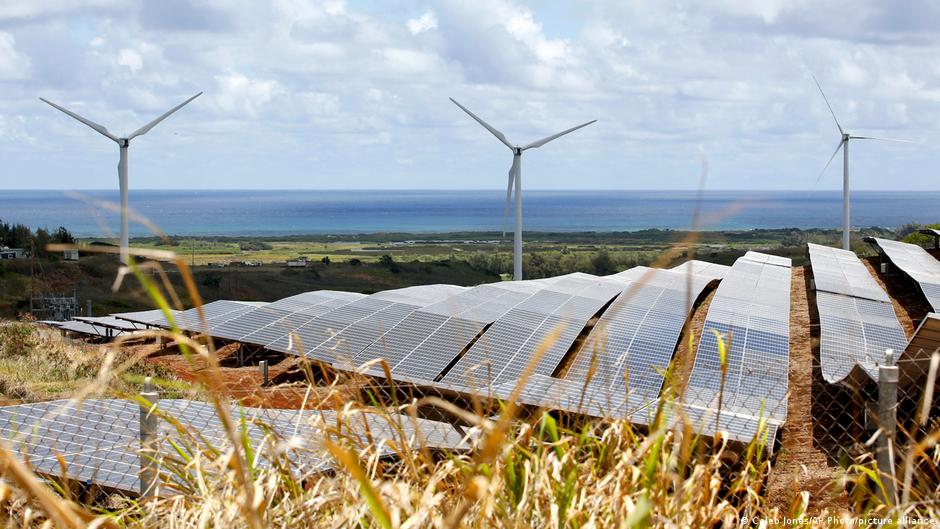
A chain of islands in the middle of the Pacific Ocean without domestic oil or gas reserves, the 50th US state has long relied on imported fossil fuels to power its economy.
Foreign petroleum fuels much of the energy grid, and the sea and air transportation on which Hawaii depends to move people and goods – and to draw nearly 10 million annual tourists to its shores.
Hawaii began reducing this fuel dependence in 2015 when it became the first US state to commit to transitioning to 100% renewable electricity by 2045. Its objective was to harness domestic solar, wind, bioenergy, hydroelectric and geothermal energy inherent in its volcanic landscape.
That goal was expanded to the entire economy in 2018, with Hawaii adopting a “net-negative” carbon emissions target leading to 2045 at the latest. And the world’s first youth-led climate case also forced the state to decarbonize the transport sector by the same year.
Peter Sternlicht, a board member of Sustainable Energy Hawaii, a renewable energy nonprofit, says ambitious sustainable energy goals that “reduce, or completely eliminate, dependence on imported energy” are motivated by the pursuit of energy self-sufficiency.
As the latest oil shock caused by the US-Israel war over Iran reverberates across global markets, the target remains even more relevant. But how can a decarbonized, energy independent economy be achieved within 20 years?
challenge
“The state needs a number of policies if it is to achieve its 2045 goal,” said Paul Bernstein, an economic policy expert at the University of Hawaii.
Hawaii’s chain of islands have diverse energy needs depending on their population and geography. Decarbonizing the island of Oahu, home to the state’s largest city, Honolulu, won’t be easy.
Mark B. Glick, Chief Energy Officer for the Hawaii State Energy Office, said, “On Oahu, where population density and land constraints make the transition more challenging, the state is prioritizing grid modernization, more efficient generation and major private sector investment to support large-scale renewable energy and storage in the coming years.”
Meanwhile, in Maui, after a 2023 storm collapsed power lines, sparking wildfires and killing 102 people, the state energy office says continuing an affordable transition to renewable energy has been a challenge for the state’s largest utility, Hawaiian Electric.
Even where wind, solar power and batteries are helping the transition, and about 50% of Oahu’s homes have rooftop solar, Glick says geothermal energy needs to be a bigger part of the mix.
On the Hawaiian Islands, the state’s largest, abundant geothermal energy was used to provide about 30% of electricity in 2017. Production was later reduced by volcanic eruptions, but officials are planning a 20% capacity expansion by the end of 2026.
A major challenge for Hawaii is to decarbonize shipping and air travel, made even more acute by the reliance on planes for tourism.
“Basically all our stuff is brought in from somewhere else,” Paul Bernstein said. He says sustainable aviation fuels and improved aircraft efficiency will help reduce air emissions, but flight electrification is still a long way off.
decarbonization pathways
In 2022, the Hawaii state legislature passed an act calling on the State Energy Office to “analyze the pathways” to and achieve the state’s “economy-wide decarbonization goals.”
A report commissioned by the state Legislature presented a decarbonization scenario in which Hawaii’s energy sector could be transformed within decades. This will require “deploying solar, wind and storage at an unprecedented rate”, phasing out combustion engine vehicles in favor of zero-emission EVs, and retrofitting buildings for better heating and cooling efficiency.
In addition, increased amounts of sustainable aviation fuel will need to replace the standard jet fuel required for air travel.
But the report also says biodiesel, biomass, geothermal and hydropower production will have a “significant role” to play if all Hawaiian Islands are to meet the 2045 net-zero target.
Fossil fuel phase-out could also be accelerated with a carbon tax that raises oil or gas prices to promote the transition to clean energy. Meanwhile, existing taxes on each barrel of imported fuel already support decarbonization programs.
Also important for growth could be a carbon tax, which remains the greatest hope for a transition to clean domestic energy. A relatively small-sized geothermal plant typically uses underground volcanic heat to create steam that rotates a turbine to generate zero-carbon energy.
“The state is conducting resource characterization of geothermal potential to better understand where geothermal can be developed consistent with cultural values and community interests,” Glick said.
While it was long believed that the energy source was not viable on the most populous island of Oahu, recent discussions indicate that “geothermal may actually be available where it is needed most,” said Paul Bernstein.
“If that were to happen, it would really change the game,” he said.
Although production costs are relatively low over the lifetime of a facility, uncovering geothermal resources can be expensive and will require much investment in the exploration phase. Local consultation will also be important due to opposition from Native Hawaiian communities over exploitation of sacred volcanoes.
Renewable constraints and demand for LNG
Since it will be difficult to increase geothermal energy enough over the next 20 years to meet 2045 transition targets, the Hawaii state government recently envisioned low-emission “transition” fuels to maintain momentum away from highly polluting energy.
Hawaii is considering retiring inefficient oil-fired power generators and replacing them with high-efficiency gas-fired generators powered by imported liquefied natural gas (LNG).
The state-of-the-art power plant will reduce greenhouse gas emissions by 20% over 20 years, and will be 20% cheaper than oil-fired energy – Hawaii’s electricity is the most expensive in the US.
Mark Glick of the Hawaii State Energy Office says more technologically advanced gas power plants are better able to “enhance renewable integration” into the grid.
But experts say that while LNG is cheaper than oil and has lower emissions, cooling, shipping and regasification costs are also higher.
If renewables continue to expand along with battery storage, LNG plants could become expensive, underutilized assets. “Solar and battery systems are already competitive with fossil fuels and avoid the risks associated with global fuel markets,” the University of Hawaii Economic Research Organization’s analysis said.
Edited by: Tamsin Walker