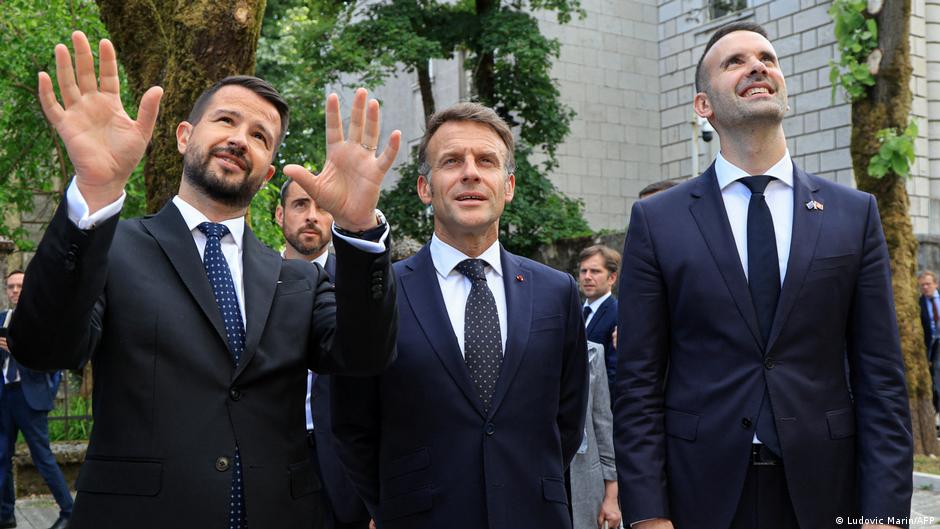
Leaders of EU countries gathered in the picturesque port of Tivat on Montenegro’s Adriatic coast for the annual EU-Western Balkans summit, with the bloc’s enlargement topping the agenda.
After the summit, German Chancellor Friedrich Merz said he was optimistic about the Franco-German initiative, which aims to bring new “momentum” to the accession process by creating incentives for faster reforms.
Host Montenegro leads the list of six candidate countries, which also includes Albania, Bosnia-Herzegovina, Kosovo, North Macedonia and Serbia.
EU enlargement is seen by Brussels as a response to new geopolitical challenges, including the security and economic threats posed by Russia and China and increasing ambivalence towards the bloc from the United States.
EU enlargement must be ‘fast’
European Commission President Ursula von der Leyen said the EU needed to make “the enlargement process faster and more credible”.
“Enlargement is a geostrategic imperative for us, as well as a long-term investment in our peace, our stability and our security,” von der Leyen said. He said the accession process “will have to become more dynamic.”
The process of becoming an EU member state takes several years, with candidates having to meet institutional and governance requirements in a multi-step process.
The Franco-German plan supported by Merz envisages candidate states being included as observers at meetings of EU bodies. Merz said other incentives could include enhanced integration into the euro payments area, or bringing in single-rate cross-border data roaming.
The German Chancellor said that the people of the Western Balkans should get a clear message that they are welcome in the EU.
“Now we will start a gradual process,” Merz said, stressing that the process must be accelerated. “There will be no excuses now,” he said.
Ahead of the summit, French President Emmanuel Macron stressed the importance of the region to the EU for energy and security issues as well as migration routes.
He added a candidate country that aligns itself with the EU on certain criteria would be allowed to join certain bloc formats, such as Council meetings.
European Council President Antonio Costa said in Belgrade, Serbia, on Thursday during a tour of the region ahead of the summit that enlargement in the Western Balkans is “the most important geopolitical investment the EU is making.”
“This is not just an opportunity; it is a geostrategic necessity for Europe. And we need to work hard and fast,” he said.
Montenegro: the next EU member state?
Of the six Western Balkan candidates, Montenegro is seen as the frontrunner, having been pursuing membership for 22 years.
The small, mountainous country of 623,000 people adopted the euro as its de facto currency in early 2002, declared independence from union with Serbia in 2006, and joined NATO in 2017.
With reportedly around 80% public support for accession, Montenegro describes itself as a “centre of Euro-optimism” and is aiming to become the EU’s 28th member state by 2028.
“The summit in Tivat is the most important and largest international event in modern Montenegro,” President Jakov Milatovic wrote in an op-ed published by local media earlier this week. He said: “Montenegro, as the 28th member of the EU by 2028, is a task we must accomplish.”
And after progress on economic and democratic reforms recently prompted the EU Enlargement Commissioner, Marta Kos, to flag the possibility of completing technical negotiations by the end of the year, that timeline appears realistic.
Among other Western Balkan countries, Albania is also seen as a promising candidate, but Kosovo’s path to EU membership remains the most complex, as five EU member states still refuse to recognize its independence from Serbia.
Merz warns Serbia against ‘oscillating between Russia, China and Europe’
Belgrade’s own route of access also remains problematic given its close political ties with Russia and economic ties with China.
During the Tivat summit on Friday, Merz called on Serbia to “clearly decide where it sees its future.”
“There cannot be politics of swinging between Russia, China and Europe,” Merz said at the summit in Montenegro, adding: “When Serbia’s answer is ‘Europe’, Europe’s answer will be ‘Serbia’.”
Enthusiasm towards joining the EU has declined in the country in recent years, with polls showing support below 50%.
EU Enlargement Commissioner Koss recently blamed Serbia for democratic “backsliding” under populist President Aleksandar Vucic.
Merz is interested in promotion
Merz is keen to encourage Western Balkan countries to remain committed to their EU accession plans and meanwhile desperately discourage them from entering into economic partnerships with Russia and China.
Incentives are also designed to compensate candidate countries for what some see as preferential treatment given to Ukraine, for which Merz has proposed an accelerated “associate membership” or “EU membership light” – even if this falls short of President Volodymyr Zelensky’s demands for full membership.
“Merz wants Kiev to gain a newly defined status of associate membership,” reports DW’s Michaela Küfner, who is accompanying the German delegation to Montenegro. “Despite Ukraine’s rapid insistence on full status, this is much higher – and much faster – than that of any Balkan country. Rapid access to the EU market and observer status in EU institutions are designed to compensate for Ukraine’s preferential treatment.”
The chairman of Germany’s parliamentary committee on foreign affairs, David McAllister (CDU), told the dpa news agency this week that Berlin was determined to avoid a “dangerous gray zone” in the Balkans in which other global powers could take advantage of the absence of a strong EU presence.
“Stability in the Balkans means stability for the whole of Europe,” he said, referring to lessons learned from the history of major conflicts in the region (World War I 1914-1918 and the Balkan Wars of the 1990s).
McAllister stressed, “We can provide economic, financial and political support, but in the end, the necessary reforms must be passed by national governments and parliaments.”
Edited by: Dmytro Lyubenko, Sam Dusan Inayatullah
Don’t let algorithms hide news. If you rely on our team for reliable reporting, please take a moment Select us as your favorite source on Google by clicking here and pressing the “Star” or “Favorite” buttonThat’s why you’ll always see our verified news first.